
Lesson 2 - Speciality Malt
This lesson deals with speciality malt. Speciality malt is any malted product other than standard pale barley malt. We explore how these malts are made. We discover how using speciality malts or malt extracts, provides different beer flavour, aroma and can also affect colour.
Stewed and Roasted Speciality Malt
Our final group of speciality malt products are those where the green malt is stewed before roasting. The stewing process provides a very high concentration of amino acids and reducing sugars so maximises flavour and colour production in the Maillard reaction. The names of these malts can get confusing!
What is the difference between crystal and caramel malt?
In some cases, there is none and in other cases they are very different. It depends on what the supplier chooses to call the product. Some products marketed as caramel or cara malts are made without the use of a drum roaster and stewing occurs in the kiln. If the product is stewed and has some degree of crystalised endosperm it can be called either, or in some cases both! Because what is sold as crystal and caramel malts include such a wide range of products, different products have differing effects on flavour, colour, foam and flavour stability.
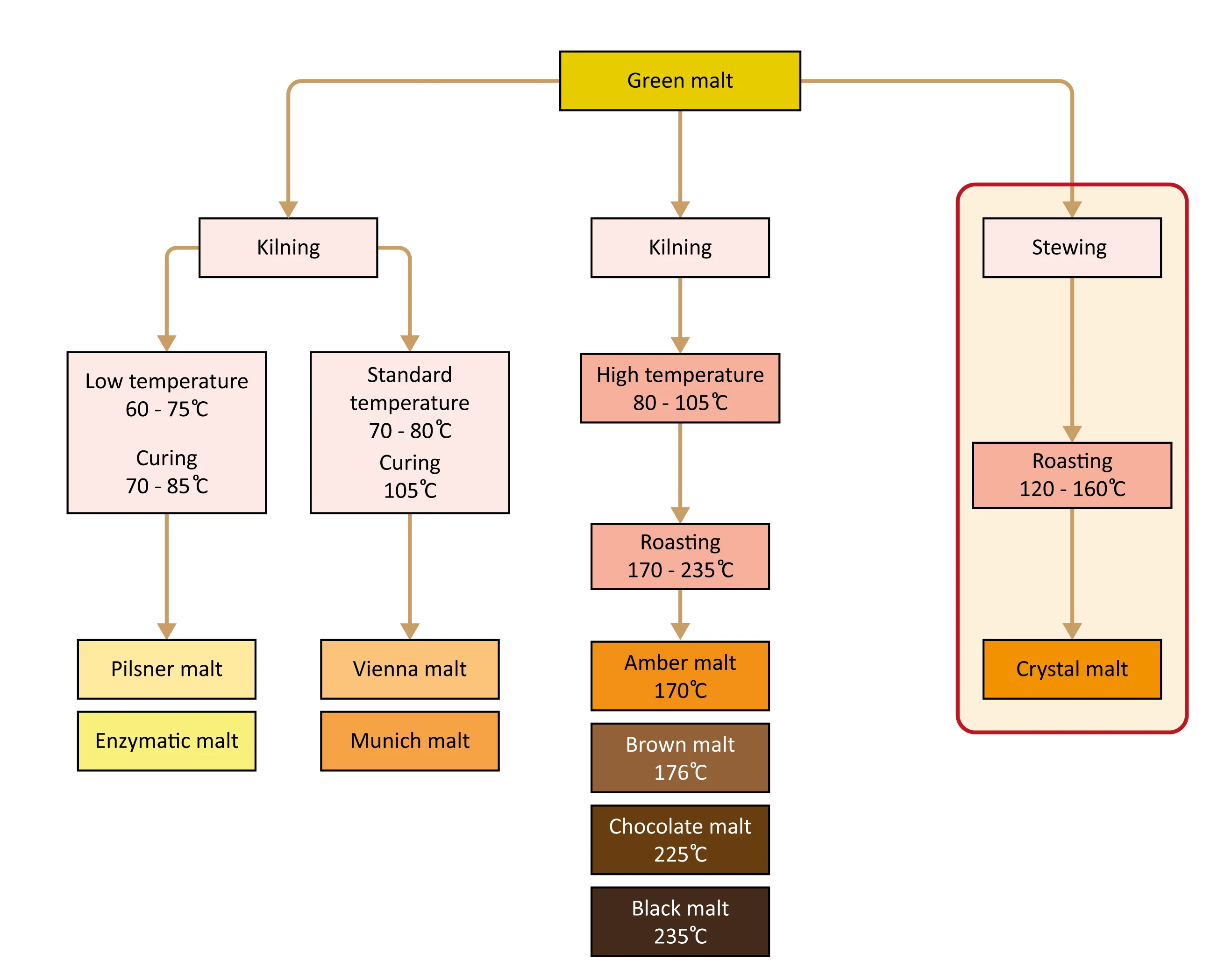
Figure: Production of crystal malt
Crystal malts (also known as caramel malts) are distinctly different from the rest of the speciality malts. This is due to the change that the endosperm undergoes during stewing and roasting. During production, the endosperm of the green malt is transformed from its usual flour-like structure, to one of crystalline sugar.
Some lower colour crystal malts can be produced in a kiln but it is difficult to obtain a homogenous batch, so it is better to use a roasting drum. Here a light roasting can be considered equivalent to kilning in a malt kiln, but with better control.
The malt used to produce crystal malt is always well (but not over) modified. Some producers maintain a moisture level of 50% during germination to help with endosperm conversion while others work slightly lower at 45-48% moisture. Some maltsters complete germination in the drum, while others use as standard germination vessel. The temperature at the end of germination is allowed to rise by restricting air flow or by warming. The typical temperatures used are 40-50°C. At this temperature range, proteolytic enzymes are active and amino acids accumulate as proteins are hydrolysed. The green malt is then moved to a roasting drum where after any surface moisture is driven off, the drum is sealed to maintain the moisture level in the grain. The temperature in the drum is slowly increased to 60-80°C (depending on malt type and supplier). At these temperatures, the amylolytic enzymes that would normally operate in the mash break down the starch into sugars. Saccharification continues for 1-2 h but is usually stopped once the endosperm can be squeezed from the end of grain as a translucent sweet liquid paste. Once this is achieved the temperature is either increased suddenly or slowly, or if producing a carapils malt, hot air at 55-65°C (again depending on the supplier) is used to dry the grain. For other types of crystal malt, direct firing to a temperature of 120-180°C is used to roast the grain and increase its colour and flavour through the Maillard reaction and to a lesser extent caramelisation.
On heating and drying, the liquefied endosperm becomes crystalline due to its high sugar concentration. At least 90% of the endosperm should have a clear, glassy appearance with no mealy or floury parts. The higher the curing temperature, the higher the colour of the finished malt. The malt grains are smooth, round, swollen, bright and evenly coloured without any dark spots which indicates scorching on the surface of the drum. Grains of more highly coloured crystal malts may have some dark spots on their husks, as some scorching is inevitable.
As with roasted malts, operators check the grains as roasting progresses for colour and degree of crystallisation. Once the required colour is achieved the grain is moved to the cooler where air is blown through it to reduce its temperature. Crystal or caramel malts are probably the most diverse category of speciality malts. Some may help improve beer foam (Carafoam® for example) while others can reduce foam stability.
The complicated relationship of crystal malts with foam stability is due to the diversity of crystal malt products. The link below provides some further reading:
https://onlinelibrary.wiley.com/doi/pdf/10.1002/jsfa.6117
We have covered some of the main speciality malts in this lesson. Take some time and research some of the speciality malts available in your area, or research this on the internet. Use caution when reading marketing information. Not everything marketers say is true!