
Lesson 2 - Speciality Malt
This lesson deals with speciality malt. Speciality malt is any malted product other than standard pale barley malt. We explore how these malts are made. We discover how using speciality malts or malt extracts, provides different beer flavour, aroma and can also affect colour.
Speciality Malt Made by Kilning
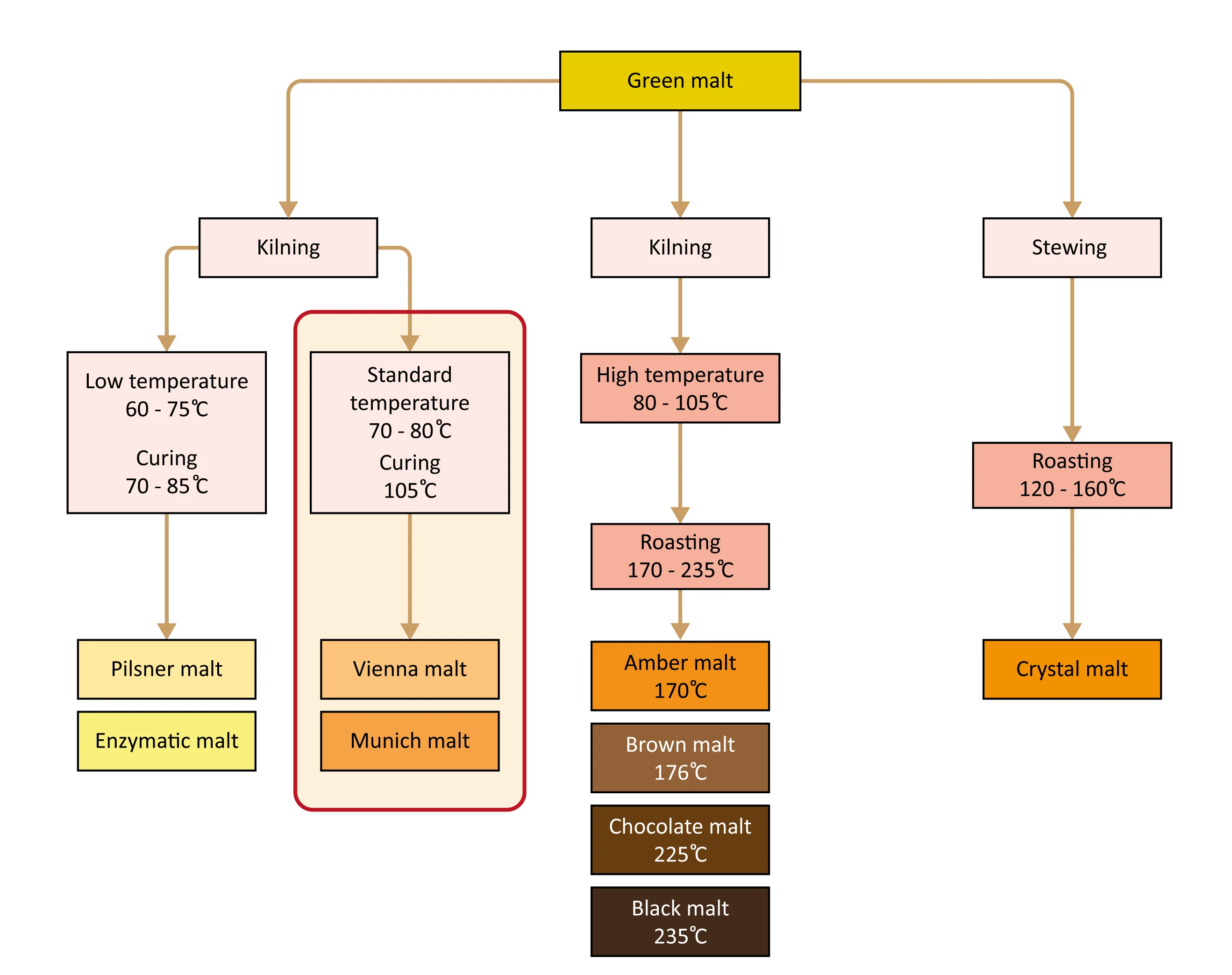
Figure: Production of speciality malts through kilning
Munich malt
Munich malt is typically made from nitrogen-rich barley (1.84% nitrogen; 11.5% protein). It is steeped to a higher of moisture content than pale malt often 48-50% and has a long, warm germination at 18-20°C. Historically, Munich malt was dried slowly at 38°C before more intensive drying and curing. Today, the green malt is held in warm recirculating air for an extended period to slow evaporation and allow the grain to modify further. This allows the development of more reducing sugars and amino acids and hence colour and flavour. A number of initial drying stages may be used, with drying periods being followed by periods of recirculation. The kilning temperature is increased to 70-80°C for 12 h and then 100-105°C for 2 h to increase colour and flavour.
Vienna malt
The green malt used to produce Vienna malt tends to be well-, but not over-modified and often has a higher protein level than barley used for pale malt. An elevated temperature is often used at the end of germination. Like Munich malt, kilning starts at low temperatures with recirculation to encourage the formation of reducing sugars and amino acids. Vienna malt has a lower kilning temperature (63˚C) than Munich malt and is cured at 90-96°C. This preserves more of the enzymes.
Vienna and Munich have lower diastatic power than pale malt but can be used as 100% of the grist for a brew. Neither (Munich especially) has sufficient enzymes to convert starch from more than a few per cent of adjuncts effectively.
Vienna and Munich malts are named after the cities in which they were first produced. They can also be used in the lagers that bear their name.
Melanoidin/Brümalt/Honey malt
Munich and Vienna are the most common examples of kilned speciality malts. Another example is Brümalt. Brümalt is made from green malt that has been steeped to around 48% moisture. It is germinated for six days, and the temperature is allowed to rise in the last 36 hours. It is then moved to another vessel forming a deep bed of grain. The grain bed is covered, or airflow is prevented, and is left for 30-40 h. As there is no airflow through the grain the temperature rises to about 50°C in the first 24 h. As the oxygen is used up, respiration slows and heat is no longer produced, allowing the temperature to fall. Rootlet growth ceases, and the endosperm is broken down causing reducing sugars and amino acids to accumulate. The grain is then dried slowly in the kiln at about 65°C and cured at 80-100°C for 3-4 h. The result is a darker product than Munich and Vienna at 15-30 or in one case 80 EBC units. The name Honey malt is used interchangeably with Brümalt in North America and malt made in the same way is sold by some maltsters as Melanoidin malt. Heating amino nitrogen and reducing sugars together for long enough can give melanoidins, so the name is appropriate.