
Lesson 2 - Barley
Barley Kernel Component - Endosperm
Endosperm cells produce starch, which appears as granules of differing sizes embedded in a protein matrix. The endosperm is the food storage organ for the embryo.
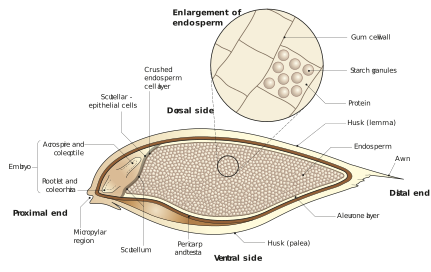
Figure: The endosperm of the barley kernel
Endosperm composition
Cell walls
- β-Glucan (75% of cell wall dry weight)
- Pentosan (20% of cell wall dry weight)
- Protein (5% of cell wall dry weight)
Starch granules
- Amylopectin (75% of total starch)
- Amylose (25% of total starch)
Protein matrix
- Albumin (around 4% of total grain protein)
- Globulin (around 31% of total grain protein)
- Glutelin (around 30% of total grain protein)
- Hordein (36% of total grain protein)
-
- B hordein (70-80% of total hordein)
- C hordein (10-12% of total hordein)
- D and γ hordein (< 5% of total hordein)
The endosperm is sometimes called the starchy endosperm. The figure above showed that the basic endosperm elements are protein, starch granules and cell wall material. In the figure below, we can see the individual cell structure and its composition. The cell structure is broken down during the malting process.
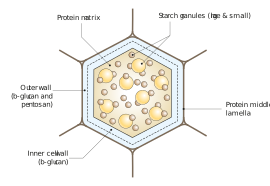
Figure: Endosperm cell structure
Endosperm cells are not alive. They contain the starch granules embedded in a protein matrix. There are two types of starch granule. Large granules are lenticular (lentil shaped) and small granules are spherical. Small starch granules require a higher temperature to gelatinise during mashing. This temperature is higher than most enzymes can tolerate. The good news is that most of the small starch granules are degraded during the malting process, so we don’t need to deal with them in mashing.
Key points:
- The endosperm makes up to 75-80% of the grain’s dry weight.
- Endosperm cells next to the aleurone layer are smaller and more cuboidal.
- The cells are packed with starch, embedded in a protein matrix.
- Starch granules in the grain have different sizes (this and their proportion varies between varieties): Small granules are typically 1-5 µm in diameter. Large granules are typically 20-25 µm in diameter (10% of the total number of starch granules, but representing 90% of the total starch by weight).
Barley kernels can be differentiated by having mealy endosperms or steely endosperms.
Mealy endosperm
When cut transversely, well-filled grains have a rounded kidney shape. The endosperm appears opaque, mealy and floury. They are higher in starch than steely endosperms. There are numerous cracks in a mealy endosperm, some of which are filled with air.
Steely endosperm
Poorly filled grains with steely endosperms are angular in shape when cut transversely. The endosperm protein is more tightly packed and less starch is present, causing the endosperm to appear translucent and grey. Hence the term steely. The figure below shows mealy and steely endosperms.
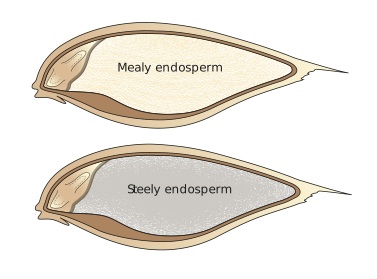
Figure: Mealy and steely endosperms
Mealy grains are easiest to malt due to their tendency to take up water more readily. Some grains have endosperms with mealy areas and steely areas. These grains are very difficult to malt because the two different types of endosperm hydrate and modify at different rates.
Modification
Starch is the most important component in brewing. However, the protein matrix and cell walls prevent starch conversion during mashing if they are not removed during the malting process.
Some enzymes are present in the grain before germination and are activated or released from bound forms during endosperm modification. The following enzymes are activated during endosperm modification:
- Endo β-(1,3)(1,4) glucanase
- Endo β-(1,3) glucanase
- Pentosanase
- β-Amylase
- Carboxypeptidases and other exoproteases
- Phytase
- Lipase
Proteins are broken down into peptides, and the peptides are broken down into amino acids also known as free amino acids (FAN).
You can read more on this process in the following paper:
Before the protein matrix and starch granules can be broken down, the endosperm cell walls must first be broken down.