
Lesson 2 - Barley
Barley Growth on the Spike: Six-row and Two-row Barley
Two- and six-row barley are different species. Two-row barley is Hordeum distichon and six-row is Hordeum vulgare. The figure below shows the difference between the development of six and two-row barley spikes.
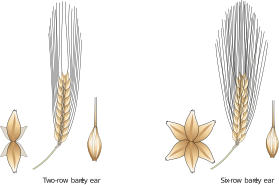
Figure: Two-row and six-row barley spikes
The part of the barley plant that holds the grains is known by several names. These include the ear, the head and the spike. The grains are attached to the rachis which is the central stalk of the spike. For grains to be formed, spikelets attached to the rachis, must form florets (flowers) which if fertilised develop into the grains.
In two-row barley, only the central spikelet is fertile and can develop into a grain. When looking at the spike from above, it looks flat as two rows of grain form on the rachis. In six-row barley the two lateral spikelets are also fertile and can form grain. However, grains formed from these spikelets are shorter, thinner and slightly more twisted than those formed from the central spikelet. You can see the additional grains when looking at the spike from above.
Most brewers favour malt made from two-row barley due to its higher extract and uniform grain size. Six-row barley is mostly grown for animal feed but there are some malting varieties used by brewers. Six-row barley has a higher protein content and hence enzyme potential. These enzymes are beneficial if we need to convert the starch from adjuncts. The protein also helps with body and foam potential if we are using adjuncts lower in protein.
When malting six-row barley, some maltsters divide the corns into different sizes. Each size takes up water differently and therefore malts at a different rate. The plumpest grains are malted for brewing and the smaller grains may be used for distilling or animal feed. Barley breeding programmes have resulted in six-row barleys with higher extract potential but similar enzyme levels.
You can read more about brewing with six-row versus two-row in the below article.
https://onlinelibrary.wiley.com/doi/10.1002/jib.168
Most brewers brew with only two-row barley.