Lesson 2 - Barley
Barley Kernel Component - Pericarp and Testa
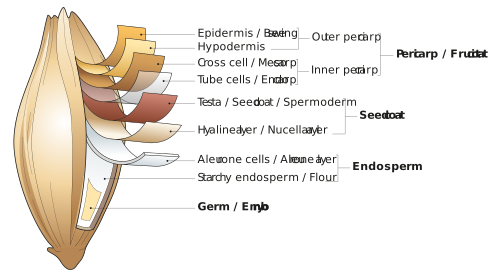
The pericarp and testa form the layers directly underneath the husk. The pericarp outermost layer is a cuticle, which adheres to the inner face of the husk. The pericarp is the remains of the ovary wall and the testa is the seed coat.
Pericarp composition
The pericarp consists of an outer pericarp and inner pericarp layer. The outer pericarp has two layers called the epidermis and the hypodermis. During grain development, the epidermis becomes compressed and the cells become less specialised. This leaves an air-filled space between the outer pericarp and the inner pericarp.
Key points:
- The pericarp is a very thin layer: ~ 0.5mm.
- It accounts for 1% of total grain weight.
- The pericarp is semipermeable to water.
- It restricts water absorption to protect the grain.
Testa composition
The testa makes up 1-3% of the weight of the grain. It is made of two layers of waxy cuticles that protect the embryo and limits the ingress of water and dissolved substances. It is selectively permeable to gibberellic acid but does not allow nutrients to permeate to the outside of the grain. It is more porous in the micropylar region of the grain which helps allow water uptake during steeping.
The testa is rich in polyphenolic and phenolic materials and these can be extracted into the wort during mashing. The major simple phenolic compounds from malt are ferulic and p-coumaric acid. These compounds are part of a group called hydroxycinnamic acids (HCA). They are important because 4-vinylguaiacol (4-VG) is formed from the decarboxylation of ferulic acid and p-coumaric acid by yeasts and bacteria. 4-VG gives beer a spicy, or clove-like aroma. In most beers 4-VG is considered an off-flavour. However, it is usually desirable in German wheat beers.
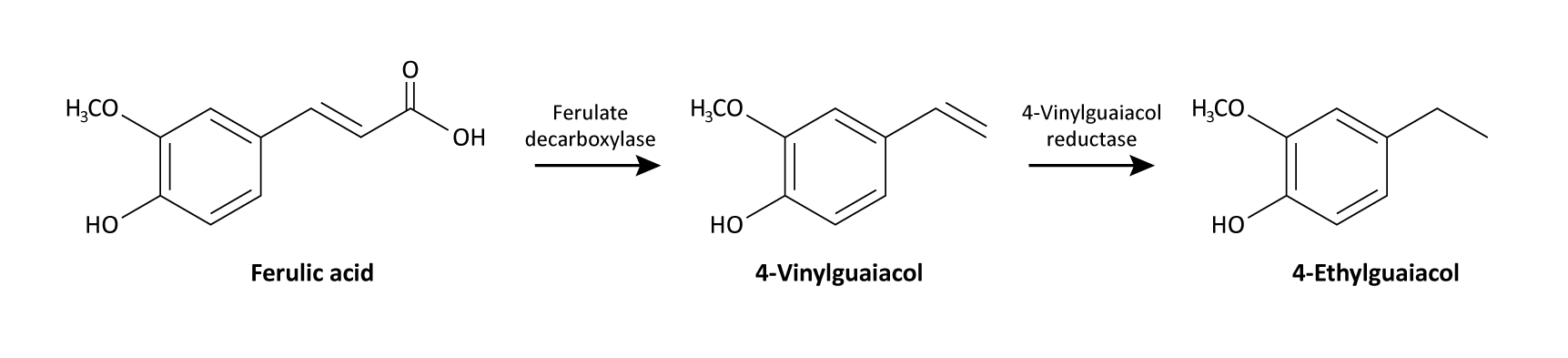
Figure: Formation of 4-VG through decarboxylation of ferulic acid
The testa is not thought to be a significant source of wort or beer polyphenols, because it is a small proportion of the grain’s weight.
Key points:
- The testa covers the whole grain including the embryo.
- It is composed of two waxy layers; most barley varieties have polyphenols between the layers.
- It forms the main barrier to water entry.
- It makes up ~ 1-3% of the grain’s weight.
The figure below shows each layer of the barley kernel below the husk including the pericarp and testa.