
Lesson 2 - Barley
Barley Plant Development in the Field
Growth starts at a grain moisture above 30%. This applies to the kernel in the ground as well as in the malting process. Chitting is the first sign of the rootlet (coleorhiza) at the proximal end of the kernel. The figure below shows some chits. The rootlet continues to grow, branching out and forming the seminal roots of the barley plant (as seen in the mature barley plant diagram later).
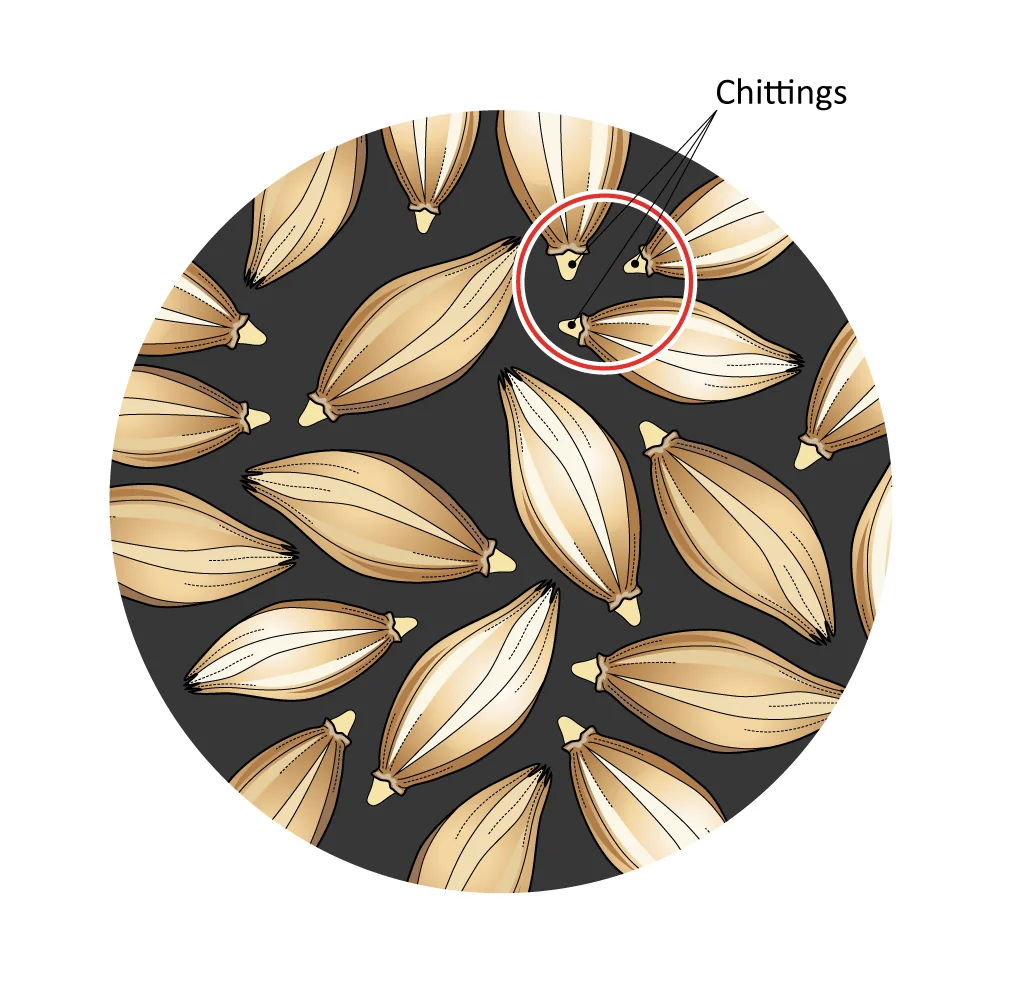
Figure: Chitted barley during the malting process
The coleoptile (leaf sheath) grows between the aleurone layer and the testa, from the proximal end to the distal end of the grain. It eventually breaks through the husk, stops growing and then the first leaf breaks through the coleoptile tip. Once the shoot has broken out of the soil, it gets energy from the sun via photosynthesis.
The first leaf grows within a few more days followed by second and third leaves in the following weeks. After two months, additional stems (tillers) elongate above the leaf mass. Next, the spike emerges from each stem. After about eight weeks, the spike is fully mature, and the plant has used most of its energy to produce the grain. The plant starts to dry out, and the grain is harvested.
The figure below shows the key growth stages of a barley plant. The time from emergence to final grain maturity is not fixed and varies depending upon these factors:
- Where the crop is grown
- Time of the year
- Rainfall during the growing season
- Temperatures during the growing season
- Barley variety
- The hours of sunshine during the growing season
For some barley varieties, it can be almost 200 days between planting to harvest, while for others, it can be as short as 60 days.
In most barleys, when the plant has fully matured, the spike drops into an inverted position. This position aids rain running off the spike, and the grains do not get too wet. However, there are a few barleys where the spike remains erect when fully mature. The figure below shows the stages of growth. °C days are thermal time, the accumulated mean daily temperature from sowing.
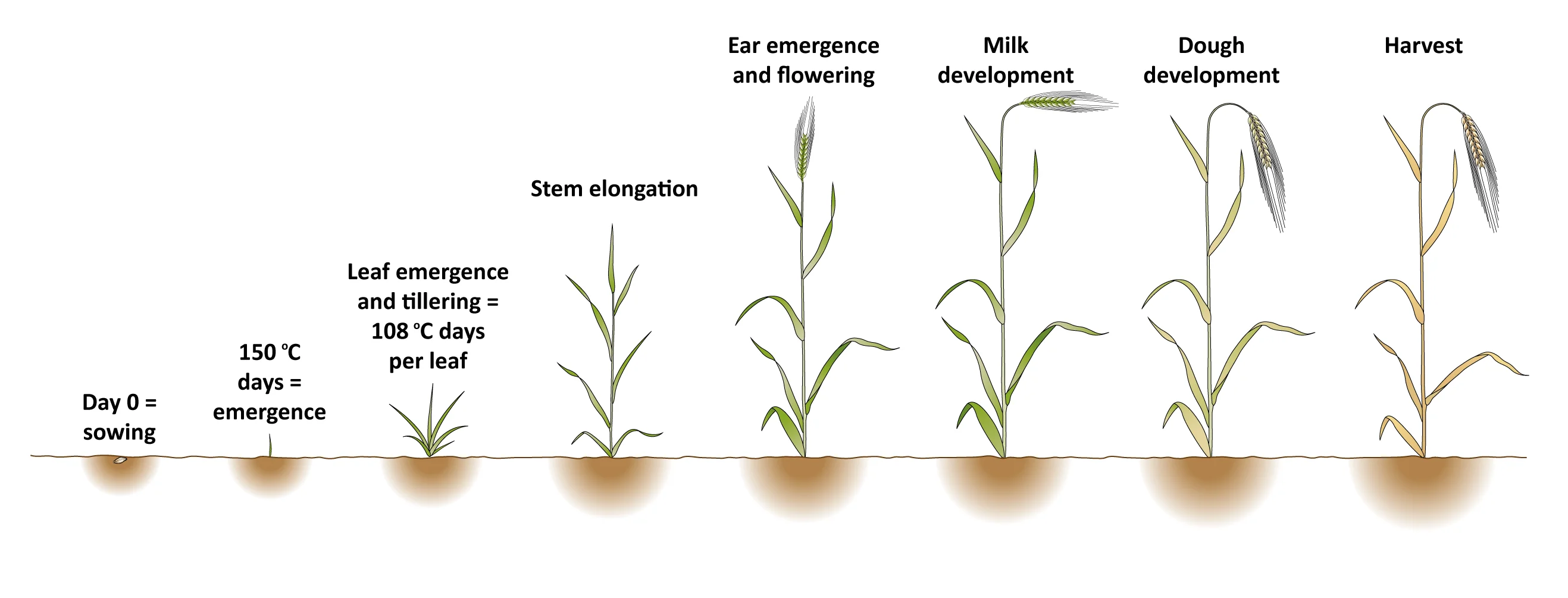
Figure: Growth stages of a barley plant
One plant can have many tillers. Each tiller elongates until it reaches the booting stage, which is when the flag leaf (last leaf) appears. The spike develops grains within the flag leaf sheath. Each tiller develops one spike; the number of tillers determines the crop yield (t/ha). The spike develops on the rachis. The rachis is segregated (by internodes); a node divides each segment. A spikelet develops at each joint.
During development, barley kernel length is determined first, and then the width. Any stresses experienced during the filling of the spikes (e.g. drought), can cause thin, narrow kernels.
The figure below, shows the barley floret. Pollen from the anther or from another plant deposits on the stigma and from there travels to the ovary to fertilise the flower. Once fertilised the floret closes. The lemma forms the lower part of the husk and the palea becomes the upper part.
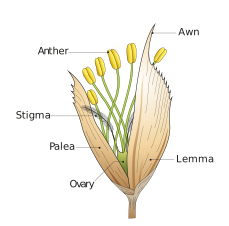
Figure: Barley floret
You should now understand how the floret develops into the barley kernel. Remember that in two-row barley only the central florets can be fertilised, whereas all three spikelets in six-row barley can develop into a kernel. However, the two lateral kernels are thinner and slightly twisted. This inhomogeneity presents a problem in brewing where we need everything to be consistent!