
Maths for Diploma Studies
This lesson is designed to provide the background knowledge in maths required to study CIBD Diplomas successfully. It will describe the basics of maths before detailing the more complex concepts encountered in CIBD lessons. Techniques for working with numbers, equations, and units will also be described.
Unit Conversion and Cancellation
In the CIBD lessons, particularly in Module 3, we are presented with process information such as temperatures, pressures, material densities, flow rates and more. Each of these values has its own unique unit of measurement, and there will be times where the units of measurement in the information provided will require conversion to provide the correct answer. Let’s get on with an example.
We have just purchased a new 400 hL buffer tank and will fill it at a flow rate of 400 m3/hr. Our boss wants an estimate of how many minutes it takes to fill the tank.
It is good practice to use the description provided to write a summary of what we know and, if applicable, produce a quick sketch of the situation. This will help us to visualise what is going on.
Here’s a sketch of our new buffer tank with the rate of filling:
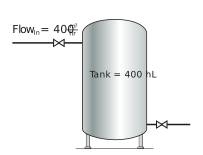
Volumetric flow rate is represented by the symbol Q. For this example, our flow rate is 400 m3/hr and can be written as:

We need to convert this flow rate, so it relates to the units we have for our 400 hL buffer tank. It is therefore a good idea to convert our flow rate into hL/hr.
Let’s start with what we know:
We want to get to hectolitres. Our trusty reference book does not have the direct conversion between cubic metres and hectolitres but does tell us that there are 1,000 L in one m3:

That looks promising. We can use this to convert m3/hr to L/hr. That would look like:

Whoa. What just happened? Where did this other fraction come from? In order to perform the volume unit conversion, we multiply our original flow rate by the relationship we found in our reference book, being very careful to make sure our units work out correctly at the end. Remember what we recently worked through with fractions with identical values for the numerator and denominator? Here we will use this to convert units of measurement.
To drive this point home, let’s ignore the numeric values for a moment and rewrite the equation simply with units of measurement:

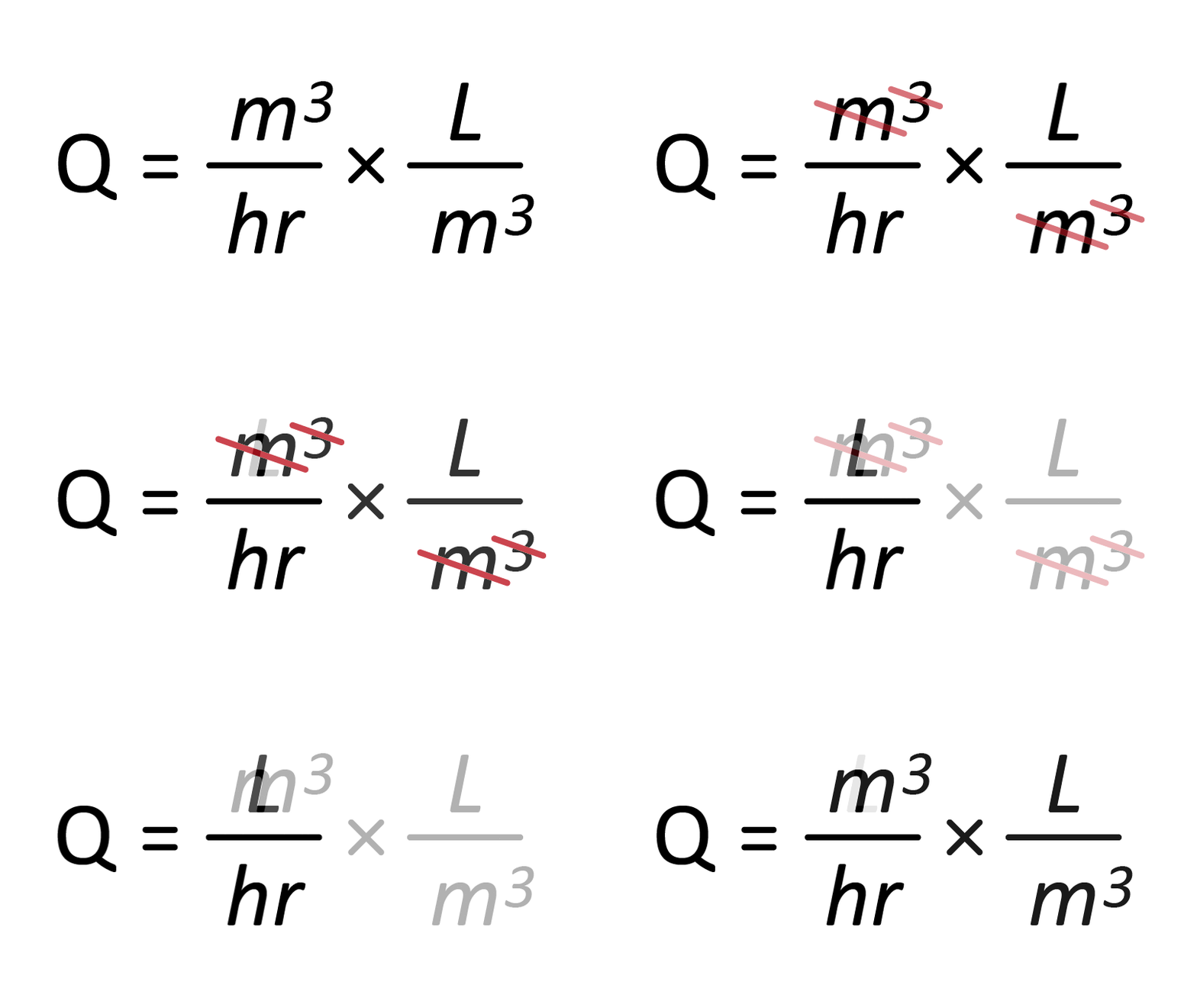
Perhaps that makes things a bit clearer. Here we now have m3 in both the numerator and denominator positions of the equation. The m3s cancel each other, and we are now left with hours in the denominator and litres in the numerator:

For some, it may be helpful to talk this through using language rather than numbers and equations. From our reference book, we found:
If you were to say this out loud, you might say, ‘One cubic metre equals one thousand litres’. Or, you may say, ‘There is one cubic metre per thousand litres’. Said differently, ‘There are one thousand litres per cubic metre’. This last sentence, when written as an equation, would look like:

Getting back to our original work, we had just begun converting our known flow rate into litres:

Now, do the calculation and unit conversion:

The calculation for this conversion is done by multiplying the 400 by 1,000 to get 400,000. The unit conversion follows exactly what we had done just moments ago to cancel out the m3 leaving litres per hour. We are now halfway to converting our flow rate. We now have:

and are working towards representing the flow rate in terms of hectolitres per hour. What would you do next? Let’s follow the same principles and complete this work.
From our same reference book, we found that there are 100 litres in one hectolitre:

Great, that means we can proceed with plugging in this relationship and get:


If we had got our units the wrong way up, we would have ended up with this disaster:


We don’t measure flow rate in  and as hectolitres are larger than litres, the flow rate should not have gone up! This shows the value of including the units in the calculation. If the units don’t make sense, we have messed up!
Keeping close track of our units through each calculation and checking them in the answer provides us confidence that we arrived at the correct answer.
Lastly, let’s answer the question about how long it will take to fill the 400 hL tank. We will follow the same steps as before. The question is looking for an answer with a unit of time. We know our flow rate, the tank capacity, and both have volume units of hectolitres that match. How would you put this all together?

To confirm this calculation will give us the answer we need, we can check that the units of measurement look sensible:

This looks a bit daunting, but if we remember back to our work on fractions earlier, we can easily cancel the units. First, we need to change the division into a multiplication with the denominator on top of the fraction:

Next, we need to change the hL into a fraction by adding the denominator of 1:

Now we have hL in the denominator and the numerator so we can cancel to get:


Perfect. Nearly everything cancels out, and we are left with hours, an appropriate unit of measurement for time. With this unit validation, let’s finish by inserting the process values and completing the calculation:


We can now provide our boss a fill time in minutes:

At this point, you may be questioning how to handle the units of measurement. We can make 0.1 hr a fraction by adding 1 as the denominator like so:

And since hr appears in the numerator and denominator, we can cancel it:

Leaving:

And finally:

To help reinforce what we have just learned, on the next page there are some practice questions. Answers and explanations can be revealed by clicking on show answer.