
Maths for Diploma Studies
This lesson is designed to provide the background knowledge in maths required to study CIBD Diplomas successfully. It will describe the basics of maths before detailing the more complex concepts encountered in CIBD lessons. Techniques for working with numbers, equations, and units will also be described.
Rates
A ‘rate’ is the ratio between two variables; this can be baked bean per sausage, glasses of beer consumed per goal scored or degrees Kelvin per hour.
A rate everyone is familiar with is velocity (speed). The System International (SI) unit of velocity is m/s or m.s-1 or even m s-1. Previously, we saw that a value with the exponent of -1 could also be represented as a fraction with 1 as the numerator and the value as the denominator.
So, m.s-1 can also be displayed as  or
 or m/s.
Likewise, m.s-2 (the unit for acceleration) can also be displayed as  or m/s2.
In the CIBD course material, we tend to show units in a single line (m.s-1) or sometimes m/s rather than as a fraction. Why is it sometimes written as m.s-1 and other times shown as  or
 ? Often, for written maths and science questions, it is simpler, cleaner, and less involved to show units on one line of text rather than representing them in an equation as a fraction. Remember the pile of numbers we saw when dividing fractions earlier? When cancelling units, we need to use the fraction representation. We will cover how to convert from the m.s-1 format to the or format later in the lesson.
Back to our rate, velocity. With velocity, we are comparing how many metres we have travelled with how much time has passed. If we drive 100 m in 5 seconds, this can be represented by:

Using the m.s-1 expression formatting, it would look like:

Let’s look at that last representation a bit closer. You should remember that a negative exponent gives a fraction, with 1 as the numerator and the denominator the original number raised by the power of the exponent but as a positive number. So, for the above  is
 , and we know that the denominator 51 is 5, so we have
 the decimal of which is 0.2.
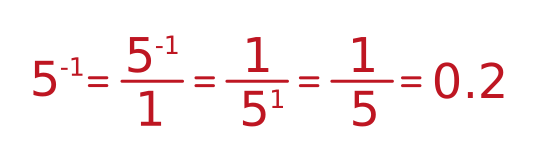
Figure: Review and application of exponent rules
Going back to our example of velocity, as we drive 100 m in 5 seconds, let’s write this in the two different methods, first using the fraction format:

Using the m.s-1 expression formatting, the same equation would look like:

This is mathematically the same as:

And is the same as:

In either arrangement, these equations give us the same answer:


Although they look slightly different, they mean the same thing.
We can also have rates that reflect changes in rates. For example, acceleration which is the rate of change in speed. The units of acceleration are m/s2 or m.s-2. Accelerating at 2 m.s-2 our speed is increasing by 2 metres per second every second. So, if we are travelling at 10 m.s-1 and then accelerate at 3 m.s-2 for 8 seconds our new speed is:


In the above scenario, what would our acceleration over the 8 seconds have been if we are now travelling at 150  ?
Acceleration is the rate of the change in speed, so to find the rate, we need to divide the change in speed by the time taken. Or:


Some units of measurement we encounter are also rates. These are called derived units. For example, density is unit mass per unit volume. The SI unit of density is kilograms per cubic metre (kg/m3). We will discuss units in depth later in the lesson.
Concentrations
Although we call it a different name, concentrations are treated the same as rates. Of course, you can’t accelerate a concentration, but you can increase its rate of change. A concentration can either be written as the amount of solute/solution, the solute.soltution-1 or parts of the solute per parts of the solution. For example, 25 milligrams of solute in a litre of solution are written as:

You can also express concentrations as the amount of mass of one substance per unit mass of another substance which can be written as:

Concentrations can also be represented as a percentage. Because percentages are fractions with 100 as a denominator, a percentage concentration is the volume of solute in 100 volumes of solution written as:

To help reinforce what we have just learned, on the next page there are some practice questions. Answers and explanations can be revealed by clicking on show answer.