
Lesson 6 - Hygienic Design
In this lesson we will discuss the principles of hygienic design and how it is applicable in the brewing industry. Hygienic design covers equipment that is in contact with the product, as well as equipment and the environment that is not in contact with the product.
Welding
Welding is by far the most common way of joining steel, and especially stainless steel, pipes together. As such, it deserves special attention.
We covered welding in the Material Application in Brewing lesson, but here we will focus more on welding in terms of how it plays a role in hygienic design.
Welding is a critical part of any installation and is required to join materials together. We would want to ensure that the weld has the same properties as the materials being welded together. From a hygienic perspective, the requirements on welding are even more onerous, as one needs to ensure that the weld does not bring in unhygienic conditions.
Some welds, like those on vessels, can be easy to evaluate, as one can see both sides of the weld. However, installing pipework makes this more difficult, and so even more care needs to be taken. Take a look at the two examples in the figure below and decide which one you would prefer to have in your brewery.
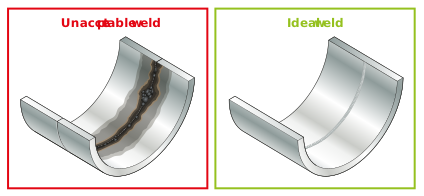
Figure: Unacceptable and ideal welds
There is no doubt that we would all prefer the second example to the first one!
Welding is a specialist task and should only be done by a qualified welder. They are qualified for different materials and types of welding, which means some work should only be done by a coded welder, like that on pressure vessels or pipes.
The welding itself requires the correct technique, setup, welding electrode, filler material, welding speed, welding current, gases and other factors. For this lesson, the important thing to remember is that the welder must be qualified and follow the correct procedures.
The most central principles for ensuring that a stainless steel weld meets hygienic standards are:
-
Piping setup has to be free of misalignment or ovality (meaning the pipes must be round).
-
Inside and outside of the joints must be properly cleaned and dried.
-
Adequate back purging with an inert gas, such as argon, to prevent oxide formation and ‘cauliflowers’ on the inside. You can clearly see the effect of not back purging in the image below.
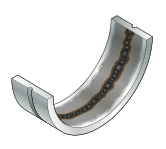
Figure: Effects of poor back purging
-
A properly qualified TIG (Tungsten Inert Gas) welder, or better still, the use of an automated orbital welder.
-
Proper inspection of finished welds. It is accepted practice to insist that a percentage of welds get X-rayed or dye-pen tested.
The way the weld is treated and finished once completed is also very important. The welding process does not end when the welder lifts his welding goggles. Let us consider what the cleaning up process entails.
-
Slag, splatter and oxide removal – this is normally done with a stainless steel brush, as using a mild steel brush can leave particles that cause discoloration.
-
Grinding – care must be taken to do this without causing temperatures above 200°C.
-
Polishing -– this is done with a finer grade of grinding medium, but the same precautions as with grinding are required.
-
Pickling and passivation – these are done to remove the oxide layer if present and to restore passivity by forming a new passive layer. A nitric acid solution is used for this. Most commonly it is either painted on or the item is submerged in a solution. However, for pipes, a solution can be pumped through.
-
Welded joints should be butt-welded (meaning face-to-face and not overlapping).
-
When overlapped, the welds must be continuous, and the rims sloped.
-
Joins should not be done in corners, and materials should be formed so that the weld is adjacent to the corner, where possible.
-
If a corner weld is required, then the weld should be adequate, and, after grinding and polishing, present as a 3 mm radius bend.
The figure below shows examples of some of these welding recommendations:
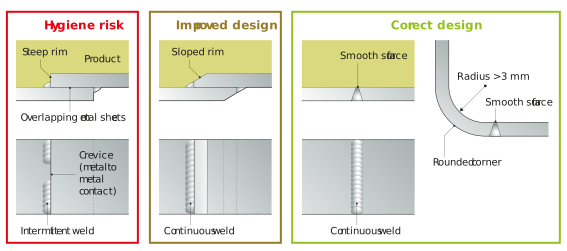
Figure: Welded joints