
Lesson 6 - Hygienic Design
In this lesson we will discuss the principles of hygienic design and how it is applicable in the brewing industry. Hygienic design covers equipment that is in contact with the product, as well as equipment and the environment that is not in contact with the product.
Pipes
Pipes are the most common piece of equipment in any brewing environment. It is important that they can be cleaned in place as it is virtually impossible to take them apart.
What makes a pipe cleanable?
-
Hygienic material is used
-
Internal smoothness
-
Pipe diameter
-
Deposit of solids in the pipe can occur if a pipe has a diameter that results in low velocities.
-
The larger the diameter of a pipe, the higher the flow rate of cleaning fluid that will be required to maintain the correct turbulence.
-
-
Drainability – some of these factors are illustrated in the figure below
-
Pipes should be sloped to allow for draining
-
Adequate drainage options have to be built in
-
Pipe runs should be well supported to prevent sagging
-
Eccentric reducers should be used (the figure below shows an example)
-
Some systems require that pipes are run overhead
-
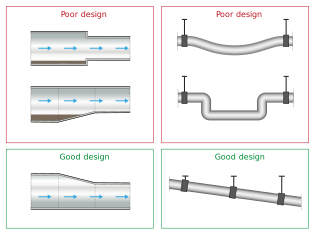
Figure: The do’s and don’ts of pipe installations
-
Equipment such as gauges, instruments, valves and similar components should be close coupled. Close coupled means that the length of the pipe used to mount the equipment should be shorter than one pipe diameter. If you look at the figure below this means that a is less than d.
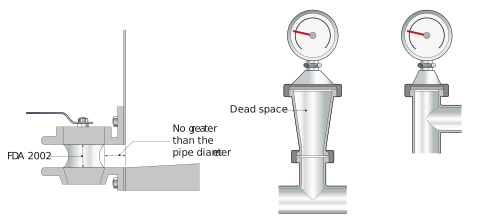
Figure: Installation of pipe fittings and equipment
-
Valves used should be hygienic (more about this later)
-
Consider double seat valves, as these reduce or eliminate dead-legs if installed correctly. Dead-legs does not refer to what happens if you sit cross-legged for a long time, but rather to any area where full flow does not occur.
Think about the following example:
A temperature transmitter is to be installed in a bigger diameter pipe. The figure below shows some possible solutions. The transmitter is installed in a smaller diameter stub (short pipe) and angled in such a manner that it will always drain, and that flow will be forced into it. These installation options ensure that optimal cleaning is possible.
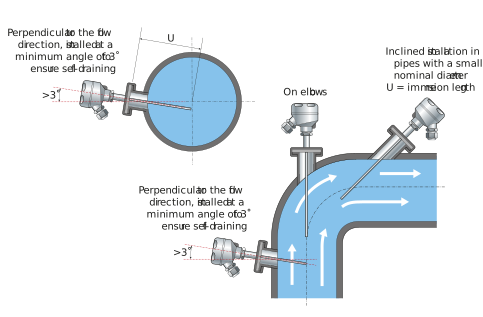
Figure: Installation of a temperature transmitter
Let us now move on to look at vessels.
Why do you think vessels require special design focus? What makes them different from pipes? Give yourself 5-10 minutes to think about this, and then click ’Next’ to continue with this lesson.