
Lesson 6 - Hygienic Design
In this lesson we will discuss the principles of hygienic design and how it is applicable in the brewing industry. Hygienic design covers equipment that is in contact with the product, as well as equipment and the environment that is not in contact with the product.
Installation
Installation is vital to hygienic design. Focus is required for both installation and welding. Installation can cover a wide array of possibilities so we will focus on the main principles and the couplings used.
The design of the system as a whole is important. During the design phase of any project, a design review should be done. Contamination is normally covered during a HAZOP study and as part of HACCP processes.
Earlier in the lesson, we looked at the different piping arrangements, how to avoid dead-legs and other issues under the piping section.
The main principles
Joins are critical when installing equipment and piping. From a hygienic perspective, no metal-on-metal joins are permitted. This requires that the correct seals are used. Seals have to be stable and gap-free under all process conditions; this means that they must be stable in terms of their centring and compression. Thermal expansion during cleaning and sterilisation and other process conditions can result in thermal expansion that can cause damage.
In the beverage industry, the standard dairy coupling, designed according to DIN11851, is widely used.
In the figure below compare the seal on the left to a coupling designed according to DIN11864 on the right. We can see that the DIN11851 coupling has some room for ingress due to the gap left. Thus, if we strictly apply hygienic design principles, we would not use the coupling. However, these couplings are normally used for hoses and swing-bends that are frequently removed and cleaned, which mitigates the risk associated with it.
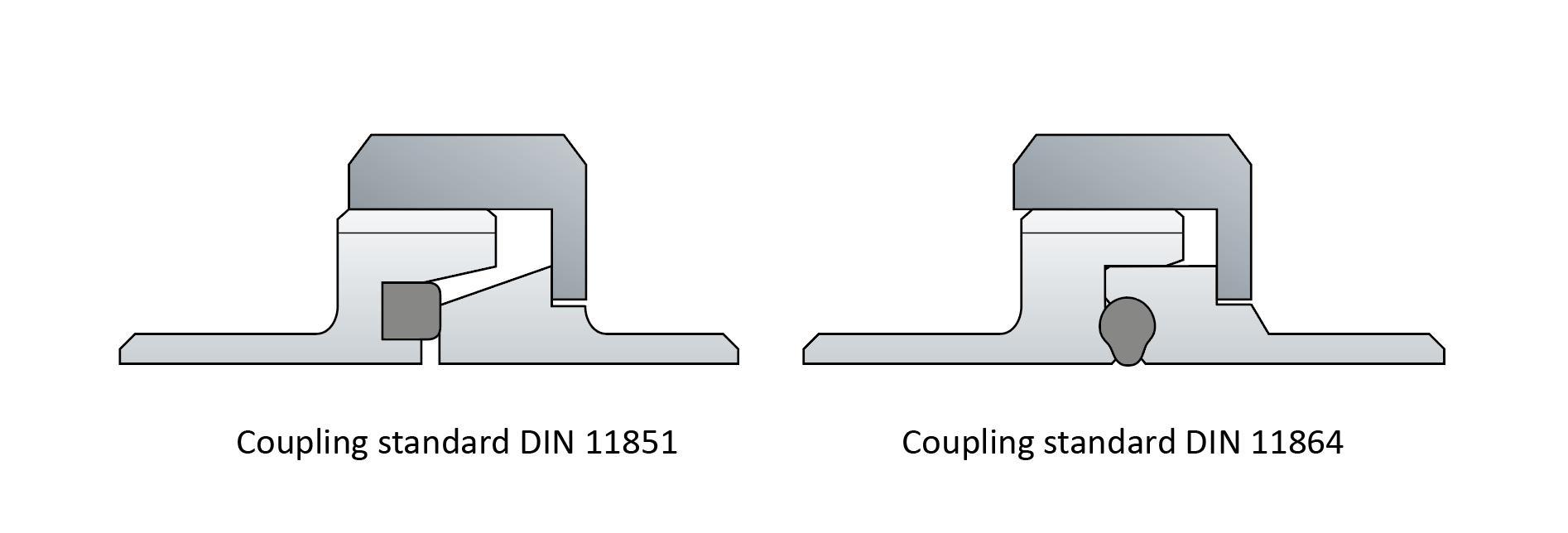
Figure: Comparison of two different coupling standards