
Lesson 6 - Hygienic Design
In this lesson we will discuss the principles of hygienic design and how it is applicable in the brewing industry. Hygienic design covers equipment that is in contact with the product, as well as equipment and the environment that is not in contact with the product.
Hygiene Organisations
We shall now look in more detail at EHEDG and 3A as they are well known and used extensively. NSF does not have the same focus on equipment as these two organisations, thus we will not be looking at them further.
EHEDG
The EHEDG (European Hygienic Engineering & Design Group) was founded in 1989 as a non-profit consortium. It is made up of equipment manufacturers, food producers, suppliers to the food industry, research institutes and universities, public health authorities, and governmental organisations. The 40 largest companies who are EHEDG members as of 2019 are represented in the figure below.
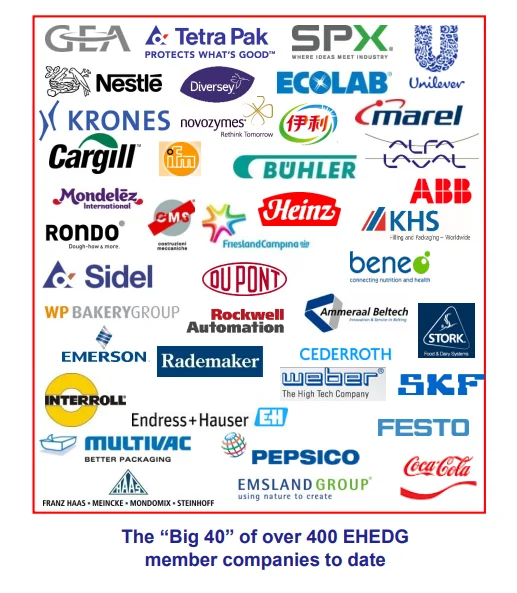
Figure: The Big 40 of EHEDG members
The EHEDG mission is to enable safe food production by providing guidance as an authority on hygienic engineering and design. It currently operates in 55 countries around the world.
The principal goal of EHEDG is the promotion of safe food by improving hygienic engineering and design in all aspects of food manufacture. As such, EHEDG actively supports European legislation. Equipment manufacturers and users are responsible for the implementation of these requirements and EHEDG provides them with guidance on the essential hygienic design standards to comply with national and international legislation.
For more on EHEDG you can watch the following video:
3-A Sanitary Standards Incorporated (3A-SSI)
The first standards for the hygienic design of equipment used in the dairy industry were introduced in the 1920s. These standards became known as '3-A standards' because three 'associations', or interest groups, co-operated to improve equipment design and sanitation. The groups were regulatory sanitarians, equipment fabricators, and processors. Today, 3-A SSI is an independent corporation. It is dedicated to education and the mission to promote food safety through hygienic equipment design in the rapidly changing food, beverage and pharmaceutical industries.
How hygiene organisations can benefit you
We may ask what the use of these organisations are so let us go back to our example of the war zone. These organisations are like the military advisers of the industry. They are the someone else that arranges the ‘clean-up’ strategy for you. Ensuring that your equipment conforms to their standards is beneficial if you are designing it yourself. And if you are relying on engineering companies to perform work or supply equipment to you, specifying that it is certified by one of these organisations will ensure it is hygienically fit for purpose.
The four main objectives of hygiene organisations are to:
-
Provide guidelines for hygienic design
-
Provide certification for equipment
-
Provide training and education
-
Conduct research into areas where gaps in hygienic standards have been identified
Now that we have covered the organisations and the history let us investigate further, the practical details of hygienic design.