
Lesson 4 - Effluent Treatment
In this lesson we take a closer look at effluent from a utilities perspective. We will consider different forms of effluent treatment.
Tertiary Effluent Treatment
To be able to reuse water, a reverse osmosis (RO) system is required (RO was covered in this unit’s lesson on Water). The water supplied to a RO system should be relatively free of larger particles, and also of bacteria which can foul the membranes. The two most common systems for this either use ultrafiltration or incorporate the filtration as part of the aerobic treatment in the form of a membrane bioreactor (MBR).
The figure below shows how these integrate into the overall scheme.
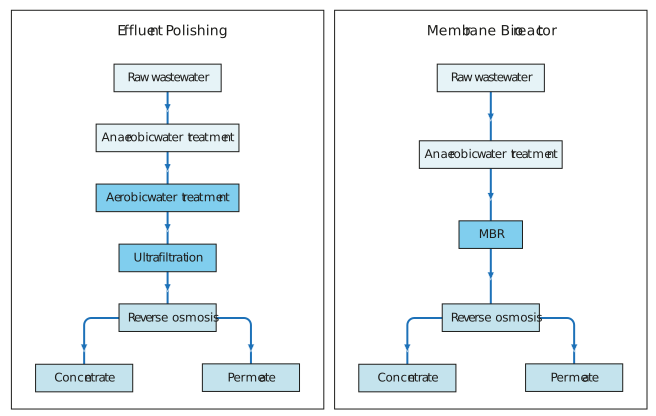
Figure: Effluent polishing with ultrafiltration vs using an MBR
So how do MBRs work? An MBR is essentially an activated sludge system fitted with either an internal or external membrane system which filters the effluent as the activated sludge removes the COD. The figure below shows both systems.
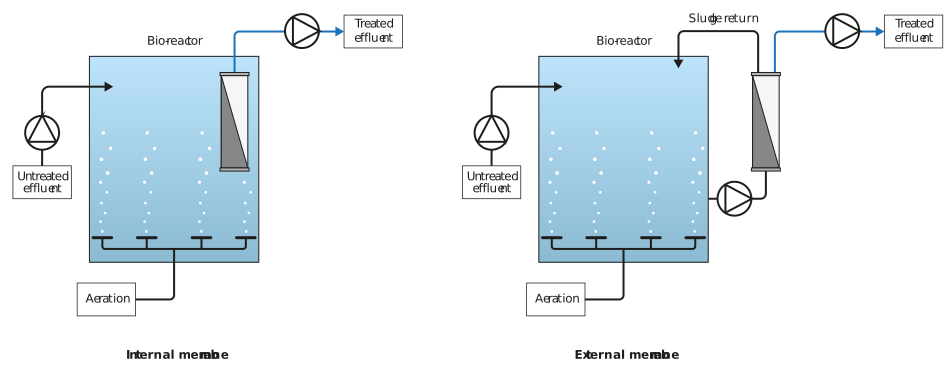
Figure: Internal and external MBR systems
An important consideration for RO treatment is the quality of the concentrate, which can end up being out of specification for a brewery’s permitted discharge limits.