
Lesson 4 - Effluent Treatment
In this lesson we take a closer look at effluent from a utilities perspective. We will consider different forms of effluent treatment.
Secondary Effluent Treatment
Secondary effluent treatment is traditionally done using biological processes. These processes can be anaerobic (without oxygen), aerobic (with oxygen), or a combination of both.
Both aerobic and anaerobic processes use microorganisms to do the job.
Aerobic processes use aerobic microorganisms that use oxygen to convert the biomass into CO2, water, and a growth in the aerobic biomass.
Anaerobic processes use anaerobic microorganisms that convert the biomass into methane, CO2, and anaerobic biomass.
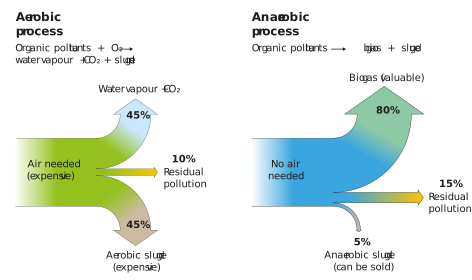
Figure: Comparison of aerobic versus anaerobic
As you can see, the aerobic process makes a lot of biomass whilst the anaerobic process generates methane which can be used as a fuel.
The figure below shows the biochemistry in the anaerobic process. Do not panic – this is just to give you an indication of the complexities involved. There are a whole range of microorganisms involved in this process.
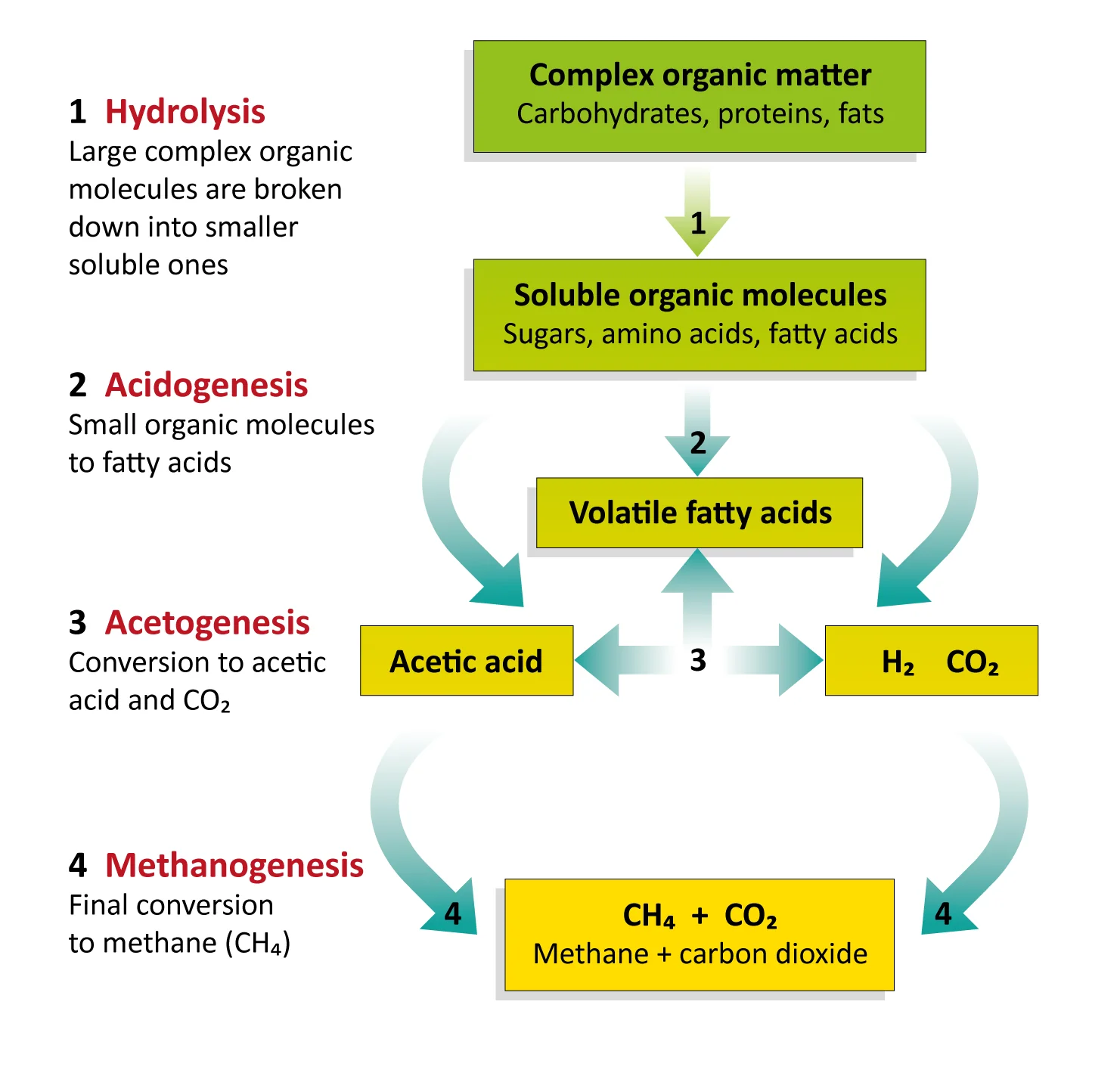
Figure: Biochemistry of anaerobic digestion
It is important to realise that anaerobic and aerobic treatment options are often used in conjunction with each other as both processes have specific outputs.
Aerobic systems typically reduce COD by 90-98%, whilst anaerobic systems can only reach 70-85% reduction. Aerobic systems are also far superior at removing nutrients such as nitrogen and phosphorous, thus they have a big role to play in final treatment.
The big downsides of aerobic treatment are that it requires pumping of air, which is costly, and it requires sludge disposal systems. If you are lucky, you may be able to sell this off. On the other hand, anaerobic treatment provides biogas and thus more than pays for itself as long as you have a use for the biogas.
Let us now look at anaerobic effluent treatment in more detail.