
Lesson 4 - Effluent Treatment
In this lesson we take a closer look at effluent from a utilities perspective. We will consider different forms of effluent treatment.
Primary Effluent Treatment
Primary effluent treatment removes solids and harmonises the flow and composition of the effluent. After removing solids, it is important to balance the effluent and correct the pH.
Removal of solids
Solids removal is critical, whether it is done to prepare the effluent for further treatment or for discharge purposes. Downstream equipment can easily be fouled by having too high a solid content, and using relatively simple physical and mechanical means at this stage improves the performance of the rest of the plant.
This can be done through a variety of processes, which can include static or moving screens. The figure below shows a rotary drum screen.
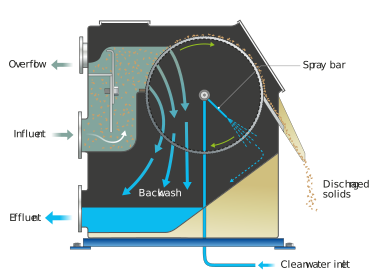
Figure: Typical rotary drum screen
The untreated effluent enters the drum, and the flights within the drum move the solids out, preventing the drum from getting clogged up. The screened effluent drains through the bottom of the rotating screen. Other options include rotating belt screens such as the one below.
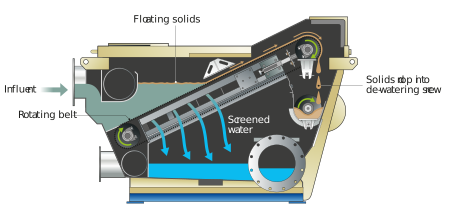
Figure: Typical rotating belt screen
Here the solids are collected on a rotating belt and the screened effluent runs out of the bottom of the belt.
The principle of both of these is to have a screen that is self-cleaning. In a small operation you could have a basket screen that is manually emptied at set intervals, but for larger breweries this is not feasible or practical. A simple inclined screen could also be used. See the figure below.
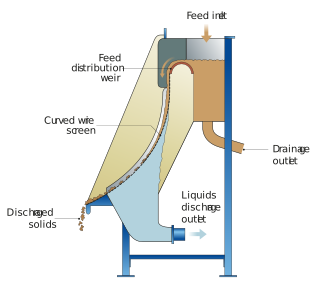
Figure: Simple inclined screen
There are several ways to reduce the solids even further.
One of these is dissolved air flotation (DAF), shown below.
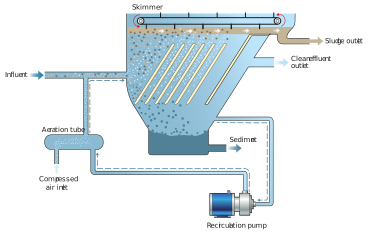
Figure: DAF unit
The effluent feed to the DAF system is mixed with a stream of recycled aerated water. Solids attach to small bubbles that push them to the surface. Heavier particles settle out and a set of plates help with the separation. This allows for floating solids to be removed from the top and settled solids from the bottom. Before entering the DAF system, flocculants are added and if necessary pH correction is done to ensure optimal flocculation.
Balancing of effluent and pH control
Other than removing solids, the other major role of primary treatment is to cater for fluctuations in flow, temperature, and composition. This is normally done by a balancing or effluent collection tank. The size of the tank depends on the size of the brewery and the variability that is possible. It can be very difficult for an effluent system to deal with widely varying inputs. It is a bit like your stomach having to digest very different food every day. Maybe eating one piece of chocolate a day instead of feasting on an entire slab will be easier. Some systems also have a ‘calamity’ tank for when abnormal conditions occur. This allows for the dumping of a dirty caustic tank by slowly blending it back in with the rest of the effluent. In some systems, diversion to the calamity tank is automatic based on pH or other relevant parameters.
The pH adjustment can be done in a number of ways. Various acidic or alkaline solutions can be injected inline or in the effluent tank. It is also possible to inject CO2 from the process as this is weakly acidic. Some plants also recycle some treated effluent back to the effluent tank.
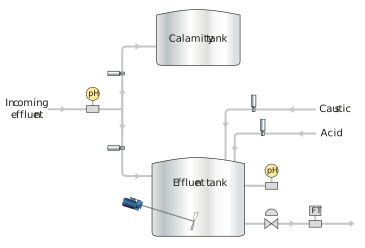
Figure: Typical layout of equalisation and calamity tanks