
Lesson 2 - Steam Theory
This lesson introduces steam as a heating medium. It outlines its uses, benefits, and various properties. It also explains the difference between utility and culinary (clean) steam, as well as the production methods employed for both.
Types of Steam
There are several types of steam, which carry different thermodynamic properties. First, let’s define a few different types of steam, then talk about their uses in a brewery.
Types of steam:
-
Saturated steam is steam that is in equilibrium with water, so the slightest loss of energy causes liquid water to form.
-
Wet saturated steam is steam that contains liquid water within it.
-
Dry saturated steam is steam that contains no liquid water. In practice, dry saturated steam is difficult to achieve.
-
Superheated steam, as discussed earlier, is steam that has been heated beyond its saturation temperature (at a defined pressure).
Let’s discuss the difference between superheated and saturated steam a little more.
Superheated steam is a stable vapour. The transfer of sensible heat from any vapour is relatively poor compared to liquids. For this reason, superheated steam is not used in breweries for heat transfer purposes, but is preferred for distribution around the brewery to minimise the amount of condensate being formed in our pipelines. However, superheated steam is used in power generation applications, such as with turbine driven power equipment.
Saturated steam is steam that is holding 100% of the specific enthalpy possible at that pressure and temperature. This is made obvious by looking at the Mollier diagram again.
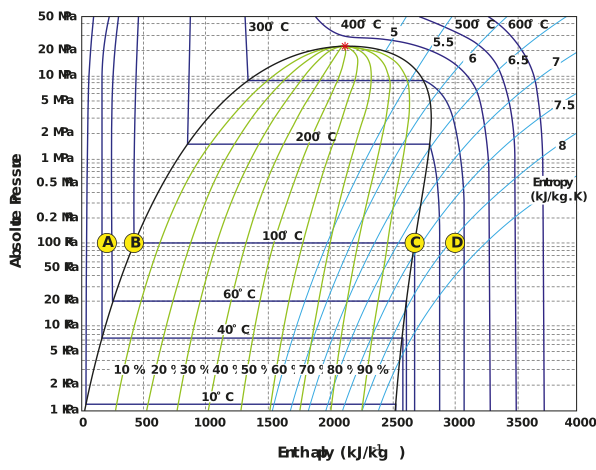
Figure: Conditions of water as shown on a Mollier diagram
If we add enthalpy to the saturated steam at point C, we are no longer on the saturated vapour line, and we move into superheated steam.
For heat transfer applications in a brewery, dry saturated steam is the ideal steam because the condensation of such steam results in a large release of energy, which can be used effectively as sensible heat in heat transfer processes.
In practice, however, dry saturated steam is difficult to achieve with everyday boiler equipment. The steam used in a brewery will almost always have a small amount of water in it, hence it is technically wet saturated steam.
As discussed earlier, the steam quality refers to the percentage of dry steam, sometimes called the “steam dryness”. When quality equals 0%, we have saturated liquid and when it is 100%, we have saturated vapour. Only on the saturated vapour line can we have dry saturated steam.
Conversely we can refer to it as the wetness fraction where if steam contains 10% water (wetness fraction 0.1), it is 90% dry. The stream dryness factor of this steam would be 0.9.
Steam quality, or steam dryness, has a direct effect on the total amount of usable energy in steam.
Looking back at the Mollier diagram, it is easy to conclude that the drier the steam, the higher the specific enthalpy. At a certain pressure, if we were to condense steam with a quality of 90%, we would get less energy out than if we were at 100% quality (saturated). This is because condensation will always lower the specific enthalpy back to the saturated liquid line.
Now that we have discussed the types and properties of steam, we need to make one last distinction between utility and culinary steam.
Culinary and utility steam
Culinary, or clean steam, is a requirement of the pharmaceutical industry and is rapidly becoming a requirement of the food and beverage industries as well. Utility steam, on the other hand, is used in heat transfer processes where cleanliness and sanitation are not as important.
Clean steam is generated from softened and deionised water in high quality equipment. It contains no debris or other impurities. Generally, you use utility steam as the heating medium to make clean steam. Clean steam needs to be used anywhere that steam usage comes into contact with a surface that the beer will also be in contact with.
For example, yeast propagation equipment needs to be sterilised using clean steam. The steam needs to be free from any chemical additives that might be present in utility steam. Additionally, the water needs to be softened to avoid any scale build up.
In the next lesson, we will explore the production methods used to make both clean and utility steam. We will also look at steam distribution systems.