
Lesson 2 - Steam Theory
This lesson introduces steam as a heating medium. It outlines its uses, benefits, and various properties. It also explains the difference between utility and culinary (clean) steam, as well as the production methods employed for both.
Mollier Chart Example
To thoroughly understand how to use a Mollier chart, let’s walk through an example.
Say we have water in a brewery at 60°C and 100 kPa a, that is heated until it becomes steam. A Mollier diagram can be used to illustrate what is happening, and to help us make decisions about operating conditions. An example of this is shown below. Review it for yourself, and we will then walk through each point.
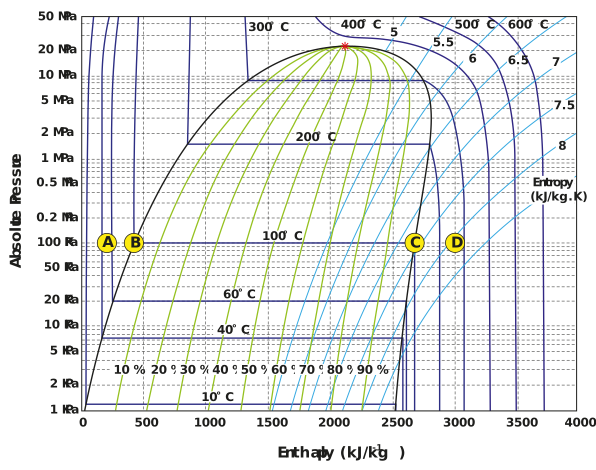
Figure: Conditions of water as shown on a Mollier diagram
-
The first point to make is that this diagram has 0°C as its datum – the point where the x and y axes meet. This will not always be the case, and we will see examples when we look at Mollier diagrams in later lessons (such as the lesson on Refrigeration Cycle and Theory), where 0°C is not always the datum.
-
Water at 60°C and 100 kPa a is a liquid, and has a specific enthalpy of 250 kJ kg-1. This is point A on the above figure. You may recall, from the Heat Transfer unit, that we could have also calculated this using Q = MC∆T, where C is the specific heat capacity. So, Q = 1 × 4.2 × (60 – 0) = 252 kJ kg-1.
-
If we add energy (follow the x-axis to the right), the first effect we see is a temperature increase until we reach the saturated liquid line. This is point B on the figure. Adding heat to raise the temperature from 60°C to 100°C at constant pressure (isobaric), brings us to a specific enthalpy of 420 kJ kg-1. This is referred to as ‘adding sensible heat’. Again, using Q = MCΔT, Q = 1 × 4.2 × (100 − 60) = 168 kJ kg-1. Add this to the 252 kJ kg-1 to get from 0 – 60°C and we get 168 + 252 = 420 kJ kg-1. Which is our enthalpy of saturated liquid at 100°C
Remember, sensible heat is the heat required to change the temperature of a substance, while staying in the same phase.
-
Adding more heat results in liquid being converted to vapour. This process occurs at constant pressure (isobaric) and constant temperature (isothermal). The process continues through the phase envelope (the area within the upside down ‘U’), until there is no more liquid. At the point that the last drop of liquid is converted to vapour, we reach the saturated vapour line. At this point, the water is a saturated vapour, and is called dry saturated steam, as the last drop of water disappears. In practice, dry saturated steam is difficult to achieve since any slight cooling or heating will result in a move away from the saturation line. This is point C on the illustration. The specific enthalpy is now at around 2,700 kJ kg-1. The energy used to vaporise the saturated liquid into saturated vapour is called the latent heat, also known as the enthalpy of vaporisation.
The difference between the specific enthalpy of saturated liquid and saturated vapour is the latent heat at that given pressure.
-
If we add even more energy past the saturated vapour line, the vapour starts to increase in temperature and becomes a superheated vapour. At this point it is considered to be, and behaves like, a gas. This is point D on the illustration, which is at around 250°C and 3,000 kJ kg-1.
This approach also works in the reverse direction. In a brewery using saturated steam as a heat carrier, once the steam reaches its end point where it will be used, it is condensed. The latent heat released from the condensation is the usable heat energy. In our example, the difference in specific enthalpy of point C and point B is the usable energy, also known as the latent heat or specific heat of vaporisation.
In our example we have:


Therefore, if we condense saturated steam, which is at 100 kPa a, we will have 2,280 kJ kg-1 of heat energy. We can use this energy to heat our wort in our kettle, or in other areas where heat is needed.
Next, we will discuss how to find this information on a steam table.