
Lesson 2 - Steam Theory
This lesson introduces steam as a heating medium. It outlines its uses, benefits, and various properties. It also explains the difference between utility and culinary (clean) steam, as well as the production methods employed for both.
Steam Properties
Water can exist in three phases: solid (ice), liquid (water), and vapour (steam). Depending on the temperature and pressure, water will be present in one (or more) of these three states.
A phase diagram is a useful tool that graphically represents the physical state of a substance under varying conditions of temperature and pressure. The figure below shows the phase diagram for water.
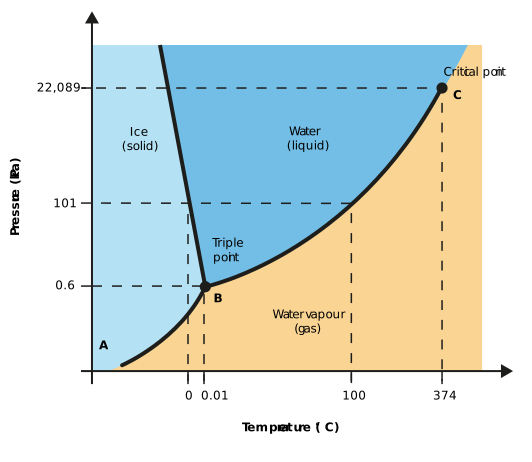
Figure: Phase diagram for water
The SI unit for pressure is Pa, which is often reported in kPa or MPa, depending on the magnitude. In the brewing industry, it is often reported in bar. 1 bar = 100 kPa = 0.1MPa.
Given a specific temperature and pressure, we can use the phase diagram above to determine what phase water will be at under these specified conditions.
It is possible for water to exist in all three forms at the same time; this is called the triple point. Identified in the figure above as point B, the triple point for water occurs at 0.01°C and 0.6 kPa. Raising or lowering the temperature or the pressure of water from its triple point will result in a change of phase into one or two phases.
The critical point of a substance is where it can no longer exist as a liquid. The critical point for water is 22,089 kPa and 374°C. This is point C on the phase diagram shown in the figure above.
The curve from point B to point C on the figure separates the liquid and gaseous regions of the phase diagram. It is this line that will provide the boiling point of water at a given pressure.
Using the phase diagram, we can determine the phase of water under specific conditions of temperature and pressure. Here are some examples:
-
At atmospheric pressure (101 kPa), water freezes into a solid at 0°C.
-
At atmospheric pressure (101 kPa), water vaporises into water vapour at 100°C.
Steam in a brewery is often supplied at around 1,000 kPa (10 bar). Steam at this pressure has a temperature of 179.9°C. This pressure is usually reduced before the steam is used in a process.
An important property of steam is that pressure is directly related to temperature. In a brewery, by controlling the pressure, we can control the delivered temperature. We will discuss this further, later on in this lesson.
Before we move on, we need to first remind ourselves of a few definitions related to heat transfer.
In the Heat Transfer unit, we learned that the energy associated with a phase change is the latent heat – measured in KJ Kg-1. The latent heat of vaporisation is the amount of energy required to vaporise 1 kg of water.
Another important term to know is specific enthalpy. Also measured in KJ Kg-1, specific enthalpy is the heat content per unit mass of the material at a given temperature and pressure.
When making steam heat transfer calculations, it is very useful to know the specific enthalpy of steam under specific conditions. Let’s now learn how to determine the specific enthalpy of water and steam given certain conditions.