
Lesson 12 - Heat Transfer End of Unit SAQ
This lesson allows you to test yourself on the material covered in the Heat Transfer unit and determine the level to which you have met the learning outcomes.
Suggested Response - Q5
*** Your company is building a new brewery. They have asked you to provide the equipment suppliers with the required information to design and size the heat transfer equipment for various stages of the brewing process.
a) List the steps of the brewing process where heat exchangers are used.
b) How would you categorise these heat exchangers?
c) What information would you provide to an equipment supplier, so that they can design and size this equipment?
Response:
a) The figure below shows the complete brewing process, highlighting the most common processes where heat exchangers are used.
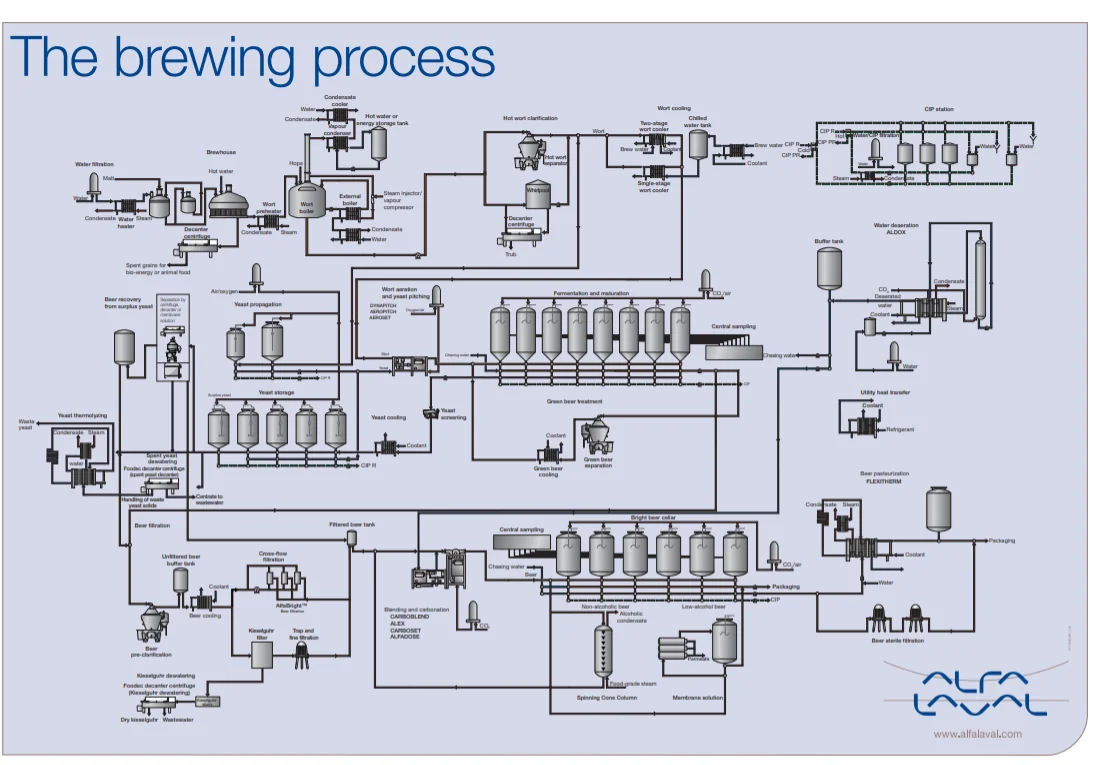
These are:
• Mashing
• Cereal cooking
• Wort preheating
• Wort boiling
• External wort boiling
• Wort boiling energy recovery
• Wort cooling
• Fermentation and maturation
• Green beer cooling
• Yeast chilling
• Yeast propagation and storage
• Beer chilling
• CIP heating
• Water deaeration
• Hot water generation
• Chilled water generation
b) Heat exchangers used across brewing can be categorised in the following ways:
• By their purpose – heat exchangers can be categorised according to whether their purpose is to heat, cool, boil, or condense the product fluid.
• By their type – heat exchangers can be categorised based on whether they are plate heat exchangers, shell and tube heat exchangers, or jacketed vessels.
The type of exchanger can then be broken down even further. For example:
• Shell and tube exchangers can be categorised based on whether they are fixed tubesheet, “U” tube, or floating head.
• Jacketed vessels can be categorised based on whether they are conventional, dimple, or half-pipe jackets.
• By their flow configuration – inline heat exchangers can be categorised based upon their flow configuration. In brewing applications, flow configurations can be co-current, countercurrent or counter/co-current hybrid.
c) To size and design these heat exchangers, the equipment supplier will require the following information:
• Information about the product fluid, such as the product type, the volume or volumetric flow rate, the initial and target temperatures, the evaporation and/or heat up rates and the time required for boiling or heat up. This will allow the supplier to design and size an exchanger fit for purpose. This information is needed because the primary purpose of a heat exchanger is to heat up or cool down product fluid. The amount of heat to be transferred is determined by the mass / mass flow rate, initial / inlet temperature, and target final / outlet temperature of the product stream.
• Information about the utility fluid such as the fluid type, its supply temperature and pressure, the maximum available flow rate, and any exit temperature and pressure requirements. This information is needed because the utility fluid is used to remove or add heat to the product stream. The type of utility fluid used in the exchanger has a major impact on its design.
• The utility and product fluid characteristics – this includes information such as the specific heat capacity, the heat of evaporation, and the density. These factors are all used in heat exchanger sizing calculations.
• The tendency of the product and utility fluids to foul, scale, or carry particulate matter over into the exchanger. Some exchangers are better suited for high-fouling/scaling fluids. Furthermore, measures can be taken in exchanger design if one fluid is high-fouling or scaling.
• The maximum operating conditions, such as the pressure and temperature of the fluids under startup, operating, shutdown, and CIP conditions. This will influence any specific design codes that need to be adhered to, such as pressure vessel regulations.
• Whether any of the fluids in contact with the exchanger, product, utility, or CIP are corrosive and/or hazardous. This impacts the choice of materials selected for the heat exchanger.
• The heat exchanger type and design, as this influences pressure drop. Any constraints on system pressure drop must be considered by the supplier in the selection and sizing of the heat exchanger.
• Any space or accessibility constraints, to ensure that the selected exchanger will fit into position. Heat exchangers come in many different shapes, sizes, and heat transfer surface area to volume ratios; the supplier must thus be aware of these.
• Whether there is a requirement for the new exchanger to be the same type, size, or design as the existing exchangers in a brewery. This can be advantageous, as the exchanger is already familiar to maintenance and operating staff, so spare parts will already be kept in stock.