
Lesson 12 - Heat Transfer End of Unit SAQ
This lesson allows you to test yourself on the material covered in the Heat Transfer unit and determine the level to which you have met the learning outcomes.
Self-Assessment Questions
1. **
a) Define the terms forced convection, natural convection, conduction, and radiation.
b) Identify which of the above heat transfer modes are active in the following brewing processes:
(i) Mash heat up in an agitated mash vessel
(ii) Fermentation and cool down in a jacketed vessel
(iii) Beer chilling through a plate heat exchanger
2. *** You have been asked to design a yeast collection vessel for a small scale brewery. It is required to hold 10 hL (1,110 kg) of yeast collected from a fermentation vessel. The specific heat capacity of yeast is 3,900 J kg-1 K-1.
a) The yeast is cropped at 7°C but must be stored at 3°C. What is the heat transfer surface area required to achieve this cooldown in 30 minutes?
• Cooling is done using glycol supplied at 0°C and returned at 2°C.
• The overall heat transfer coefficient is 350 Wm-2 K-1.
• Assume negligible heat gain from the environment.
b) Comment on the area calculated in a). Discuss what changes you would make to the vessel design to address this. The vessel was originally designed with the following characteristics:
• Straight conventional jackets
• Diameter = 0.9 m
• Height = 2.5 m
• Surface area = 6.9 m2
• Total volume = 1.3 m3 (30% headspace)
c) What is the actual heat gain during the 30 min cooldown?
• Vessel surface temperature = 5°C
• Ambient temperature = 20°C
• Convective heat transfer coefficient = 5 Wm-2 K-1
• Absorptivity of stainless steel = 0.4
• The Stefan-Boltzmann constant = 5.672 × 10⁻⁸ Wm-2 K-4
d) In question (a), we assumed negligible heat gain from the environment. Is this a valid assumption?
e) Describe how insulation would assist in reducing the heat gain from the environment. How much is the heat gain reduced by when the vessel is insulated?
• The surface temperature of the insulated vessel is 18°C
3. *** 1,000 hL of wort at a temperature of 79°C is collected to the wort kettle. Wort is heated and boiled by pumping through an external shell and tube heat exchanger with a countercurrent flow configuration.
• The specific heat capacity and density of wort are 4,000 J kg-1 K-1 and 1080 kg/m3 respectively. The heat of vaporisation of wort is 2,256 kJ kg-1.
• The wort boiling temperature is 100°C.
• Steam is supplied to the heat exchanger at a temperature of 140°C. The latent heat of condensation of steam at 140°C is 2,144 KJ kg-2.
• The exchanger has 150 tubes of 32.5 mm diameter and 2.5 m long, with an overall heat transfer coefficient of 2,100 Wm-2 K-1.
a) Define the overall heat transfer coefficient as it applies to this example.
b) List three design features of shell and tube heat exchangers that improve their overall heat transfer coefficient. List these in order of biggest to smallest influence.
c) What would be the downside of the design features suggested in b) for this application?
d) What is the evaporation rate (%) after one hour of boiling?
4. *** A wort cooler uses chilled water at 5°C to cool wort at 97°C. The chilled water flow rate is 1.05 times the wort flow rate, and it exits the heat exchanger as hot water at 85°C. The specific heat capacity of wort and water are 4,040 J kg-1 K-1 and 4,200 J kg-1 K-1 respectively.
a) What type of heat exchanger and what flow configuration would you recommend for this application? Explain your reasons why.
b) What are the disadvantages of using this type of exchanger for this application, and how can these be overcome?
c) What is the recommended design specification for the wort exit temperature? What is the approach temperature of the heat exchanger?
d) When first installed, the exchanger achieves an outlet temperature of 8°C. What is the reason for this?
The wort and utilities fluid inlet temperatures and flow rates remain unchanged, yet a graph of the wort exit temperature versus the number of brews collected looks as shown below:
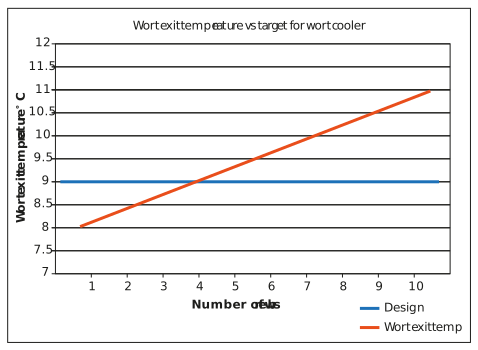
e) What is the reason for the increase in wort exit temperature as more brews are collected?
f) How can the exit temperature be maintained at the design temperature of 9°C?
5. *** Your company is building a new brewery. They have asked you to provide the equipment suppliers with the required information to design and size the heat transfer equipment for various stages of the brewing process.
a) List the steps of the brewing process where heat exchangers are used.
b) How would you categorise these heat exchangers?
c) What information would you provide to an equipment supplier, so that they can design and size this equipment?