
Lesson 9 - Heat Exchangers SAQ
This lesson allows you to test yourself on the material covered in the Heat Exchangers lesson and determine the level to which you have met the learning outcomes.
Suggested Response - Q6
** a) Using the temperature profile below, explain and calculate the following:
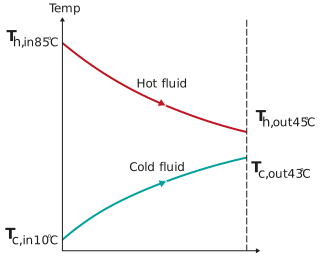
i) ∆T in q = mCpΔT of the hot fluid
ii) ∆TLM in q = UA∆TLM
iii) Approach temperature
b) Given the calculated value of the approach temperature, what type of heat exchanger would you say this is?
c) What is the flow configuration of this heat exchanger?
Response:
a)
i) In q=mCp ΔT, ΔT is the change in temperature of one of the fluids. In this case, this would be a decrease in temperature of the hot fluid across the length of the heat exchanger. The temperature difference is negative as the temperature has declined.

ii) In q = UA∆TLM, ∆T is the difference in temperature between the hot and cold fluids in the exchanger. It is called the temperature driving force. However, in a heat exchanger, this value is not consistent across the heat exchanger. It is thus estimated using the log mean temperature difference (LMTD).

Where 
And 

iii) The approach temperature is when the temperature of the product fluid leaving the exchanger approaches that of the utility fluid.
Approach temperature = 45 – 43 = 2°C
b) Based on an approach temperature of 2°C, this is a plate heat exchanger.
Plate heat exchangers typically have approach temperatures of between 1°C and 3°C. Shell and tube heat exchangers have approach temperatures of above 5°C.
c) Based on the temperature profile provided, the flow configuration for this exchanger is co-current.