
Lesson 9 - Heat Exchangers SAQ
This lesson allows you to test yourself on the material covered in the Heat Exchangers lesson and determine the level to which you have met the learning outcomes.
Suggested Response - Q4
*** Look at the exchangers presented below and give a description of each, including the type of exchanger and its flow configuration.
Considering the advantages of each exchanger type and its flow configuration, which of the below brewing applications would each exchanger be best suited for?
-
Post-filtration beer chilling using ammonia in a large scale industrial brewery
-
Wort boiling with an external calandria using steam
-
Wort cooling in a home/micro brewery
-
Fresh water heating, using recovered water from the brewing process
a)
b)
c)
d)
Response:
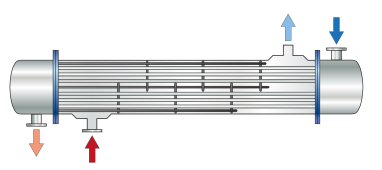
a) This is a fixed tubesheet shell and tube heat exchanger. It is single-pass, with counter current flow configuration.
This exchanger is best suited for wort boiling with an external calandria using steam because:
-
-
Wort in a wort kettle contains particulate matter and has a high capacity for fouling. So, a heat exchanger such as a shell and tube, which has relatively large spaces on the product side, and is easy to clean, is a good fit for this process.
-
Steam is a very low fouling utility fluid, so the fact that the outside of the tubes cannot be cleaned (because this is a fixed tubesheet exchanger) is not a concern.
-
In a wort kettle, wort can be pumped or thermo-siphoned through the external calandria. In both instances the low tube side pressure drop of shell and tube heat exchangers is advantageous. For pumping it means a smaller, lower cost pump. Thermo-syphoning is only possible with a shell and tube exchanger.
Shell and tube exchangers are well-suited for elevated temperature applications such as wort boiling.
-
-
In wort boiling, the wort is not highly temperature sensitive, and so countercurrent flow configuration is preferred for maximum heat transfer.
-
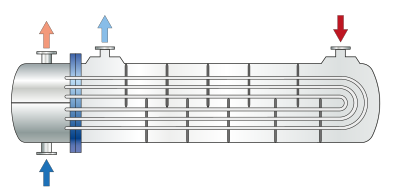
b) This is a U-Tube shell and tube exchanger with two tube side passes. It has both co-current and countercurrent flow configuration.
This exchanger is best suited for fresh water heating using recovered water from the brewing process because:
-
-
Fresh water is low fouling, so the challenges of cleaning U-Tube bundles are not a concern in this application.
-
The quality of the utility fluid is unknown. It could have residual beer in it and could therefore foul over time. The tube bundle of a U-Tube shell and tube exchanger is removable and relatively easy to clean.
-
This is a non-production exchanger, and it can therefore operate with minimal attention. It needs to be robust with low maintenance requirements. Shell and tube exchangers are just this.
-
Multi-pass heat exchangers maximise the temperature change in the product fluid for a relatively small change in temperature of the utility fluid. This feature is of benefit in this application, where the utility fluid is at a relatively low temperature.
-
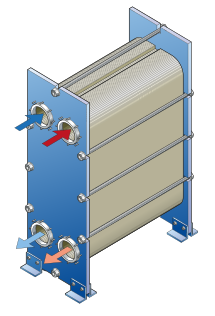
c) This is a single-pass plate and frame exchanger with co-current flow configuration.
This exchanger is best suited for post filtration beer chilling using ammonia in a large scale industrial brewery because:
-
-
Plate heat exchangers retain very small volumes of fluid inside the exchanger. This is favourable when using a hazardous fluid such as ammonia.
-
The beer at this stage (beer chilling) is temperature sensitive, and a co-current flow configuration ensures that the product on the exchanger surface will not freeze.
-
Because this is the last chilling step before the beer is packaged, precise temperature control throughout the filtration run is critical. Plate heat exchangers have highly responsive temperature control.
-
High efficiencies are important in large scale industrial breweries, and this type of heat exchanger is highly efficient.
-
In large scale industrial breweries, energy efficiency is critical to the overall energy footprint of the operation. Plate heat exchangers are the most energy efficient types of exchangers. Furthermore, plate heat exchangers have very close approach temperatures. This allows them to achieve the same product outlet temperature with warmer utility fluids.
-
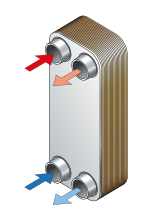
d) This is a single-pass brazed plate heat exchanger with countercurrent flow configuration.
This exchanger is best suited for wort cooling in a home/micro brewery because:
-
-
they are compact, inexpensive, and have low maintenance requirements, which can, in particular, suit smaller scale operations;
-
there is no inherent product contamination risk; and
-
in wort cooling, the wort is not highly temperature sensitive, and so countercurrent flow configuration is preferred for maximum heat transfer.
-