
Lesson 9 - Heat Exchangers SAQ
This lesson allows you to test yourself on the material covered in the Heat Exchangers lesson and determine the level to which you have met the learning outcomes.
Self-Assessment Questions
1. */** What does the term ‘multi-pass exchanger’ mean? How are multiple passes achieved in the exchangers specified below?
• Plate heat exchangers
• Shell and tube heat exchangers
How does the performance of a multi-pass exchanger compare with that of a single-pass exchanger?
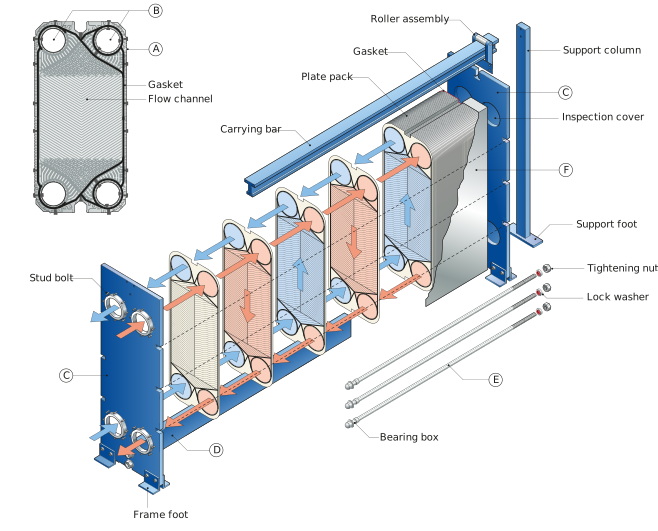
2. * Name the parts (a) to (f) of a plate heat exchanger in the image below. Explain the purpose of each component.
3. ** Please answer the following questions.
a) What are the two purposes of gaskets in a plate heat exchanger?
b) What is the biggest risk of using gaskets?
c) List some measures that can be taken when operating and maintaining a plate heat exchanger, in order to minimise this risk.
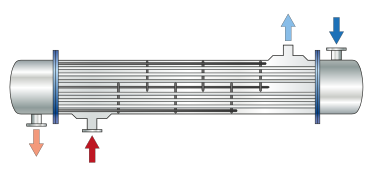
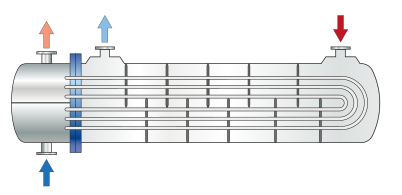
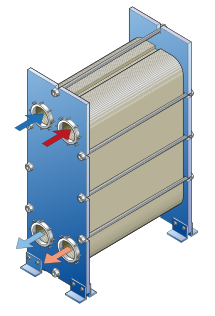
4. *** Look at the exchangers presented below and give a description of each, including the type of exchanger and its flow configuration.
Considering the advantages of each exchanger type and its flow configuration, which of the below brewing applications would each exchanger be best suited for?
• Post-filtration beer chilling using ammonia in a large scale industrial brewery
• Wort boiling with an external calandria using steam
• Wort cooling in a home/micro brewery
• Fresh water heating, using recovered water from the brewing process
a)
b)
c)
d)
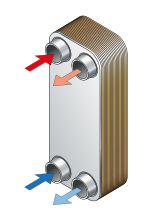
5. * Select which of the below statements are true. In a shell and tube heat exchanger, the purpose of the tubesheet is to:
a) Increase the heat transfer surface area
b) Hold the tubes in position
c) Separate the shell and tube side fluids
d) Improve shell side fluid turbulence
6. ** a) Using the temperature profile below, explain and calculate the following:
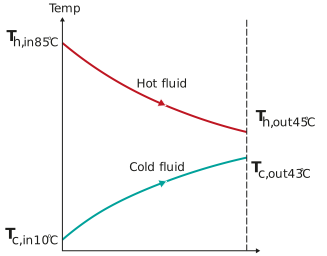
i) ∆T in q = mCpΔT of the hot fluid
ii) ∆TLM in q = UA∆TLM
iii) Approach temperature
b) Given the calculated value of the approach temperature, what type of heat exchanger would you say this is?
c) What is the flow configuration of this heat exchanger?
7. ** A brewery has an existing plate heat exchanger that uses steam to generate hot water for brewhouse and CIP operations.
• Incoming water temperature = 25°C
• The specific heat capacity and density of water is 4,200 J kg-1 °C-1 and 1,000 kg m-3 respectively.
• Steam is supplied to the exchanger at a temperature of 140°C. The heat of evaporation of steam at 140°C is 2,144 KJ kg-1.
The design documentation for the exchanger is not available, but the following measurements were taken:
• Plate width = 0.2 m
• Plate height = 0.5 m
• Number of plates = 35
• Flow configuration is counter-current
a) Assuming an overall heat transfer coefficient of 4,000 Wm-2 K-1. What volume of hot water at 85°C can the exchanger generate in one hour?
b) What mass flowrate (kg s-1) of steam is required to deliver this performance?
c) You observe that the exchanger is achieving the water flowrate calculated in a) and an outlet temperature of 85°C but to achieve these outputs the control valve on the steam supply line is open more than normal and the steam temperature to the exchanger is now 145°C. Use the various heat transfer equations to explain what is happening. What can be done to reduce the steam temperature while still achieving the performance specification of the heat exchanger?