
Lesson 10 - Control of Fluid Flow 2
This lesson will conclude our study of pumps. It will focus on two topics that deal with the unwanted generation of gas or vapour from the liquid being pumped – cavitation. It will then discuss the means by how we can ensure that cavitation does not occur when operating pumps.
Net Positive Suction Head (NPSH) – NPSHR
We have already introduced NPSHR (the NPSH required by the pump), as a safety margin for a particular pump above the limiting condition where the pump suction head is equal to the vapour pressure. Consequently, in order to ensure the safe operation of a pump, we require the following at all times:

In other words, we need to ensure that the available NPSH (the difference between the head at the suction inlet of the pump, and the vapour pressure) is greater than the required NPSH at all times. A margin of at least 0.5 m is recommended.
The NPSHR figure is provided by the pump manufacturer and can be found on pump specification sheets. In general NPSHR requirements range from 3-6 m, depending on throughout. but the following figures can be used as general guidelines:


For particular applications, where low NPSHA condition will be present in the process, so-called ‘low NPSHR’ pumps can be selected which can run with NPSHR values as low as 0.5 m. Low NPSHR applications include:
-
Pumps used to completely empty tanks – virtually every product pump in the brewery and clean-in-place scavenging pumps (these pump out accumulated CIP liquid within tanks) need to do this. Why are such duties considered low NPSHR? Well, as the tank empties the hydrostatic head on the pump, suction reduces.
-
Pumps which empty tanks of very hot liquids – virtually every brewhouse transfer pump needs to do this. Why is such a duty considered low NPSHR? For the same reason above, but also, the liquid has a high vapour pressure due to its high temperature.
Let us have a look at an example of how to use NPSHR in a system design to ensure that the pump will not cavitate.
NPSHR worked example
In the previous example of a wort boiler cast-out pump, the NPSHA was found to be 5.2 m water. If the NPSHR for the pump is 2.5 m wort, would the pump safely empty the wort kettle?
Let us remind ourselves of the plant set-up.
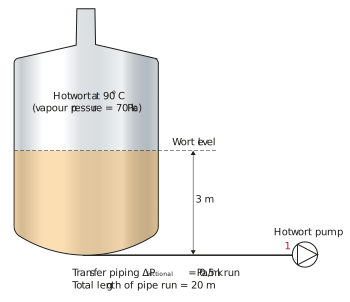
From our discussion of NPSHA and NPSHR, we know that in order for the pump to operate safely, i.e. without cavitating, we require NPSHA ≥ NPSHR, i.e. 2.5 m wort.
From the previous worked example, we know that NPSHA:

Where the pump suction head, HSuction, is given by:

In other words:

As the wort kettle empties, the only one of these terms which will change, and hence change NPSHA, is the hydrostatic head due to the wort depth. So, in order to determine if the pump will safely empty the wort kettle, we need to determine the NPSHA when the tank is empty, i.e. when the wort depth is 0 m.

There is an additional complication in that some of the terms are heads (m) of water and wort, and also kPa, which are not directly comparable, so let us work everything out as kPa, and then convert back to metres of wort:


Expressing this as a head of wort:

Therefore, the NPSHA is less than the required NPSHR of 2.5 m wort, and the pump will cavitate before the tank is empty.
The bulk of our consideration has been on hot liquids, and consequently vapour pressure considerations. We mentioned at the beginning of this section that dissolved gases coming out of solution were another form of cavitation, i.e. equilibrium pressure considerations. So, we will finish with a worked example showing this. It is worth noting that the principles of NPSHA and NPSHR are exactly the same, in this case, and that we merely replace vapour pressure with equilibrium pressure.
Example:
A bright beer tank (BBT) is connected to a horizontal main feeding a beer pump with an NPSHR of 3 m water. The suction line is 20 m long and has a linear pressure drop of 0.5 kPa/m.
The BBT headspace is pressurised with CO2 to a gauge pressure of 2 bar. The equilibrium pressure associated with the dissolved CO2 content is 0.8 bar g. What is the NPSHA at the end of tank emptying? Atmospheric pressure is 100 kPa.
NPSHA is similar to what we have considered before but with the replacement of vapour pressure with equilibrium pressure (or head equivalent):

And suction head is given by:

So,

There are two things to note in the above equation:
· We need to represent the headspace pressure as an absolute pressure to account for the influence of atmospheric pressure on the outside of the BBT.
· The head, due to the 0 m of beer, is shown even though it would be zero.
We can now make the calculation using pressures, and then convert back to head.


Expressing this as a head:

As the NPSHA > NPSHR, then the pump could safely empty the tank without cavitating.