
Lesson 10 - Control of Fluid Flow 2
This lesson will conclude our study of pumps. It will focus on two topics that deal with the unwanted generation of gas or vapour from the liquid being pumped – cavitation. It will then discuss the means by how we can ensure that cavitation does not occur when operating pumps.
Net Positive Suction Head (NPSH) – NPSHA
Net positive suction head (NPSH) is a term which allows us to determine the likelihood of a pump system to cavitate and to choose a pump that ensures cavitation does not occur. To do this, we can also use many of the tools of fluid mechanics which we have been considering in previous lessons, such as hydrostatic pressure, and frictional and fitting pressure losses.
There are two different forms of NPSH which we need to consider, and there needs to be a balance between them. The two forms are:
-
The available NPSH (NPSHA) – this is simply the difference between the absolute head (or pressure) at the suction (inlet) of the pump and the vapour pressure of the liquid. It can also be thought of as how close the liquid is to flashing and hence cavitating.
-
The required NPSH (NPSHR) – this is what is required by the pump at its inlet to avoid flashing, and therefore cavitation within the pump. This value can be thought of as a safety margin for a particular pump above the limiting condition where the pump suction head is equal to the vapour pressure (we will cover this in more detail in a later section.)
NPSHA worked example
Below is a worked example of how to calculate the NPSHA in a common cavitation hot spot, namely the cast-out pump of a wort kettle.
Wort is pumped out of a wort kettle by a centrifugal pump with a 20 m long suction line, with a linear frictional pressure of 0.5 kPa/m. The suction inlet is at the same level at the base of the kettle, and the working level of the wort is 3 m above the pump inlet. The temperature of the wort, when cast, is 90°C with a vapour pressure of 70 kPa.
What is the available NPSH, expressed as metres of water, at the pump inlet? The wort density is 1,060 kg/m³, and atmospheric pressure is 100 kPa.
Firstly, let us put together a sketch of the problem to help us understand what is required. This is shown below.
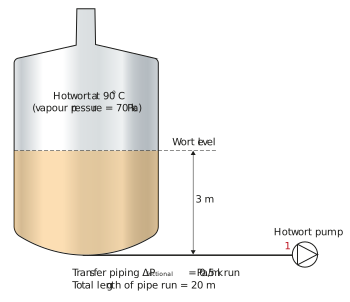
Let us remind ourselves of the definition of available NPSH.
NPSHA is the difference between the absolute head (or pressure) at the suction (inlet) of the pump and the vapour pressure of the liquid.
We can determine the absolute pressure at the inlet of the pump by starting at the headspace of the vessel and working towards the pump inlet.
The pressure at the pump inlet (P₁) would consist of:
-
Atmospheric pressure (remember, we want the absolute pressure, so we need to account for atmospheric pressure) which is pushing down on the wort.
-
Added to the hydrostatic pressure due to the 3 m head of wort which is pushing down on the outlet of the boiler.
-
The pressure drop along the suction line. This would not add to the suction pressure, as the two pressures above do, but rather it would reduce the pressure at the suction; it is, after all, a pressure drop or loss, so we would need to deduct it.
Hence:


The absolute pressure at the pump inlet is 121.2 kPa, and we know that the vapour pressure of the wort is 70 kPa. Therefore, we have a net positive pressure (or head) at the pump suction (inlet) of:

This means that at the suction inlet of the pump, there is a pressure of 51.2 kPa above the pressure at which the wort would flash, causing the pump to cavitate. So, we have a safety margin of 51.2 kPa above the pressure at which we would flash vapour.
Expressing this as a head of water, rather than a pressure:

Let us consider the set-up in the previous example in a little more detail, to further understand NPSH and its role in preventing cavitation, and we will do this by allowing you to reflect on the situation.
By considering the set-up in the previous worked example, identify which factors assist in preventing cavitation, and which factors contribute to the potential for cavitation to occur.
Give yourself 5-10 mins to think about this and then click ‘Next’ to continue with this lesson.