
Lesson 10 - Control of Fluid Flow 2
This lesson will conclude our study of pumps. It will focus on two topics that deal with the unwanted generation of gas or vapour from the liquid being pumped – cavitation. It will then discuss the means by how we can ensure that cavitation does not occur when operating pumps.
Cavitation
Cavitation isn’t only something that you should avoid when it comes to a visit to your dentist! It should always be avoided, particularly when transporting liquids around a brewery.
Cavitation involves, as its name suggests, the formation of cavities in a liquid. Wait a minute, how can that be? We cannot form cavities in a liquid, can we? They’d collapse surely? Well, if the cavities are formed of gas or vapour, these cavities would be called bubbles! And those are things that we are familiar with in beer. We want to intentionally produce bubbles so we can generate foam, but cavitation during the transport of liquids is unwanted and should be avoided.
Cavitation is the generation and subsequent collapse of gas or vapour bubbles due to localised reductions in pressure within the pump/pipeline system. The cause of cavitation is related to flashing (or vapour generation), which will occur if the pressure on a liquid is reduced to or below a threshold pressure. This threshold pressure is different depending on whether a dissolved gas is present or the liquid is gas-free, and vapour is generated. We shall consider these threshold pressures separately, starting with vapour evolution and then with a dissolved gas.
Vapour evolution
You will be familiar with generating vapour from a liquid, e.g. boiling water, in which we apply heat until the temperature of the liquid reaches its boiling point. At this stage it will produce vapour (in the form of steam if the liquid is water).
You will also probably be aware that the temperature at which the vapour is generated is a function of the pressure which the liquid is exposed to. We commonly exploit this in the kitchen with a pressure cooker, where we create an overpressure to generate vapour at a temperature greater than we can achieve at atmospheric pressure. Vapour pressure is the pressure exerted by the vapour, at the prevailing temperature. Liquid boils if its vapour pressure reaches the ambient atmospheric pressure.
This effect also works in reverse, in that we can reduce the pressure to reduce the temperature at which we evolve the vapour. This would be very apparent should you visit the top of Mount Everest, where the reduced atmospheric pressure causes water to boil at a little over 70 °C. The figure below shows this relationship for water, and you can see, using the Mount Everest example, if water boils at 70 °C, then the vapour pressure is approximately 30 kPa abs, which would be atmospheric pressure at the top of Everest.
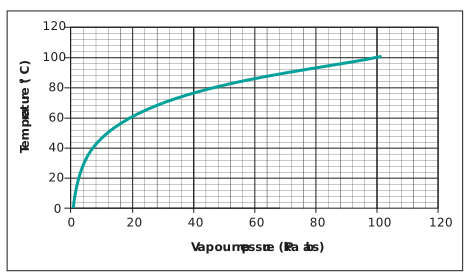
Figure: Water vapour pressure variation with temperature
Imagine we have a pipeline at sea level with flowing (or stagnant) water in it which is at a theoretical temperature of 70°C. From the vapour pressure curve above, we know that the vapour pressure at that temperature is approximately 30 kPa. Therefore, if the pressure in the pipeline is above 30 kPa abs, the water will remain as a liquid. However, if the pressure falls to below 30 kPa abs, then the water will begin to boil, and small bubbles of vapour will rapidly form (called flashing). This flashing process is shown in the figure below.
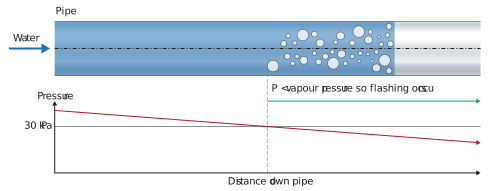
Figure: Flashing of vapour bubbles due to a drop in line pressure
Flashing is a reversible process; the vapour bubbles can be reabsorbed (more precisely, condensed) back into the liquid water if the pipeline pressure increases above (in this case) 30 kPa abs. If the line pressure increases, e.g. due to an expansion of the pipe diameter, then as the bubbles pass into this higher pressure region they would collapse and condense back into the liquid as shown below. Bernoulli’s equation would suggest that an increase in flow area would result in a decrease of mean flow velocity and hence an increase of pressure.
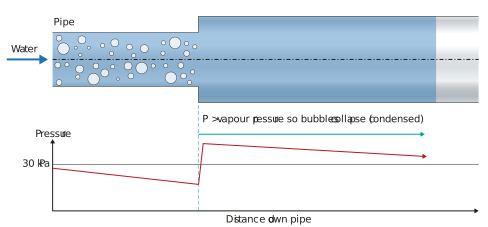
Figure: Collapse of vapour bubbles due to localised increase in line pressure due, in this case, to an expansion in line diameter
We have discussed the evolution of vapour due to the pressure dropping below the vapour pressure. Now we shall now consider dissolved gases coming out of solution.