Lesson 6 - Principles of Fluid Mechanics 3
This lesson considers the factors which contribute to pressure loss when fluid follows through a pipe or duct system. It will examine in detail, the factors which contribute to frictional pressure losses and also losses due to the presence of fittings in the pipeline.
Loss Coefficient (k)
The loss coefficient (k) is the number of velocity heads that would be equivalent to the head loss across the fitting:

Consider the figure below which shows two horizontal lengths of pipe connected by a 90° horizontal bend.
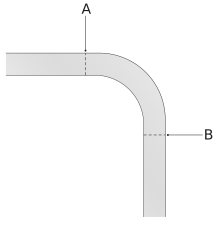
Figure: Two horizontal lengths of pipe connected by a 90° bend
The head loss across the bend – between sections A and B – would be given by:

So, if we wanted to express the fitting head loss as a fitting pressure loss in N/m², we would convert using the density of the fluid and acceleration due to gravity g, as we have done previously by:


Let us look at a worked example to determine the fitting loss as a head and as a pressure.
A pipeline carries water of density 1,000 kg/m³ at an average flow velocity of 1 m/s.
A fitting in the line has a loss coefficient k of 1. Determine the head loss (m water) across the fitting and the equivalent pressure loss of the fitting.

And converting this to a pressure:

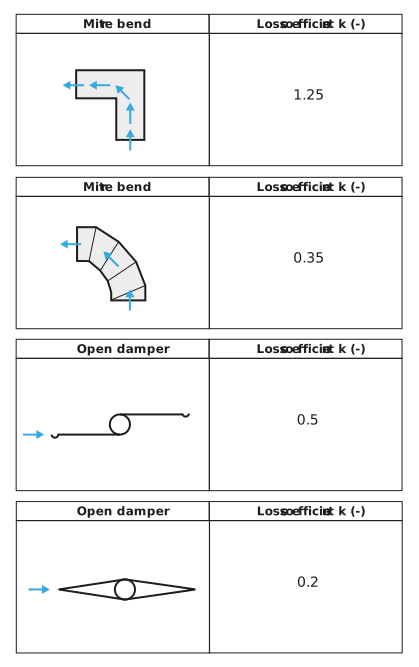
Some typical fitting loss coefficients for pipeline and ductwork fittings are shown in the tables below.
Table: Loss coefficient k for various pipe fittings
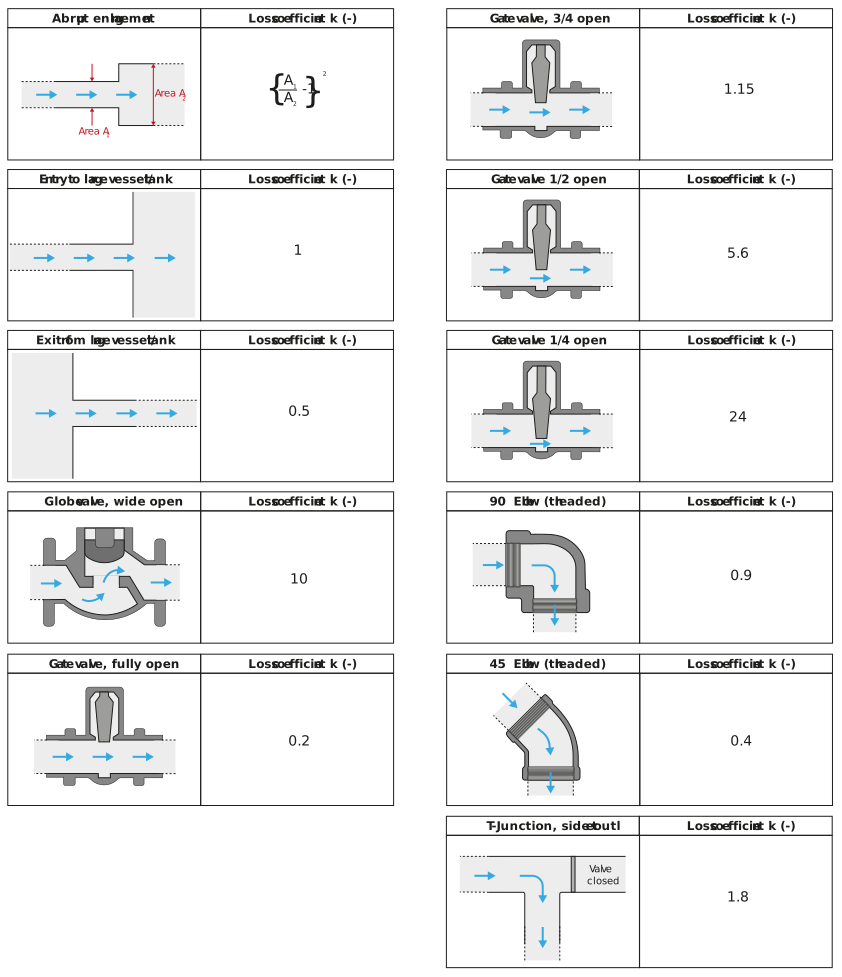
Table: Loss coefficient k for various duct fittings