
Lesson 6 - Principles of Fluid Mechanics 3
This lesson considers the factors which contribute to pressure loss when fluid follows through a pipe or duct system. It will examine in detail, the factors which contribute to frictional pressure losses and also losses due to the presence of fittings in the pipeline.
The Loss of Energy in Pipe Systems – in Practice
Estimating pressure losses in pipes involves consideration of the conservation of energy. When we have introduced energy previously, via Bernoulli’s equation, we did so through the conservation of energy only in the forms of pressure, gravitational potential energy, and kinetic energy. Well, the practical world is not quite as simple – real pipes also have friction. And friction is such a drag, but we cannot let it slow us down too much. So, let us slide on in, and consider it further!
Firstly, let us remind ourselves of the application of Bernoulli’s equation along a horizontal pipe of constant diameter containing a flowing fluid (as seen in the figure below). As before, this equation assumes a fixed fluid temperature, and no gain or loss of heat or work.
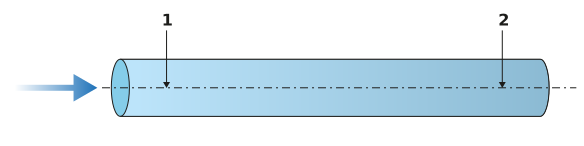
Figure: Horizontal flow in a pipe of constant diameter between measurement points 1 and 2

Applying this equation between points 1 and 2, gives:

So, here is something for you to consider, what would the pressure difference be between points 1 and 2?
Give yourself 5-10 mins to think about this, and then click ‘Next’ to continue with this lesson.