
Lesson 6 - Principles of Fluid Mechanics 3
This lesson considers the factors which contribute to pressure loss when fluid follows through a pipe or duct system. It will examine in detail, the factors which contribute to frictional pressure losses and also losses due to the presence of fittings in the pipeline.
The Friction Factor φ
The friction factor parameter represents the value of friction between the fluid and the pipe inner wall surface. Sounds simple enough doesn’t it? Well no, it is a bit more complicated than that!
Firstly, it is not a constant for a particular fluid-pipe wall pairing. Instead, it is a function of the Reynolds number of the flow within the pipe, for laminar flow only, as well as the (relative) roughness of the inner surface of the pipe, ε (Greek symbol, epsilon), for turbulent flow. Let us examine how to determine the friction factor for both flow regimes: laminar and turbulent. We will not consider transitional flow for the reasons previously outlined, i.e. transitional flow is very rarely present in industrial flows.
Laminar flow and friction factor
For laminar flow, the friction factor can be considered to be a function of Reynolds number as follows:

Where Re is the Reynolds number and given, as before, by, ρud/µ.
So, what do you think a typical value of φ would be? A large or a small number? Let us do a worked example to assess this.
What would be the expected range of friction factor for laminar flow?
We know that laminar flow is that considered up to a Re < 2,100, so the value of φ at that limit would be given by:

As we reduce Re, we would expect φ to increase. However, a Re = 0 would be meaningless as there would be no flow, so let us consider a Re = 5.

In brewery situations, we would be very unlikely to operate as low as Re = 5, but hopefully, you can see that φ would typically be a number larger than 0.008 for laminar flows.
This equation for friction factor, under laminar flow conditions, is strictly only applicable to smooth pipes where any internal surface roughness is not an appreciable portion of the diameter. There is little guidance available, but it is safe to assume that most commercially manufactured pipes and ducts would be considered smooth.
Turbulent flow and friction factor
For turbulent flows (Re > 4,000), the friction factor is a function of the relative roughness of the inner pipe wall and the Reynolds number. You might find a number of correlations in the literature describing this relationship, but these tend to be quite involved algebraically (tricky maths) and difficult to use. Fortunately, these correlations are readily available in charts which are far more user-friendly. An example is shown below. These diagrams are often termed ‘Moody’ diagrams (not because of their temperament), but after Lewis Moody who first plotted them in 1944. The diagram also covers the laminar regime (described above) as well as the turbulent regime.
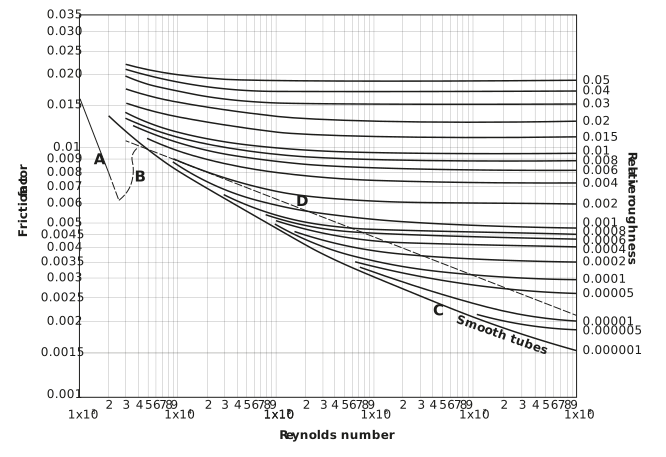
Figure: Moody Diagram showing friction factor as a function of Re and relative roughness. (Based on Moody, Trans.Am.Soc.Mech Engrs.,66,671 (1944).)
Differing values of relative roughness are shown on the diagram where relative roughness ε is defined as the ratio of absolute roughness e to the pipe inside diameter d:

The absolute roughness is essentially a measure of the size of the surface irregularities. These are either naturally present or most commonly remain as a by-product of the manufacturing process, e.g. rolling, drawing, or casting.
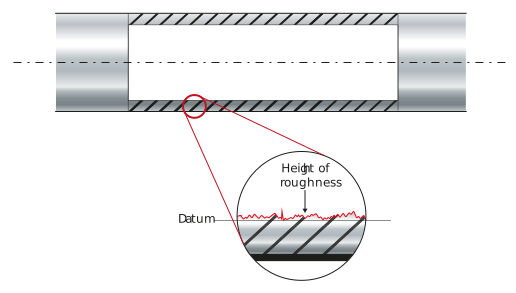
Figure: Surface roughness
Measuring surface roughness is quite a complicated thing to do in practice, and it is more common to use tables of typical absolute roughness as shown in the table below.
Table: Absolute roughness e of differing engineering materials
|
Material/construction |
e (mm) |
|
Drawn tube |
0.0015 |
|
Commercial steel |
0.046 |
|
Wrought iron |
0.046 |
|
Asphalted cast iron |
0.12 |
|
Galvanised iron |
0.15 |
|
Cast iron |
0.26 |
|
Wood stave |
0.2-0.9 |
|
Concrete |
0.3-3.0 |
|
Riveted steel |
0.9-9.0 |
|
Aluminium ducting |
0.05 |
|
Galvanised steel spiral wound |
0.075 |
Let us consider a worked example to determine relative roughness.
Example:
A drawn pipe of 150 mm inside diameter has an absolute roughness of 0.005 mm. What is the relative roughness?

Relative roughness does not have a unit.
Example showing how to use the Moody diagram:
A pipe of 75 mm internal diameter has an absolute roughness of 0.0075 mm. It carries liquid with a density and viscosity of 1,200 kg/m³ and 3 cP respectively, at an average flow velocity of 1.9 m/s. Determine the friction factor.
We know that Moody diagrams plot friction factor against Reynolds number and relative roughness. So, let us start with the relative roughness. This is given by:

Next, we need to calculate the Reynolds number:

We must remember to convert the units of viscosity from cP to kg/ms.
Plotting these two values on a Moody diagram below:
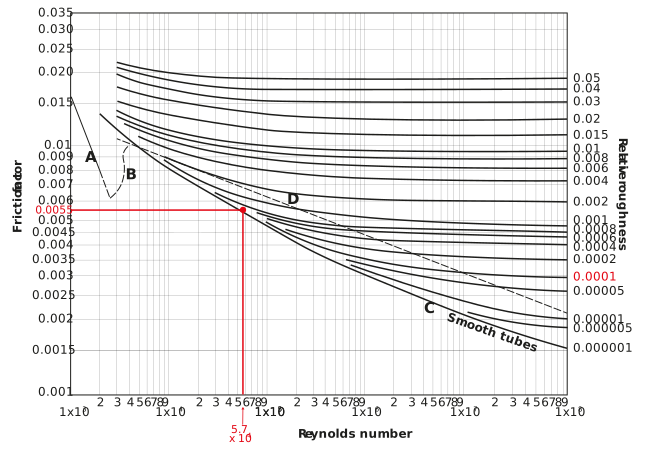
So, plotting the relative roughness on the right-hand side of the diagram and intersecting this curve with the value of Re, and reading friction factor at the left-hand side gives φ = 5.5 x 10⁻³. Note these diagrams are plotted on logarithmic scales on both axes ( to base 10), not linear, so care must be taken when obtaining values from axes, as illustrated
Friction factor warning φ
If you are looking for friction factors in design guides, textbooks or on the internet, you should be cautious of using the incorrect type of friction factor and Moody-style diagram. There are different types, with conflicting values for the same situation available. Therefore, we need to be mindful of our sources.
Differing authors have plotted Moody-style diagrams and have developed friction factors, some of which are termed Moody, Darcy, or Fanning friction factors, some being multiples of the friction factor φ which we have considered which is known as the Fanning friction factor. There is no reason to panic about this, but as ever, if we are using a Moody-style diagram and the Darcy-Weisbach equation, we need to double-check the suitability of the friction factor, and if required, consult an engineer.
Moody diagram calculators are also available online, for reason described here, should be used with caution.