
Lesson 4 - Principles of Fluid Mechanics 2
This lesson will extend our knowledge of fluid mechanics by considering two important laws: the conservation of both mass and energy. We will also examine the various flow regimes which are present within a pipe or duct carrying moving fluids.
Determining Re for Non-circular Pipes/Ducts
So far, we have almost exclusively considered flow within circular pipes or ducts, however, if you have taken a walk around a brewery or maltings, you will have noticed that although circular sections are very common, they are not exclusive.
Common examples of non-circular sections include:
-
Square or rectangular ducting for the supply of air within maltings plant
-
Square or rectangular ventilation air-handling units in a packaging hall
-
Square section drainage channels in a brewhouse floor
-
Cooling jackets on fermenters or bright beer tanks
-
Flow channels within certain heat exchangers
When trying to calculate the Reynolds number for non-circular sections, the challenge is which value of diameter do we take? After all, in a rectangular duct, for instance, diameter has no meaning. In such cases, we can determine what is called the ‘equivalent diameter’ (also called the hydraulic mean diameter – do not let the term hydraulic throw you; the term is applicable for fluids other than water). We can use the equivalent diameter as an alternative way to determine the Reynolds number. The equivalent diameter de is defined as the ratio of four times the flow cross-sectional area to the wetted flow perimeter:

The flow cross-sectional area is exactly as its name suggests; it is the cross-sectional area that the fluid occupies. The wetted perimeter is the length of perimeter (or perimeters) that the fluid is in contact with.
Let us look at an example to understand these parameters better.
Example:
What is the equivalent diameter of a rectangular cross-section duct 0.5 m wide by 0.25 m high?
The equivalent diameter is given by:

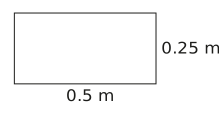
The cross-sectional area for a rectangle is the product of the width and the height:

The wetted perimeter would be the length consisting of the two long sides and the two short sides:

Consequently, de is given by:

It should be noted that the equivalent diameter concept is only strictly applicable to turbulent flow.