
Maths for Diploma Studies
This lesson is designed to provide the background knowledge in maths required to study CIBD Diplomas successfully. It will describe the basics of maths before detailing the more complex concepts encountered in CIBD lessons. Techniques for working with numbers, equations, and units will also be described.
Roots
So far, we have used the term ‘base number’ to describe the number subject to the exponent. It can be described as another term, and that is the root.
We use square and cube roots, referring to numbers that have been squared or cubed by the exponents 2 and 3, respectively. For higher exponents, we use nth root, for example, 4th, 5th, and 6th roots.
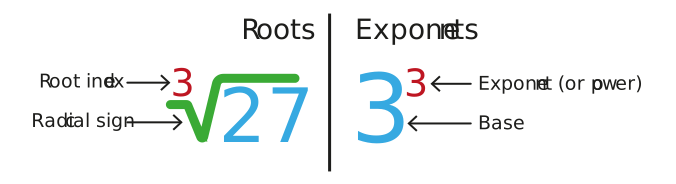
Figure: Relationship between exponents and roots
For example:


In the above, the root is squared to get the result, so if we take a square root of the result, we get back to the root:

To show a cube root, we use a 3 above the root symbol or radical sign like so:

Which, as we now know, is the opposite of:

As any number squared must be a positive number (remember from earlier that if we multiply a negative number by a negative number, we produce a positive answer), we cannot calculate the square root of a negative number. We can, however, calculate cube and nth roots for negative values. For example:

To help reinforce what we have just learned, on the next page there are some practice questions. Answers and explanations can be revealed by clicking on show answer.