
Maths for Diploma Studies
This lesson is designed to provide the background knowledge in maths required to study CIBD Diplomas successfully. It will describe the basics of maths before detailing the more complex concepts encountered in CIBD lessons. Techniques for working with numbers, equations, and units will also be described.
Rearranging Equations
Although rearranging equations is a fun and exciting activity, loved by all the family, it is important to keep in mind why we do it. When we rearrange equations, we are trying to isolate the term of interest. This is called making it the subject.
Rearrange or solve?
Technically speaking, solving an equation is determining the value of a specific term in the equation. For example, this is solving an equation to find x:

So:

And therefore:


In certain parts of the world, people use the word solving to mean rearranging.
Technically, when rearranging, we do not find the value of any terms, we simply isolate a term of interest (make it the subject). You will see solving used to describe both rearranging and calculating the required value in equations online and in CIBD lessons.
As an example of rearranging equations, in the equation below, we might know all the values apart from r and need to ensure that the correct value of r is maintained to prevent something nasty from happening:

So how do we get r on its own? (It looks scary now, but it will be a piece of cake by the end of this section). The answer is inverse operations. Inverse operations are the opposite action to the operation as currently shown in the equation. The table below shows common operations and their inverse operation.
Table: Operations and inverse operations
|
Operation |
Inverse Operation |
|
Addition |
Subtraction |
|
Multiplication |
Division |
|
Square |
Square root |
|
Raising to the power of n |
nth root |
|
Log10x |
10x |
|
lnx |
ex |
|
Multiplied by x |
Multiplied by 1/x |
|
Reciprocal |
Reciprocal of the reciprocal |
|
-x |
x -1 |
An inverse operation returns something back to its original value. For example:

In this instance, the inverse operations are:

When you perform an inverse operation on both sides of the equation, it cancels out the operation on one side and adds the inverse operation to the opposite side. In effect, you are moving the term across the equals sign and making it the inverse of its previous form. For example in this equation:

If we add d (the inverse operation of -d) to both sides, it will cancel out the -d on the right and be included on the left-hand side, giving us:


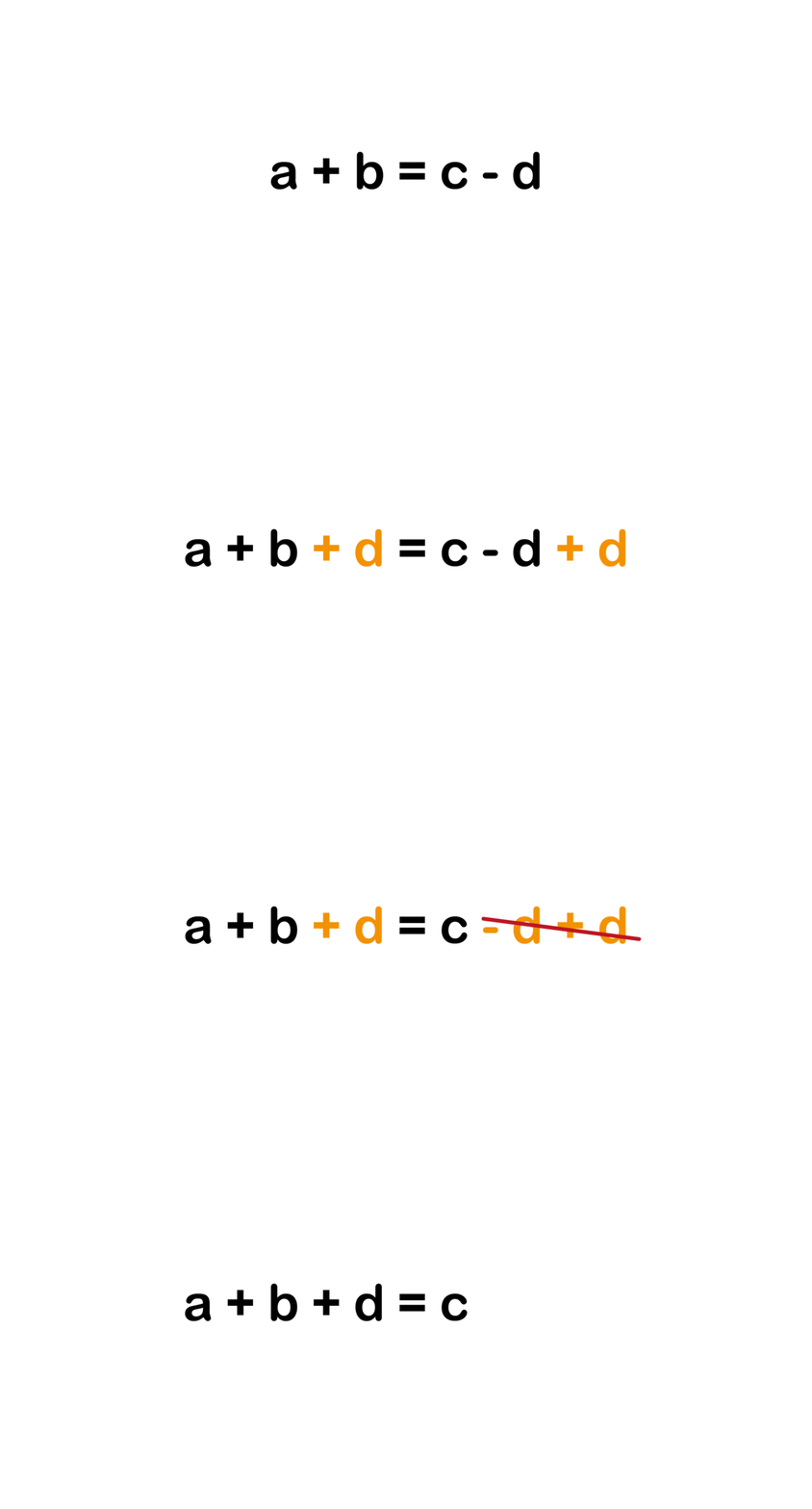
or

So if we needed c on its own, it’s job done!
Here you will notice that c jumps to the left when we present the final form of the equation. As we know that what is on one side of the equals sign always equals what is on the other, we understand that what side we show our subject (term of interest) on is irrelevant. However, the standard way to present equations is to show the subject on the left.
It would be nice if all equations were as simple as the one above, but they are not. Let’s go back to the nasty looking equation we saw earlier where we need to isolate r.
The first thing we do is to get the d over the other side of the equals sign. The inverse operation of divided by d is multiplied by d, so we do that to both sides. On the left, this cancels out the d and, on the right, it multiplies everything by d. Because we are multiplying everything, we need to put the  in brackets, so we get:

If we didn’t do this, we would only be multiplying the 7b by d and not everything on the left of the equals sign.
Now we need to move the c2 across the equals sign. As it stands, r is being multiplied by c2, so we need to divide both sides of the equation by c2. This cancels out the c2 on the right and divides everything on the left by c2. This leaves us:

You might be wondering why we didn’t need to do the inverse operation on the c2 of  to cancel it. The reason for that is the r is being multiplied by c2 rather than rc being squared. If that were the case, it would be written as (rc)2. In that case, we would have done this:

Take the square root of both sides, cancelling the square of rc:

Then we just need to divide both sides by c to cancel the multiply by c on the right:

Let’s have a go at an example from a Diploma Module 3 lesson.
Here’s the equation for calculating the heat transfer across a heat exchanger.

Don’t worry about what all the terms mean but just say we need to isolate A. At the moment, A is multiplying U and being multiplied by  the inverse operations of all these multiplications is to divide. So we divide both sides by
 . This cancels out the on the right and means we are now dividing q by on the left, leaving us with:

Or:

It’s important to note that we can do this because apples multiplied by pears is the same as pears multiplied by apples, so you can pick out the multipliers you want and perform an inverse operation on them, leaving any of the other terms where they were. It’s a great way of moving lots of terms across the equals sign in one go. You can’t do that with subtraction or division.
To help reinforce what we have just learned, on the next page there are some practice questions. Answers and explanations can be revealed by clicking on show answer.