
Maths for Diploma Studies
This lesson is designed to provide the background knowledge in maths required to study CIBD Diplomas successfully. It will describe the basics of maths before detailing the more complex concepts encountered in CIBD lessons. Techniques for working with numbers, equations, and units will also be described.
Order of Operations
The order of operations is how we approach calculations set out in equations. It is important that we undertake the component calculations in the correct order.
For example, if we work through this calculation from left to right, we come up with the wrong answer:
3 + 7 – 4 / 2 × 3 = 9
When in fact, it should be:
3 + 7 – 4 / 2 × 3 = 4
If there are no brackets or exponents in equations, we start with multiplication and division before moving on to addition and subtraction. In both cases, we work from left to right. When introducing brackets or orders, we use the acronym PEMDAS standing for:
-
Parenthesis (posh word for brackets)
-
Exponents
-
Multiplication
-
Division
-
Addition
-
Subtraction
An easy mnemonic to help remember the order of operations is by using a flatulent aunt. As a consequence of her flatulence, we would often find it necessary to say, ‘Please Excuse My Dear Aunt Sally’. The first letter of each word will serve as a reminder of each action.
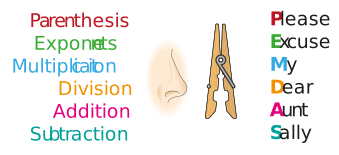
Figure: A memory jogger for mathematical order of operations
We do our calculations in the order set out here. Brackets first, then orders, then working from left to right, multiplication and division and finally addition and subtraction again left to right.
Other acronyms, BIMDAS, where B stands for brackets and I stands for indices (another word for exponents), or BOMDAS, where O stands for orders (another word for exponents!), are used, but the procedure is always the same.
It is interesting to see that there are a lot of names for the same thing used in maths. With bases, roots, orders, exponents, and indices all having several terms used to describe them. It’s almost confusing!
Let’s look at our example from above:

We don’t have any brackets or exponents, so we can move straight to multiplication or division. Going from left to right, the first one of these we encounter is division, so first, we do:

Which gives us:

Next, we arrive at the multiplication, so we do that:

Which gives us:

Next addition:

Which leaves:

And finally the subtraction:

And now a more complicated example.
What is?

Give yourself 5-10 minutes to think about this, and then click ‘Next’ to continue with this lesson