
Maths for Diploma Studies
This lesson is designed to provide the background knowledge in maths required to study CIBD Diplomas successfully. It will describe the basics of maths before detailing the more complex concepts encountered in CIBD lessons. Techniques for working with numbers, equations, and units will also be described.
The Fundamentals
It is always wise to start at the beginning, so we are starting at the most basic level. Here’s a table of the basic symbols you will see throughout this lesson with a simple explanation of their meaning(s).
Table: Maths symbols
|
Symbol |
Meaning and Explanation |
|
+ |
Add two numbers together. It doesn’t matter what order the numbers are in – we just add them. |
|
- |
Subtract the number on the right from the number on the left (2 minus 60 is not the same as 60 minus 2). It can also denote a negative number if placed on the left of a number. |
|
× |
Multiply two numbers. It doesn’t matter what order the numbers are in – you just multiply them. In equations, just having the two numbers next to each other without a space means the same thing. |
|
÷ |
Divide the number on the left by the number on the right. This can also be written as / and . With the / you divide the number on the left by the number on the right, and with you divide the top number by the bottom number (2 divided by 60 is not the same as 60 divided by 2). |
|
X2 |
This means the x (any number or term) is multiplied by itself. It is called squared. |
|
√ |
This is the square root which is a number that gives a target number when multiplied by itself. It is the opposite of squared. |
|
/ |
This can mean divide as shown above or per when it is representing a rate. |
|
: |
This denotes a ratio in which the number on one side of the : is compared to the number on the other side. |
|
= |
The equals sign means the two things on either side of it are equal. |
|
(x + y) |
Brackets around a sum/term means the sum in the brackets is subject to the ‘what is done’ in the sum before or after the brackets. For example (2 x 2) + 4 is 8, not 12. Pairs of brackets next to each other means what is in one bracket is multiplied by what is in the next bracket. |
Negative and positive numbers
Positive numbers are those above zero, and negative numbers are those below zero.
If we add a negative number to a positive number, we are, in effect, subtracting the negative amount from the positive amount. So:

If we add a negative number to a negative number, we increase the negative value. So:

If we subtract a negative number from a positive number, we increase the value of the positive number. So:

If we multiply a positive number by a negative number, we increase the size of the negative number by the value of the positive number. So:

If we multiply a negative number by a negative number, we produce a positive answer:

The same applies to squaring numbers (multiplying the number by itself):

The good news is that your calculator knows all these rules, so you just need to use the +/- button to assign the negative or positive values to the numbers.
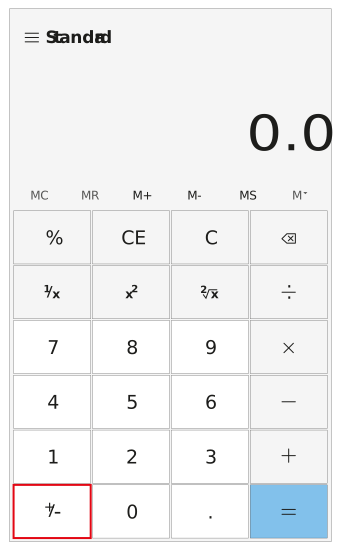
Figure: The +/- button
However, it is important to remember these rules for rearranging equations that we will cover later.
If you are not familiar with the calculator on your PC, please read the following: https://www.howtogeek.com/392134/how-to-use-the-windows-10-calculator/