
Lesson 6 - Microorganism Detection and Control
This lesson covers the procedures available for detecting microorganisms in wort and beer. It compares traditional detection methods, which use solid and liquid media, with more modern, rapid methods. It then looks at microorganism entry points within the brewing process and discusses factors that inhibit or encourage their existence and proliferation.
Microorganism Growth in Brewing Raw Materials
We now move on to look at the brewing process and how contaminant microorganisms can exploit conditions at different parts of the process, or how the conditions in the brewing process discourage their growth. In particular, we consider the part played by key raw materials.
This figure, which we saw in the last lesson, shows the contaminants that can occur at each stage in the process.
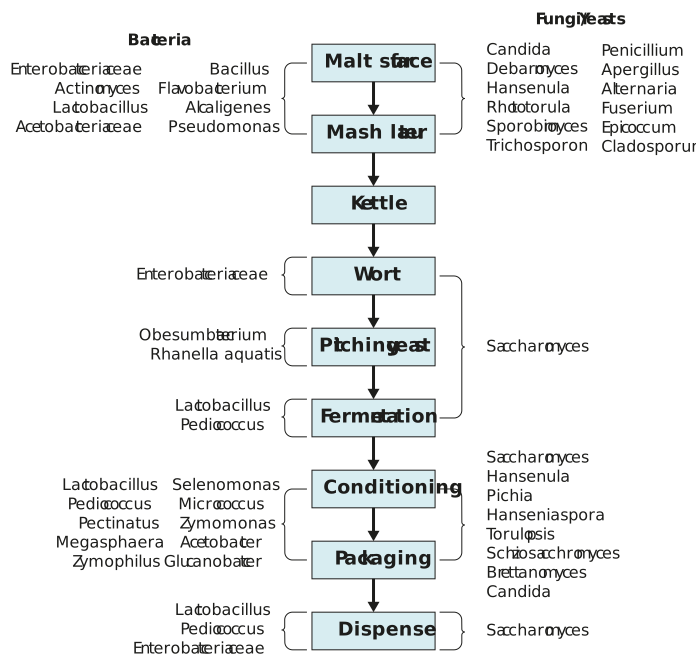
Figure: Microbial contaminants exposed to brewing raw material and beer at different stages
Raw Materials Contamination
Water
Water makes up over 90% of beer and is an often-neglected raw material. Brewing water should be microbiologically pure and conform to the standards set for public water supplies. The contamination of water is determined by screening for common intestinal bacteria, such as Escherichia coli. Presence of these bacteria indicates that faecal matter has entered the supply and that the water may be, or may become, contaminated with more dangerous organisms. It is imperative that we trace the source of the contamination and take remedial steps immediately.
It is also possible that the water may contain free-living coliforms such as the Klebsiella, Enterobacter, and Hafnia species which can develop in wort.
With an increased focus on water savings, an increased focus on water hygiene is also required. In particular, the presence of (biofilm-forming) Pseudomonas, (spore-forming) Bacillus, and (spore-forming) wild yeast can contribute to hygiene challenges. Appropriate water treatment and storage steps must be in place to secure site, product, and process water hygiene.
Malt
If malt is stored badly, with higher moisture, it can develop moulds such as Fusarium species. Although not contaminants of wort and beer, they can lead to spoilage of the final product through gushing (discussed in the Beer Properties lesson). Additionally, mycotoxins (e.g. aflatoxins, deoxynivalenol, ergotamine, and fumonisins), formed by mould growing on raw materials, are difficult to remove during the boiling process in brewhouses since they are generally heat-stable.
Adjuncts
These are derived from cereal grains and can have a variety of moulds growing on them if they were subject to wet weather before harvest.
Liquid adjuncts are generally stored warm, forming condensate which collects on the syrup surface, leading to butyric acid production from contaminating bacteria.
Hops
The microflora of stored hops has not been studied to any extent. Hops tend to be bacteriostatic but it is possible that storage under moist conditions could give rise to fungal growth which could have detrimental effects.