
Lesson 6 - Microorganism Detection and Control
This lesson covers the procedures available for detecting microorganisms in wort and beer. It compares traditional detection methods, which use solid and liquid media, with more modern, rapid methods. It then looks at microorganism entry points within the brewing process and discusses factors that inhibit or encourage their existence and proliferation.
Rapid Molecular Methods
These methods, once the realm of research institutes, are becoming available at the brewery level. The processing and measurement systems have been automated and packaged into easy-to-use kit form. This section describes some of these methods.
Hybridisation
In this test, a known organism has a single-strand segment of its DNA purified, to which a marker of a fluorescent molecule is attached. This is used to probe for complementary DNA extracted from a sample. If a match is found, the DNA or RNA will hybridise into a double-stranded complex, which is visualised using fluorescent microscopy.
In this way, we can detect microorganism-specific DNA sequences. A number of different DNA probes have been designed specifically in kit form for brewing spoilage organisms such as Lactobacillus, Pediococcus, Pectinatus, Megasphaera, and Saccharomyces wild yeast. The detection limit is between 1,000 and 10,000 cells/mL
RNA or ribonucleic acid is a single stranded nucleic acid polymer transcribed from DNA, whose function is to carry the blueprint of amino acid sequences for assembly of proteins in the ribosomes contained in the cell cytoplasm.
Ribotyping adopts the same protocol but using RNA instead of DNA. Automated methods have been developed for fastidious (difficult to grow due to their complex nutritional requirements) strains such as L. lindneri giving results in eight hours.
A more recent innovation, known as FISH (fluorescent in situ hybridisation), allows the fluorescent nucleic acid probe to bind to sequences within the cell, eliminating the need for extraction. This allows detection of 1,000 cells/mL, with specificity toward living cells, since RNA degrades upon cell death. The probes are viewed on a fluorescent microscope or flow cytometer.
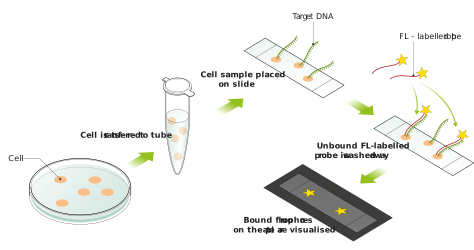
Figure: FISH principle of measurement
For more on FISH technology and its application in brewing visit https://www.vermicon.com/technology/vit-gene-probe-technology-overview/. (Note, this is for illustrative purposes only and is not a recommendation or endorsement of the supplier’s product.)
PCR (Polymerase Chain Reaction)
This technique uses a repeated heating and cooling cycle to amplify a DNA sequence, with the possibility of producing over a billion copies of a given sequence. Each cycle doubles the number of copies. To begin, DNA from the sample is thermally denatured, producing single strands. The DNA primers bind to the target microorganism’s complementary DNA, forming two strands. These are then sequentially amplified in a heating and cooling repeated cycle, using a heat-stable exogenous DNA polymerase, the enzyme responsible for DNA replication in the cell. The total time from DNA extraction to getting a result is five hours with 20-40 cycles being typical.
The DNA copies are then separated and categorised using gel electrophoresis. In an enhancement (Real-time RT-PCR), the products are analysed as they are produced, eliminating the electrophoresis step and producing a result in 0.5 to 2 hours. Microorganisms are detected and quantified through fluorescence or dyes. The quick turnaround enables brewers to make real-time decisions on beer processing rather than historical ones.
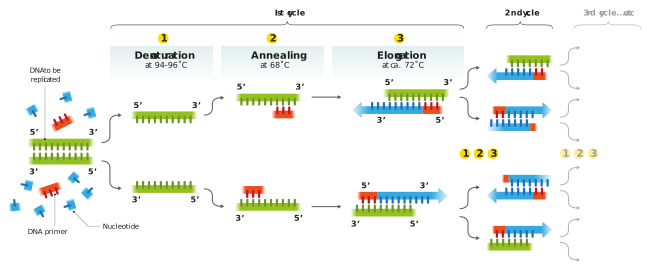
Figure: PCR thermal cycle for DNA replication
RT-PCR kits are now available for almost all beer-spoiling bacteria and yeasts at genus level. New kits have been developed to identify specific species, covering most of the beer spoilers, and the technology is ever more affordable. Major brewing companies as well as smaller craft breweries have already invested in PCR, creating competition amongst suppliers and, with that, affordability.
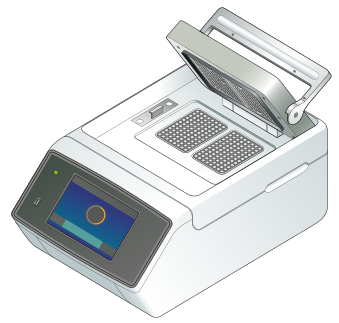
Figure: Modern desktop PCR analyser and tubes where reactions take place
Traditional methods are tried and trusted, but take time to get a result, with a minimum of three days for aerobic incubation and from seven to 14 days in the case of anaerobic incubation. Rapid methods such as PCR are becoming affordable and cut this time down to under three hours. Although the capital cost is expensive, the life cycle cost is attractive compared to traditional methods. This is particularly so if one considers the start-up cost of equipping and running a micro laboratory.