
Lesson 6 - Microorganism Detection and Control
This lesson covers the procedures available for detecting microorganisms in wort and beer. It compares traditional detection methods, which use solid and liquid media, with more modern, rapid methods. It then looks at microorganism entry points within the brewing process and discusses factors that inhibit or encourage their existence and proliferation.
Traditional Methods
Most breweries still use traditional methods, some of which have been used for a century or more. The aspects that these methods observe can be divided into three categories: morphological (microscopy), physiological criteria (selective staining), and biochemical (nutrient assimilation in liquid or solid media). In this section we explore how to take a sample of our product or surfaces, how to prepare the sample for analysis, and the traditional techniques that we can use to identify microorganisms. Before we move into sampling let us discuss a very practical method for testing microbiological stability of beer first introduced in the early 1870's, namely forcing tests.
Forcing tests
These tests involve samples of in process or packaged beer, which are 'forced' at elevated temperatures to encourage any beer spoiling microorganisms to grow in the beer, without enrichment. In traditional unfiltered and unpasteurised beers cycloheximide (actidione) can be added to prevent yeast growth.
The samples are incubated typically at 30°C for 4 days or longer and growth of beer spoilers determined by visual assessment of turbidity or spectrophotometric measurement at 660nm, as well as taste.
The forcing test has the advantage that it will mimic the consumer experience of the beer without the need for sophisticated laboratory equipment and media. It does take time to get a result however, and does not identify the microorganisms, but it is a method that could be applied to a small scale brewery operation.
A good recent description of this method adopted for draught beer can be found in this JIB paper: https://onlinelibrary.wiley.com/doi/full/10.1002/jib.470
For larger breweries a more common approach would be through traditional and rapid microbiological methods which we will now discuss.
Sampling
It is critical that any sample is taken aseptically, ensuring that its integrity is not compromised. This means that we need to steam, flame, or otherwise disinfect the sampling device to ensure its sterility. For example, you could swab its surface with alcohol-soaked cotton wool, and flush its interior with alcohol which is ignited during heating of the exterior with a butane torch. This practice tends to damage sample valve interiors so modern sample devices allow us to pass sterilant or steam through them for sterilisation. To make sure that we obtain a sample that is representative of the vessel (as opposed to liquid that may just be in the sample line), we run off a small amount of sample into a bucket first and then collect our sample in the sterile container. The volume of sample will depend on what is being sampled as well as on the volume of liquid being sampled. Waters and filtered beer will generally require larger sample volumes.
We can take samples from solid surfaces in the brewery using sterile cotton bud swabs which are then incubated in liquid media or streaked on solid media.
We can sample gas through a sterile saline solution which is then used for solid or liquid medium detection. Alternatively, we can filter the gas through a sterile membrane filter to concentrate potential contaminants.
Membrane filtration
Brewery samples, particularly where low concentrations of contaminants are expected, can be concentrated by filtering them through sterile membranes. We conduct this in the sterile environment of a laminar flow cabinet using a membrane filtration apparatus.
A laminar flow cabinet is a carefully enclosed bench designed to prevent contamination of biological samples. Air is drawn through a high efficiency particulate air (HEPA) filter and blown in a very smooth, laminar flow towards the user. Due to the direction of air flow, the sample is protected from the user and environment outside the cabinet.
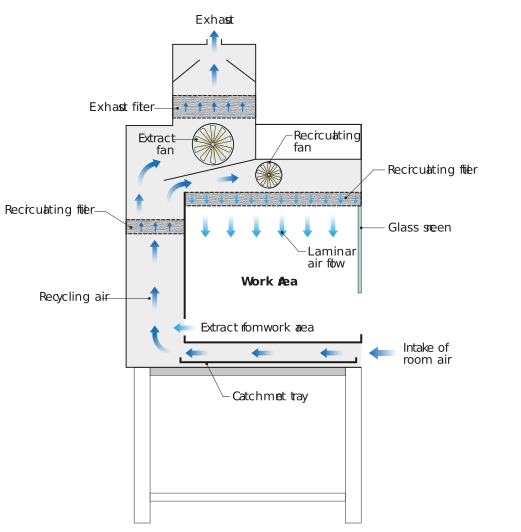
Figure: A laminar flow cabinet
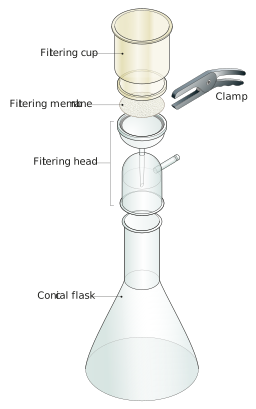
Figure: Example of a 250 mL membrane filtration apparatus
A vacuum on the filtering head draws the sample into the flask through the filtering cup. Membranes trap particles according to their pore size, often 0.25 μm or 0.45 μm, which allows brewery bacteria to be trapped. The membrane is then transferred onto solid media plates for incubation.
Usually, an amount of 250 mL of water or filtered beer is concentrated in this fashion. This enables us to report colony forming units (CFU) or cells per 250 mL, which is considered an appropriate scale for beer spoiling bacteria. The specification we need to meet is a no-tolerance 0 CFU/250 mL.
Microscopy
Many small breweries only use the light (optical) microscope for observing yeast cells and contaminating organisms. Yeast cells can be counted under a 400x magnification, whereas bacterial cells require 1,000x magnification. We obtain this with a 100x objective lens compounded with a 10x eyepiece lens. In this way, a bacterium of 1 μm would be magnified 1,000x to 1 mm under 1,000x power magnification. This is still very small but possible to see, especially when prepared with a stain.
Staining
Fluorescent dyes or stains can assist in detection and identification, together with cell morphology. We discussed the Gram stain in the previous lesson.
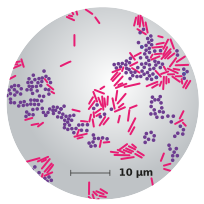
Figure: Photograph of Gram-positive lactobacilli under a light microscope
Microscopic examination will allow us to detect gross contamination of a sample, and will give us an idea of the organism (based on Gram stain, morphological shape, and clustering) but it generally will not enable us to identify the contaminant species. For that we need to go to biochemical tests.