
Lesson 6 - Microorganism Detection and Control
This lesson covers the procedures available for detecting microorganisms in wort and beer. It compares traditional detection methods, which use solid and liquid media, with more modern, rapid methods. It then looks at microorganism entry points within the brewing process and discusses factors that inhibit or encourage their existence and proliferation.
Rapid Physical Methods
These methods exploit the physical properties of a growing cell population, namely the cells ability to scatter light, hold an electric charge and form colonies on growth media.
Impedance/conductivity
This method allows us to measure the microbial density in a sample, by monitoring changes in the electrical conductivity in the growth medium. Capacitance – the ability to hold a charge – is determined by the cell density, and when a current is applied across the medium, the impedance (resistance to current flow between two electrodes) increases as a factor of the cell concentration. Regular measurements will produce a growth curve of the microorganism.
Turbidimetry
By measuring increase in turbidity with a spectrophotometer, we can infer growth rates of microbes (as shown in the figure below). If there are bacteria in the sample, the light captured will differ from the blank sample. Published methods exist for Lactobacillus and Pediococcus.
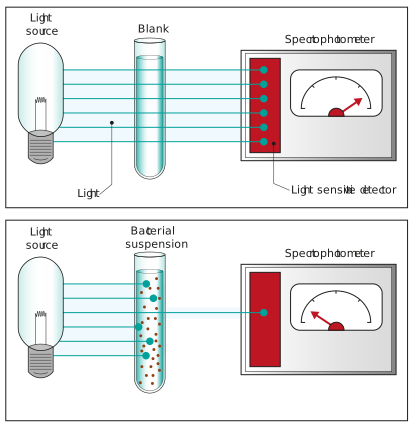
Figure: Turbidimetry to measure bacterial growth
Flow cytometry
We inject a sample containing cells into the instrument where they are forced one at a time through an orifice of 50-100 µm diameter where they are then detected by laser. The cells scatter light according to their shape, size, and surface morphology. Fluorescent dyes can be used to selectively stain mixed populations. Wort and beer contain particulate matter which may interfere with the analysis, but newer machines can screen these out. The sensitivity of analysis is a major advantage of this method.
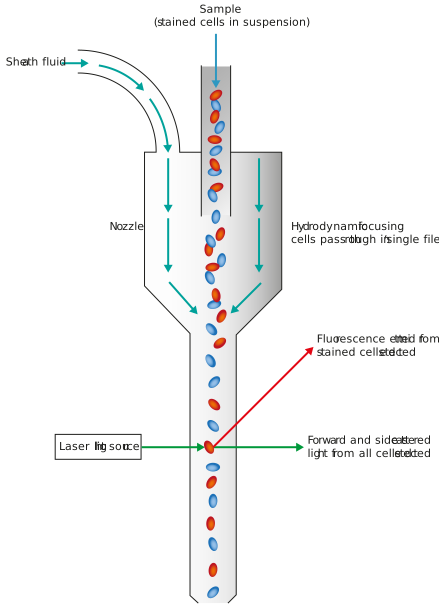
Figure: Flow cytometry
Microcolony method
We produce concentrated samples through membrane filtration and then incubate the filter on a solid media formulation containing fluorescent dyes. After 24 hours, the membrane is examined under the microscope, enabling identification and enumeration. This method will detect viable and viable but non-culturable (VBNC) cells, which can also be harvested for further classification. This provides a considerable time saving over conventional solid media methods, and both wild yeasts and beer spoilage bacteria can be identified. However, this method does not identify whether actual beer spoilage will occur, although it is useful when low counts of contaminants are present in the sample.
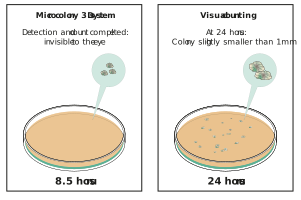
Figure: Microcolony detection