
Lesson 6 - Microorganism Detection and Control
This lesson covers the procedures available for detecting microorganisms in wort and beer. It compares traditional detection methods, which use solid and liquid media, with more modern, rapid methods. It then looks at microorganism entry points within the brewing process and discusses factors that inhibit or encourage their existence and proliferation.
Biochemical – Culture Media
Culture media contains nutrients and physical growth factors necessary for microbial growth. This section begins by looking at the consistency, composition, and purpose of this culture media.
Media consistency
Solid media contain gelling agents, typically agar, which is a mixture of agarose polysaccharide and agaropectin, derived from red seaweed. Agar is typically incorporated into media at 1-1.5% and it solidifies the media on a petri dish. This solid media is particularly good for isolating microorganisms and observing colony morphology. We can introduce the organisms onto the plate by streaking colonies (grown on a separate plate) with a tungsten wire loop/sterile plastic inoculation loop or, in the spread-plate method, by spreading a 0.1 mL liquid sample with a sterilised bent glass rod (hockey stick).
An alternative, pour-plate method is employed for larger samples of 1 mL. We pipette the sample onto the plate and then mix warm agar with it before allowing it to set.
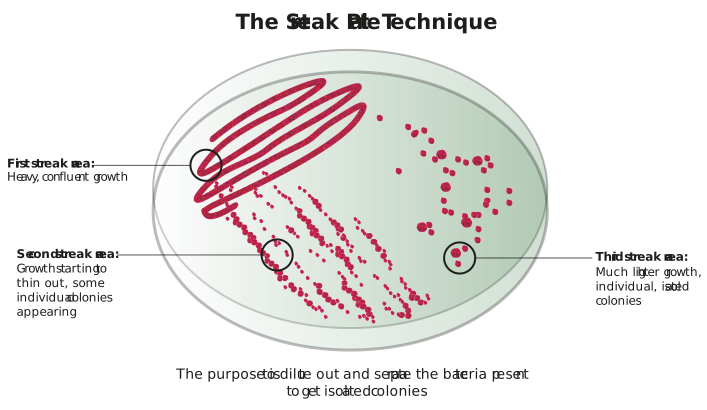
Figure: Streaking to obtain isolated colonies
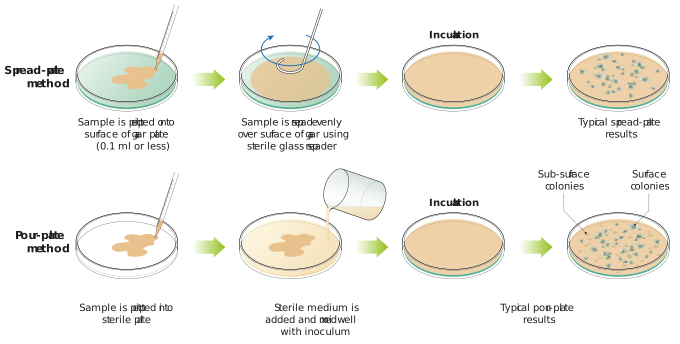
Figure: Spread plate and pour plate methods
Liquid media or broths are good for detecting growth and propagating microorganisms. We can use them, together with dyes, in fermentability tests, to measure pH change and to observe gas formation.
Semi-solid media contain agar of 0.5% or less and are useful for determining motility. Motility is seen in bacteria with flagella, which are whip-like appendages that enable them to move.
To detect anaerobic bacteria, we need to incubate the media in an oxygen-free environment. The most common method is a sealed jar from which oxygen is removed. We use a packet containing sodium borohydride and sodium bicarbonate to prepare anaerobic jars. The chemicals generate hydrogen and carbon dioxide (CO2) inside the jar when water is added. Hydrogen combines with oxygen in the presence of a catalyst (alumina pellets coated with palladium) that are present under the surface of the lid of the jar. Alternatively, more modern developments allow for the use of sachets of different sizes, filled with an oxygen-binding reagent mixture which also produces carbon dioxide to be used in anaerobic, clip-lock jars.
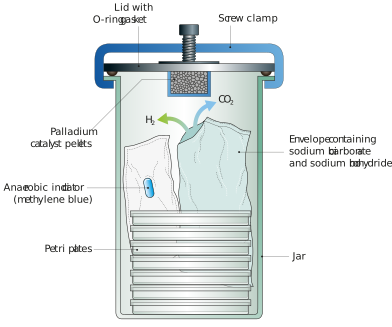
Figure: Anaerobic incubation jar
Media composition
There are two types of media composition: synthetic/defined and non-synthetic/undefined.
Synthetic media have a precise, known makeup whilst undefined media have at least one unquantified component and may not be exactly the same makeup from batch to batch. In the brewing environment, wort-containing media such as wort agar are a good example. A complex synthetic media may be capable of growing one type of contaminant only. An undefined medium could be used to enrich the growth of an isolated contaminant.
Media purpose
We can classify media according to their application.
General purpose, or basal, media support the growth of many microorganisms and are used for primary isolation. These are usually liquid media.
Selective and enrichment media are designed to inhibit unwanted contaminants from growing. This is important for when we want to select a specific type of bacteria, like lactic acid bacteria, from a general population of bacteria. A general purpose medium can be made selective through the addition of antibiotics, chemicals, dyes, pH change, or a combination of these. Solid media are referred to as selective in this context and enrichment media are liquid media.
Let us consider the application of selective and enrichment media in the context of the brewing environment. Which organism do we often want to inhibit from fermenter samples?
Give yourself 5-10 minutes to think about this, and then click ‘Next’ to continue with this lesson.