
Lesson 4 - Types of Microorganisms
In this lesson we cover organisms that occur in beer besides pitching yeast. Firstly, we look at speciality organisms involved in making traditional Belgian and wild beer styles. We then cover the spoilage bacteria, classified as Gram-positive and Gram-negative. Finally, we cover the wild yeasts as contaminants of beer processing and finished product.
Wild Yeast
Any yeast not intentionally introduced by the brewer can be considered a wild yeast (the term is not used in the sense of uncontrolled or extreme). Often, wild yeasts in beer do not produce any noticeable effects, but others necessitate product destruction. We now consider the main wild yeast contaminants, divided into Saccharomyces and non-Saccharomyces strains.
Saccharomyces wild yeast
The leading form of wild yeasts in beer are those of the Saccharomyces genus. The classic wild yeast flavour produced is that of the phenol 4-vinylguiacol or 4VG – the spicy, clove-like flavour present in German weissbiers and some Belgian styles. These Saccharomyces cerevisiae strains have the phenolic off flavour (POF1) gene and produce the enzyme ferulic acid decarboxylase which forms 4VG from the malt derived phenol ferulic acid and 4-vinylphenol from p-coumaric acid. Styrene, with its sweet plastics flavour, is also formed from cinnamic acid. Whilst the phenolics are highly desirable flavour markers in weissbiers, they would be considered unacceptable in most beer styles.
S. cerevisiae var. diastaticus is a wild yeast that can utilise dextrins as an energy source, by virtue of possessing the glucoamylase gene. Glucoamylase, otherwise called amyloglucosidase or AMG, attacks dextrins, producing simpler sugars that are fermented, causing super attenuation of the wort. In unpasteurised bottled beers S. diastaticus can induce burst bottles, due to CO2 pressure build up.
Non-Saccharomyces wild yeast
The non-Saccharomyces group contains different genera such as Brettanomyces, Candida, Debaryomyces, Filobasidium, Hanseniaspora, Kluyveromyces, Pichia, Torulaspora, and Zygosaccharomyces.
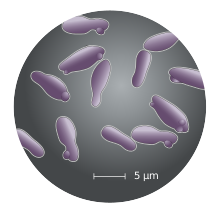
Figure: Brettanomyces yeast showing bud scars
Other non-Saccharomyces yeasts can grow in beer but are less likely to spoil beer due to low oxygen levels, high ethanol content, and competition with brewing yeast. When beer spoilage occurs, it is because of more favourable conditions, such as in barrel-aged beers where oxygen ingress is possible through wood or underfilling. Most of these yeasts produce organic acids and phenolic off flavours, pellicles on the beer surface in the presence of oxygen, and haze or sediment.
The beer spoilage microorganisms reported, and their area of contamination are shown below.
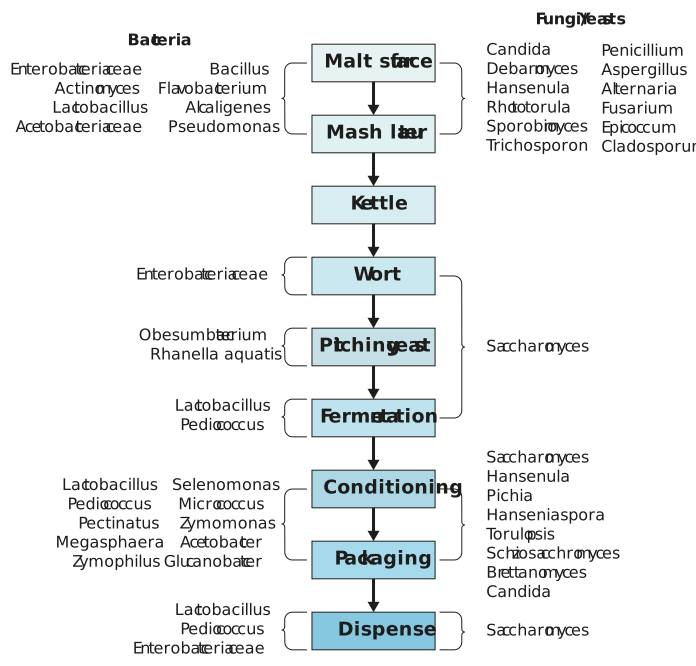
Figure: Microbial contaminants exposed to brewing raw material and beer at different stages