
Lesson 4 - Types of Microorganisms
In this lesson we cover organisms that occur in beer besides pitching yeast. Firstly, we look at speciality organisms involved in making traditional Belgian and wild beer styles. We then cover the spoilage bacteria, classified as Gram-positive and Gram-negative. Finally, we cover the wild yeasts as contaminants of beer processing and finished product.
Gram-positive Bacteria
The Gram-positive lactic acid bacteria (LAB) comprise rods (Lactobacillus spp) as well as cocci (Pediococcus spp). Although they are used in the production of certain beer styles mentioned previously, they are considered beer spoilers for the majority of beer styles.
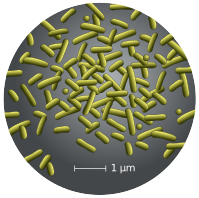
Figure: Lactobacillus
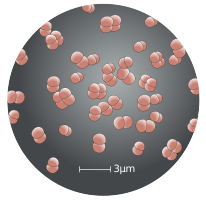
Figure: Pediococcus
The hop acids, particularly iso-α-acids, are inhibitory to most Gram-positive species, by virtue of their ability to act as ionophores. The iso-α-acids enter the cell carrying H+ ions (protons). Once inside, the hop acid dissociates from the protons increasing the intracellular concentration of protons and so lowering pH. This drop in pH disrupts many essential cellular functions including nutrient uptake. When hop acids give up the proton, they pick up a divalent cation and remove this from the cell. The LAB are hop resistant because they carry the hit A gene and a plasmid-borne gene named hor A. hor A enables them to pump the iso-α-acid and attached proton out of the cell. hit A acts as a transporter bringing divalent ions into the cell counteracting the excretory effect of the iso-α-acids. Many also have the ability to pump any accumulated protons out of the cell. The figure below shows the metabolic activity of hop sensitive and hop resistant bacterial cells.
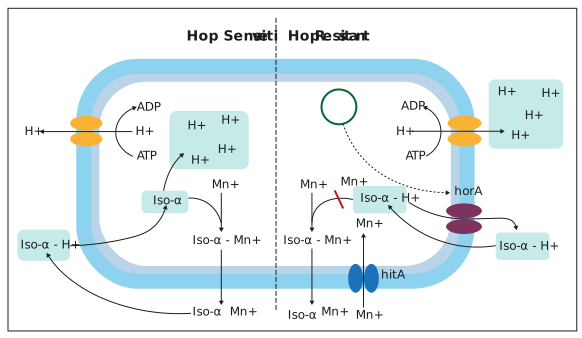
Figure: Model of hop resistance in Gram-positive bacteria carrying the hor A gene
Lactobacillus
The Lactobacillus genus is a large one with over 200 different species identified. Many of these inhabit the human alimentary tract and are the ‘good’ gut bacteria. They are well known for their role in fermented and dairy products and in addition constitute the majority of probiotics commercially available today.
Probiotics are live microorganisms intended to provide health benefits when consumed, generally by improving or restoring the gut flora.
Lactobacillus species can be divided into three groups:
- Obligately anaerobic homofermentative (Group I)
(including: L. acidophilus, L. delbrueckii, L. helveticus, and L. salivarius)
- Facultatively anaerobic heterofermentative (Group II)
(including: L. casei, L. curvatus, L. plantarum and L. sakei)
- Obligately anaerobic heterofermentative (Group III)
(including: L. brevis, L. buchneri, L. fermentum and L. reuteri)
Obligates are organisms that can grow only in either air (aerobes) or the absence of air (anaerobes). A facultative organism can make energy from oxygen-based aerobic respiration or anaerobic respiration (fermentation), in the absence of oxygen. In general, aerobes possess the enzyme catalase, which can break down hydrogen peroxide, a reactive form of oxygen.
Homofermentative LAB ferment glucose and make only lactic acid as a product whereas heterofermentative LAB ferment glucose with lactic acid, ethanol, acetic acid, and carbon dioxide ( ) as by-products.
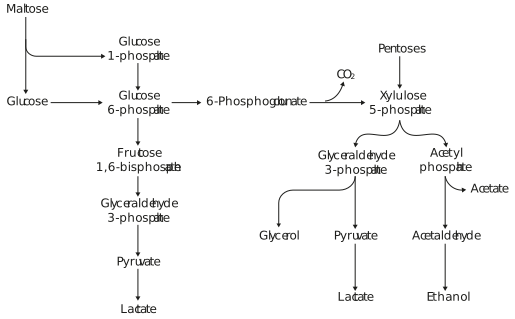
Figure: Homofermentative and heterofermentative pathways in LAB
Of the 200 or so Lactobacillus species, only a very small sub-set of them are active in beer spoilage. The species L. backii, L. brevis, L. casei, L. lindneri, and L. plantarum can contaminate average hopped beers (18 IBU+). In lower hopped beers, such as Wheat beer or Kolsch styles, L. collinoides, L. coryniformis, L. parabuchneri (‘frigidus’), and L. perolens have been detected and reliably identified. The two species L. acetotolerans and L. paucivorans have been detected in isolated incidences. LAB spoil beer by producing lactic acid which causes sourness. Acetic acid and glycerol can also be produced from heterofermenters, as shown in the figure above. Some species can form silkiness and ropiness in beer, causing turbidity, from an extracellular polysaccharide produced by the cells. Others can cause over attenuation by consuming sugars that are not fermentable by brewing yeast (such as maltotetrose and dextrins).
Lactobacillus brevis is the most important LAB involved with beer spoilage, accounting for 50% of all beer spoilage incidents. Many strains of L. brevis have been isolated and show different phenotype characteristics. The cells exhibit considerable pleomorphism (different shapes), forming long rod-shaped structures which can be up to 100 µm long.
They grow fastest at 30 °C and between pH 4 and 5. The strains that occur in the brewery environment that have developed hop resistance are typically sensitive to ethanol at around 5%. Besides producing lactic acid, L. brevis is known to produce glycerol, ethanol, and acetic acid in contaminated beer.
L.brevis var. diastaticus can utilise dextrin as a growth source, causing super attenuation of wort during fermentation.
L. lindneri is the second most active Lactobacillus in beer spoiling and was involved in 25% of German beer spoilage incidents in a decade-long study. It has a lower optimal growth temperature of 19 °C and causes the same defects as L. brevis, namely acid and turbidity. It is, however, more resistant to higher pasteurisation temperature as well as bitterness levels up to 25-35 IBU. It is small enough to escape through filtration, and it grows prolifically in beer but slowly on detection media. It should therefore be treated as a serious beer spoiler.
Pediococcus
The second group of the Gram-positive LAB is the Pediococcus species, often observed under the microscope as groups of four or tetrads. Pediococci are commonly found in wort and at the end of fermentation. The hop resistant species P. damnosus is responsible for 90% of all Pediococcal beer spoilage; it produces large amounts of diacetyl in beer, with an accompanying reduction in the fermentability of brewing yeasts. Extracellular polysaccharide slimes are also produced, resulting in rope formation in some cases. As with lactobacilli, lactic acid is produced, although the main spoilage effect is production of diacetyl.
Other Pediococci of importance to beer spoilage are Pediococcus inopinatus, P. dextrinicus, P. pentosaceous, P. parvulus, and P. claussenii. Of these, P. inopinatus and P. dextrinicus are both able to multiply in beer that contains low levels of ethanol and hop components at pH values above 4.2.
Other Gram-positive bacteria
Kocuria (formally named Micrococcus) are another member of the Gram-positive bacteria that are potential beer spoilers. Kocuria kristinae, a facultative anaerobe, is commonly found in wort but its role as a spoilage organism is low due to its sensitivity to hop acids, ethanol, and pH.
Bacillus species are often found in brewery water but are not considered beer spoilers due to sensitivity to hop acids. However, four species isolated from spoiled homebrew were found to contain the hor A gene. They are not known to exist in commercial breweries but the spores of Bacillus can survive pasteurisation of the final product.