
Lesson 4 - Types of Microorganisms
In this lesson we cover organisms that occur in beer besides pitching yeast. Firstly, we look at speciality organisms involved in making traditional Belgian and wild beer styles. We then cover the spoilage bacteria, classified as Gram-positive and Gram-negative. Finally, we cover the wild yeasts as contaminants of beer processing and finished product.
Speciality Microorganisms
The speciality microorganisms used by breweries are mainly Gram-positive bacteria and wild, or non-Saccharomyces, yeasts such as the Brettanomyces (British fungus) species. We can use them to ferment and sour beer and create unusual flavours which originate from phenols and isovaleric acid, the same cheesy/sweaty flavour noted in old hops.
Gram staining is a common technique used to differentiate two large groups of bacteria – Gram-positive and Gram-negative – based on their different cell wall constituents. In this procedure, a crystal violet stain colours Gram-positive cells violet. After washing and counterstaining, Gram-negative cells show up as red. The effect of this procedure can be seen in the figure below.
The Gram stain procedure is named after Danish bacteriologist Hans Christian Gram, who developed the technique in 1884.
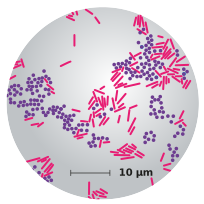
Figure: Gram stain of a mixed bacterial population showing Gram-positive cocci and Gram-negative rods
We now look at the bacterial and yeast microorganisms that we can use to produce these unique beers.
Lactic acid bacteria
This class of Gram-positive, acid-producing bacteria includes those of the genera Lactobacillus, which are rod-shaped bacilli, and Pediococcus, which are spherical cocci. Commercially, they are often sold as a mixed culture, although they can be supplied separately. Some of the strains available and their uses are:
- L. paracollinoides (L. pastorianus) – secondary fermentation
- L. brevis – traditional (pitched with yeast) or kettle souring
- L buchneri – kettle souring or secondary fermentation
- L. delbrueckii – Used for sour ales and Berliner weiss
- L. plantarum – Mash or kettle souring
- P. damnosus – Secondary fermentation diacetyl and souring
Kettle souring refers to the practice where the wort is boiled without hops for a few minutes then cooled to a temperature where the introduced bacteria will grow, typically 25-45 °C, either in the kettle or in a fermenter. Bacteria are introduced and, once soured, the wort is returned to the kettle and boiled normally with hop addition; after this, cooling and yeast pitching continue as normal.
Mash souring takes place after the saccharification process in the mash vessel is complete. The mash is cooled to around 50 °C and souring bacteria introduced. The duration needed to sour the mash varies from 12 hours to 3 days, after which the mash is processed as normal.
Secondary fermentation is a process of yeast fermentation after the initial primary fermentation is completed, often used to bring beer into 'condition' where residual unwanted fermentation compounds such as diacetyl and acetaldehyde are reduced, and CO2 produced through attenuation of residual fermentable sugar left after primary fermentation.
Secondary fermentation can be practiced in maturation vessel or final package such as in cask or bottle in the case of bottle conditioned beers.
Wild yeasts
Wild yeasts can be classified as yeasts that are not deliberately used in the brewery as pitching yeast strains and they are usually derived from the environment. It is important to note that yeast may be classified as a wild (non-pitching) yeast in one brand but may be the pitching yeast in another brand in the same brewery.
These yeasts may belong to the genus Saccharomyces or other genera, in which case they are termed non-Saccharomyces wild yeasts. Many wild yeast strains are available commercially, the following are a selection:
Torulaspora delbrueckii – A high ester producer used in mixed culture fermentations. Can only ferment sucrose, fructose and glucose so can be used to make low alcohol beers.
Brettanomyces anomalus – Produces typical farmyard flavours and less sourness than other species.
Brettanomyces bruxellensis, which includes B. lambicus – Produces farmyard aroma. Traditionally found in Lambics and in secondary fermentation of Flanders red and brown ales. But now used by brewers making sour beer.
Saccharomycodes ludwigii - Like Torulaspora delbrueckii this yeast can only ferment sucrose, glucose and fructose so can be used in low alcohol beers. Some strains produce high levels of esters especially ethyl acetate.
Saccharomyces cerevisiae var. diastaticus – This can hydrolyse and then ferment wort dextrins. It can be used to produce Brut IPAs or low carbohydrate beers.