
Lesson 4 - Types of Microorganisms
In this lesson we cover organisms that occur in beer besides pitching yeast. Firstly, we look at speciality organisms involved in making traditional Belgian and wild beer styles. We then cover the spoilage bacteria, classified as Gram-positive and Gram-negative. Finally, we cover the wild yeasts as contaminants of beer processing and finished product.
Gram-negative Bacteria
The Gram-negative bacteria exhibit a different membrane structure to Gram-positive species and are not sensitive to hop acids. Fortunately, only a few of these bacteria have been found to spoil beer.
They can be separated into two categories:
- Aerobic and facultative anaerobic beer spoilers, such as acetic acid bacteria, Zymomonas and certain Enterobacteriaceae species.
- Anaerobic beer spoilers belonging to the genera Pectinatus, Megasphaera, Zymophilus, Selenomonas, and Propionispora.
Of the Gram-negatives, the anaerobes Pectinatus and Megasphaera are the most important beer spoilers. We look at these at the end of this section, but we begin by exploring some of the aerobic and facultative anaerobic species.
Acetic acid bacteria (AAB)
This group comprises the brewery isolated Acetobacter and Gluconobacter genera. They are characterised by their ability to oxidise ethanol to acetic acid. Gluconobacter is exploited commercially for vinegar production.
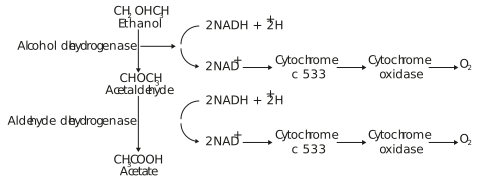
Figure: Oxidation of ethanol to acetic acid by AAB
AAB are obligate aerobes, ellipsoidal to rod-shaped cells of up to 4 μm long. They occur in pairs or chains. Some are motile, with flagella. They form pellicles (films) on beer that contains oxygen and produce haze, and they oxidise ethanol to acetic acid (vinegar) and finally, in the case of Acetobacter, to water and CO2.
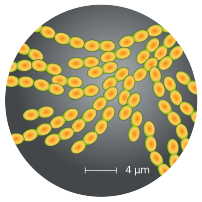
Figure: Illustration of AAB showing chains
AAB occur throughout the brewing process where oxygen is available. They are very tolerant of hop acids and can survive in beer containing up to 10% ethanol.
In the past, AAB were a big risk to beer, as packaging dissolved-oxygen levels were much higher than the sub 50 μg/L that exists today. In barrel aged beer they can be widespread, however.
There have been 10 species of Acetobacter found in breweries, with A. aceti, A. liqueficiens, A. pastorianus, and A. hansii the most prevalent. For the genus Gluconobacter only one species is associated with brewery contaminants, namely G. oxydans.
G. oxydans can metabolise simple sugars rapidly and form ropiness in beer. It produces acetic acid from oxidation of ethanol but is unable to oxidise it further.
The AAB are common contaminants of draught dispense lines, where oxygen is abundant. They can be spread by the fruit fly Drosophila.
Zymomonas
Zymomonas are short, fat rods occurring singly or in pairs. They tolerate oxygen and are facultatively anaerobic in nature. They can tolerate ethanol up to 10% and grow optimally at 25-30 °C. They can use glucose and fructose as sugar sources, but not maltose or higher dextrins. This makes primed beers a risk for contamination.
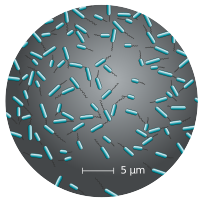
Figure: Illustration of Z. mobilis
Lager beer is not susceptible to Zymomonas contamination but cask ales, with their priming and warmer storage conditions, can be contaminated.
The metabolic products of Zymomonas include ethanol, acetaldehyde, and hydrogen sulphide, which together contribute a ‘rotten apple’ off flavour. Haze and ropiness are prevalent.
Only one species, Z. mobilis, has been isolated in breweries. This has three sub-species, with sub-species Z. mobilis spp mobilis being classified as a beer spoiler.
Enterobacteriaceae
Enterobacteriaceae are a large group of facultatively anaerobic bacteria. The beer spoiling members of the group are Enterobacter, Klebsiella, Escherichia, Obesumbacterium, and certain strains of Citrobacter. They are termed coliforms as they are related to the gut inhabitant E. coli; however, none of them are pathogenic.
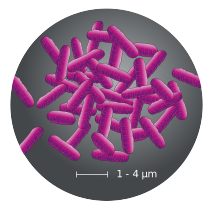
Figure: Illustration of Enterobacteriaceae
They are all hop tolerant and can ferment a range of wort sugars, but cannot use ethanol. They are inhibited by ethanol and beer pH, so are primarily wort spoilage bacteria. They enter the process through poor hygiene practices and contaminated water and are seen as hygiene marker organisms.
Obesumbacterium proteus
These short rods are aerobic or facultatively aerobic. They have been widely studied as they pose the biggest health threat of Gram-negative bacteria, due to their ability to reduce nitrate to nitrite in wort. Nitrite is a precursor, together with wort amines, for formation of nitrosamines. These compounds are known carcinogens. Levels of these N-nitroso compounds (ATNC) in beer must be controlled at <20 μg/L.
O. proteus is commonly found in cropped ale yeast; successive repitching can concentrate their levels to those that can compete with yeast for nutrients, forming a host of products with the sweetcorn-like DMS being prominent. They can survive to below pH 3.9 but are less tolerant than brewing yeast to acidic conditions and can be eliminated by acid washing at low pH.
Enterobacter (Rahnella)
These are short squat rods of up to 4 μm. They have been reported in unfermented and fermenting worts. R. aqualis can survive through fermentation and be cropped with yeast. It can thus be termed a potential beer spoiler. It produces DMS, acetaldehyde, methyl acetate, and diacetyl.
Other brewery related coliforms
Citrobacter freundii is a motile, facultative-anaerobe short rod occurring singly and in pairs. It is inhibited by ethanol and thus only occurs during early stages of fermentation. Diacetyl, DMS, acetaldehyde, and lactic acid are fermentation products.
Klebsiella terrigena and K. oxytoca have been reported in brewery environments. Klebsiella species are straight, non-motile rods. They can produce 4-vinylguiacol phenolic off flavours from malt-derived ferulic acid, similar to some wild yeasts. K. terrigena also produces high concentrations of acetoin and 2,3-butanediol from α-acetolactate.
Now let us consider the second class of Gram-negative bacteria, namely the anaerobic bacteria. With a reduction of oxygen in beer following improvements in technology, these bacteria have emerged as a new challenge for brewers.
Pectinatus
These Gram-negative, slender-shaped rods are tolerant of hop resins and ethanol and are obligate anaerobes. There are three brewery species, namely P. cerevisiiphilus, P. frisingensis, and P. haikarae.
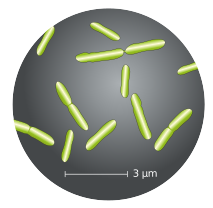
Figure: P. frisingensis
The Pectinatus species have been found in diverse brewery environments, from bottling plants to wastewater treatment. They can survive in an aerobic environment and grow in biofilms together with other bacteria. Optimal growth is reported at 30-32 oC. They can tolerate ranges of pH 3.5 to 8.0 and ethanol 3.7% to 4.4%.
Their requirement for an anaerobic environment means that their presence in beer production is limited to contamination of final beer. They produce unpleasant sulphur compounds such as hydrogen sulphide, DMS, methyl mercaptan, and various fatty acids. Their rapid growth, reported in unpasteurised and lower ethanol beers, results in turbidity spoilage as well as flavour spoilage.
Megasphaera
Within the Megasphaera genus there are three brewery-associated species. Megasphaera cerevisiae species are cocci that spoil low ethanol beer. These were reported to account for approximately 5% of European beer spoilage over a 22-year period to 2002, primarily in low ethanol unpasteurised beer. Effects include turbidity and odour due to sulphide and short-chain fatty acid production, such as butyric acid, with its classic baby vomit aroma.
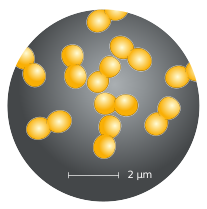
Figure: M. cerevisiae
The other two species involved with beer spoilage are M. paucivorans and M. sueciensis.
Megasphaera grow between 15 °C and 37 °C with growth inhibited at 4.2% ethanol and pH below 4.3.
The rise of contaminations from the Gram-negative anaerobes in recent years is due to the improvements in oxygen control in the brewing process, as well as a trend towards unpasteurised beers.
There are a number of Gram-negative bacteria that can spoil or potentially spoil beer but, with improved hygiene control, the aerobic AAB Acetobacter and Gluconobacter are now more of a risk for draught beer dispense lines.
Zymomonas contamination is still found in traditional primed cask conditioned ales.
Enterobacteriaceae found in the brewery are primarily wort contamination organisms and serve as hygiene-programme effectiveness indicator microorganisms.
The obligate anaerobes Pectinatus and Megasphaera have become more prevalent spoilage organisms as dissolved oxygen control has improved and unpasteurised beer has become more popular. They can survive modern cleaning protocols in biofilms and gain access through the filling process; as such, they should be considered the most dangerous of Gram-negative spoilers.
A review of the four main beer spoilage bacteria – Lactobacillus, Pediococcus, Pectinatus, and Megasphaera – can be found here:
https://onlinelibrary.wiley.com/doi/epdf/10.1002/j.2050-0416.2011.tb00454.x
Before we leave brewery bacteria, let us summarise key points of the main species in tabular form:
Table: Summary of brewery bacteria
|
Group |
Microorganism |
Typical species |
Morphology |
Cells association |
Gram stain |
Oxygen requirement |
Catalase |
Occurrence |
Metabolic requirement |
Metabolic products |
Effect on beer |
|
Lactic acid bacteria |
Lactobacillus |
L. brevis |
Slender rods |
Long chains |
Positive |
Anaerobic |
Negative |
wort, fermentation, package |
Sugars |
lactic acid (homofermentative), Lactic acid, acetic acid ethanol (Heterofermentative) |
Sourness, turbidity, ropiness |
|
Lactic acid bacteria |
Pediococcus |
P. damnosis |
Cocci |
Pairs, tetrads |
Positive |
Anaerobic |
Negative |
wort, fermentation, package |
Sugars |
Lactic acid, diacetyl |
slime, turbidity, sourness, buttery |
|
Acetic acid bacteria |
Acetobacter |
A. acetis |
Curved or straight rods |
Pairs, chains |
Negative |
Aerobic |
Positive |
Wort, dispense, cask beers |
Sugars, ethanol |
Acetic acid |
Sourness, Vinegary aroma, ropiness |
|
Acetic acid bacteria |
Gluconobacter |
G. oxydans |
Curved or straight rods |
Pairs, chains |
Negative |
Aerobic |
Positive |
Wort, dispense, cask beers |
Sugars, ethanol |
Acetic acid |
Sourness, Vinegary aroma |
|
|
Zymomonas |
Z. mobilis |
Short fat rods |
Single, pairs |
Negative |
Anaerobic |
Positive |
Primed beer |
Glucose, fructose |
Hydrogen sulphide, acetaldehyde |
Fruity, rotten apple flavour, turbidity, ropiness |
|
Enterobacteriaceae |
Enterobacter |
R. aquatilis |
Squat rods |
|
Negative |
Facultative anaerobes |
Positive |
Pitching yeast, early fermentation |
Sugars |
Diacetyl, DMS, acetaldehyde, lactic acid, esters |
Sulphury, fruity |
|
Enterobacteriaceae |
Obesumbacterium |
O. Proteus |
Short fat rods |
|
Negative |
Facultative anaerobes |
Positive |
pitching yeast, early fermentation |
|
DMS, diacetyl, higher ethanols |
Turbidity, Parsnip, Reduce nitrate to nitrite |
|
Enterobacteriaceae |
Citrobacter |
C. freundii |
Slender rods |
Single, pairs |
Negative |
Facultative anaerobes |
Positive |
Brewing water, early fermentation |
Glucose |
DMS, diacetyl, lactic acid, acetaldehyde |
Parsnip, sulphury |
|
Enterobacteriaceae |
Klebsiella |
K. terrigena |
Slender rods |
single, short chains |
Negative |
Facultative anaerobes |
Positive |
Fermenting wort |
Glucose |
4-VG, diacetyl, DMS |
Unpleasant odour |
|
Obligate anaerobes |
Pectinatus |
P. cerevisiiphilus |
Slender rods |
chains |
Intermediate |
Obligately anaerobic |
Negative |
Packaged unpasteurised beer |
Sugars |
acetic and propionic acids, sulphur compounds, lactic acid |
rotten egg, sour, turbidity |
|
Obligate anaerobes |
Megasphaera |
M. cerevisiae |
Cocci |
Single, short chains |
Intermediate |
Obligately anaerobic |
Negative |
Low ethanol unpasteurised beer |
Sugars |
H2S, butyric, isovaleric, caproic, and caprylic acids |
Putrid aroma and taste, turbidity |
There are niches that microorganisms can exploit to survive and thrive in the diverse brewery environments and operations that exist today, from small traditional processes to state of the art mega brewery production. How can microorganisms exploit these differences?
Give yourself 5-10 minutes to think about this, and then click ‘Next’ to continue with this lesson.