
Lesson 2 - Beer Foam
In this lesson we will discuss the physics and mechanics of foam formation and collapse, along with the chemistry of the compounds involved with beer foam.
Foam is affected by the brewing of raw materials and by wort and beer processing within and outside the brewery. The measuring of foam will be discussed and we will end the lesson by looking at gushing.
Nibem Foam Stability Measurement
The Nibem method is the only method approved by the ASBC, EBC and IoB. The meter was developed by the Dutch company, Haffmans (now part of Pentair), in the 1970s, and has seen certain enhancements since then. The latest model, Nibem TPH, measures foam temperature, ambient pressure and humidity to calculate a compensated result.
Beer is sampled from a piercing sampling device through the can or bottle crown. CO2 gas is introduced to push beer through to a flashing device which is depressed over a glass cuvette to generate a reproducible foam.
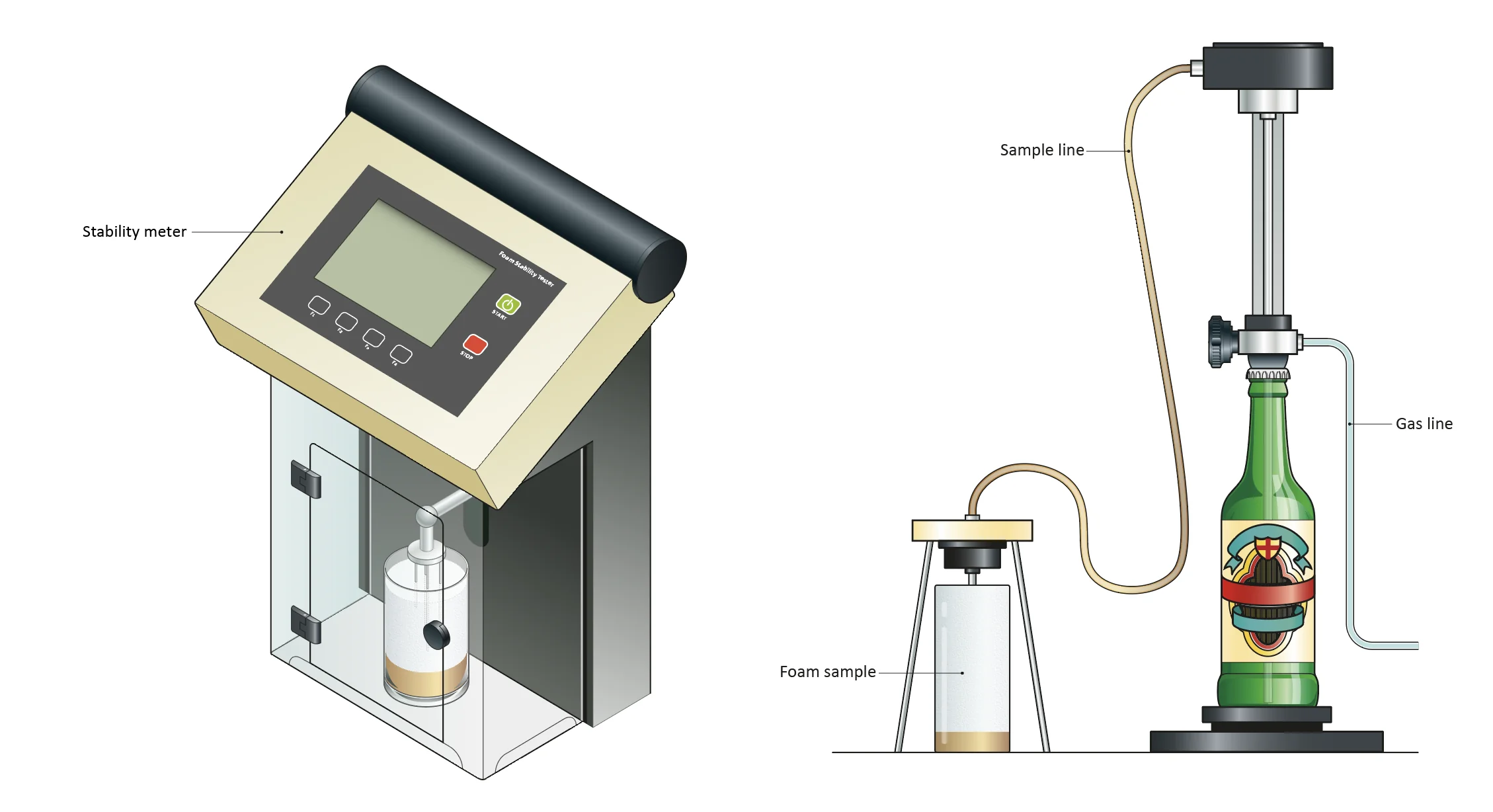
Figure: Nibem foam – sampling, foam flashing and measurement
The cuvette is placed in the meter which houses a movable plate with a central pointed electrode and four shorter ones around it. The conductivity probes lower to where they touch the foam surface, shutting off the servo motor. As the foam collapses, conductivity is lost, which starts the motor again. The probes drop again to keep contact with the foam surface, and time is recorded in seconds over 10 mm, 20 mm and 30 mm drop distance. Typically, the 30 mm result is referred to as the Nibem Foam Stability (NFS). A Nibem foam of < 200 seconds would be considered poor and > 250 seconds good.
The same limitations discussed earlier apply to the Nibem too, in that foam is artificially flashed. However, the sample is not degassed, and reproducibility is good. It provides an objective foam measurement and has become the industry standard for foam measurement.