
Lesson 2 - Beer Foam
In this lesson we will discuss the physics and mechanics of foam formation and collapse, along with the chemistry of the compounds involved with beer foam.
Foam is affected by the brewing of raw materials and by wort and beer processing within and outside the brewery. The measuring of foam will be discussed and we will end the lesson by looking at gushing.
Chemistry of Beer Foam
Let us now consider the main molecular components of beer that affect beer foam. This will cover substances ranging from barley proteins to hop acids and metal ions. In the coming sections, we will discuss the origins of these compounds from raw materials, and the influences that processing has on their levels in finished beer.
Proteins
Specific proteins from barley contribute to foam stability by associating with the bubble walls and lowering surface tension.
Surface tension is the tendency of fluid surfaces to shrink into the minimum surface area possible. It is responsible for the shape of liquid droplets. Although easily deformed, droplets of water tend to be pulled into a spherical shape because of the imbalance in cohesive forces of the surface layer. Surface tension also tries to pull the water surrounding the bubble, back to the body of water. This is offset by using compounds that surround and penetrate the bubble walls.
These proteins are surfactants or surface-active agents, which are amphiphilic compounds with both hydrophilic and hydrophobic parts. The protein’s hydrophobic part associates with the bubble interior and the hydrophilic part with the liquid.
To be effective, proteins need to be relatively small, flexible and able to distribute themselves along the bubble wall to hinder the physical effects related to bubble collapse, namely drainage, disproportionation and coalescence.
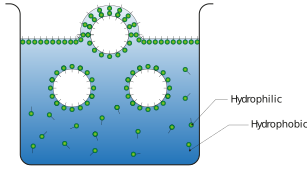
Figure: Model of surfactant protein stabilisation of foam bubbles
Only a small percentage of malt protein is involved with foam stabilisation.
The main foam stabilising proteins identified are from the albumin fraction:
-
The high molecular weight (MW) protein Z (40 kDa, kiloDalton)
-
The low MW lipid transfer protein LTP1 (9.7 kDa)
Protein Z is the most abundant non-dialysable protein in beer. It has high surface viscosity and elasticity. It is both foam-positive (from well-modified malt) and foam-negative (from undermodified malt).
LTP1, the barley lipid transfer protein, constitutes around 1% of total malt protein and is characterised as a foam stabilising protein. It is denatured at the boiling stage, increasing its hydrophobicity, and thus improving its foam stabilising potential. It is thought to have two modes of action:
-
As a foam enhancer in combination with protein Z and other fractions
-
As a foam-negative protector through binding with lipid material.
Wheat proteins, well known for promoting beer foam also show lipid-binding properties as their foam stabilising effect; however, there are malt proteins that perform the same protective function.
There is an alternative school of thought about proteins stabilising beer foam. The hypothesis is that all hydrophobic protein (and not just LTP1 and protein Z) can participate in foam stabilisation. Undoubtedly, there are hydrophobic proteins originating from the hordein fraction, which constitute the barley storage proteins. These proteins show good foamability but poorer foam retention capabilities than LTP1 and Z4.
If these compounds compete with LTP1 and Z4, foam stability will be worse overall as they enter the bubble wall more easily yet are not as effective at stabilising foam.
β-glucans
Barley cell wall derived components are known to increase viscosity in beer. This can be foam-positive if concentrated in the foam through association with hydrophobic polypeptides. This increase in surface viscosity would impede drainage, as discussed earlier. In well-modified malts however, the β-glucan level would be insufficient to have a significant effect on viscosity, so they are considered to play a minor role in foam stability.
Hop acids
The hop derived iso-α-acids stabilise beer foam by binding and cross-linking to foam proteins in the bubble layer. A reduced form of iso-α-acid, the more hydrophobic tetra-hydro-isohumulone, is known to be particularly foam enhancing, producing foam with a stability 1.7 times greater than that produced in the presence of non-reduced iso-α-acids.
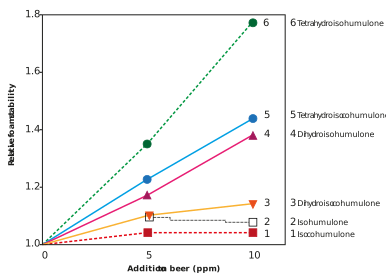
Figure: Foam stabilising effects of hop acids
A major effect of the hop acid interactions is seen in lacing; the hydrophobic hop acid complexes that are concentrated in the foam, stick to the side of the glass and dry to a solid residue.
Cations
Cations in beer are derived from water, malt and brewing salts. They improve foam stability by binding to iso-α-acids and hydrophobic proteins, bridging the two. Many ions such as iron, copper and manganese are foam stabilising but undesirable in beer – showing toxicity to yeast and catalysing oxidative reactions.
The desirable cations, calcium and magnesium, have a weaker affinity for the bittering resins; however, the addition of 2 mg/L zinc enhances foam stability.
Lipids
As mentioned earlier, lipids are foam-negative and promote bubble coalescence which leads to foam collapse. Fortunately, a high percentage of lipids are removed across the brewing process through precipitation in the brewhouse and by healthy yeast in fermentation. However, beer can suffer foam collapse through lipid action from the carryover or yeast excretion.
More damaging lipid foam destruction is normally from poor glass washing practices or introduced from foodstuffs consumed while drinking beer!
Ethanol
Ethanol is foam enhancing, or foam positive, in low alcohol (1%) concentrations due to the lowering of surface tension. However, in higher concentrations, such as those that exist in high gravity brewing and high alcohol beer, it is foam negative. At these higher concentrations ethanol acts in a way similar to lipids, disrupting protein and iso-α-acid complexes in the bubble boundary layer.
We should note that hydrophobic protein content is decreased with increased gravity beers, due to poorer extraction and proportionately higher precipitation in brewhouse and beer processing. These effects, together with foam loss and yeast protease excretion, are the main reasons why high gravity beer suffers from poorer foam stability.
Polyphenols
Polyphenols (from the malt and hops) have not been extensively studied in relation to beer foam. They are thought to play both minor and contrasting roles. On the one hand, they have been found concentrated in beer foam bound to the stabilising protein, but on the other hand, their role in precipitating protein, including foam-positive protein, is well documented.
Brewing trials with proanthocyanidin free malts showed little change in foam stability, supporting the hypothesis of the minor role.