
Lesson 2 - Beer Foam
In this lesson we will discuss the physics and mechanics of foam formation and collapse, along with the chemistry of the compounds involved with beer foam.
Foam is affected by the brewing of raw materials and by wort and beer processing within and outside the brewery. The measuring of foam will be discussed and we will end the lesson by looking at gushing.
Physics of Foam Formation and Collapse
In this section, we will explain the fascinating mechanics of foam formation and collapse:
-
How bubbles form and rise to create a foam head
-
Which components in beer strive to preserve the foam
-
The forces and agents acting against this (which encourages foam collapse)
Charlie Bamforth reviewed the subject of beer foam in papers encompassing its physical nature, components, measurement, and processing conditions influencing foam.
https://onlinelibrary.wiley.com/doi/10.1002/j.2050-0416.1985.tb04359.x
https://onlinelibrary.wiley.com/doi/epdf/10.1002/j.2050-0416.2004.tb00620.x
The following summarises key points on the physics of foam formation and collapse.
Bubble formation
A supersaturation of gas in beer is needed to generate foam. This is achieved during packaging by injecting CO2 into cold beer under pressure. Higher pressures used during packaging keep the CO2 in the solution.
Another way that is bottle or cask conditioning where fermentation occurs in the package producing CO2.
When the container is sealed, the CO2 is kept in solution by the pressure equilibrium. The figure below shows what happens once the beer is opened; pressure is released, causing bubble formation in the container. As the beer is poured, a mass of CO2 bubbles are released creating the first head. As we all know, the extent of the initial foam head is dependent on the vigour of the pour.
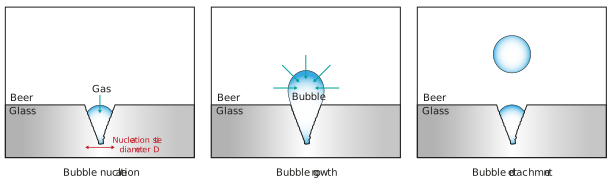
Figure: Bubble development
Beading
Bubble size is proportional to the nucleation site radius; the smallest radius is desirable for fine beading and a stable foam. The CO2 moves from the liquid phase into the gaseous phase, growing the bubble until it is large enough to escape and travel upwards – leaving a new seed bubble to grow. This can happen very quickly and is seen as beading-streams in the glass.
The key factor for producing a constant stream of bubbles is CO2 content – given enough nucleation sites. Beading should continue to happen throughout the time of beer consumption to replenish and sustain foam.
The rate of bubble formation increases at higher beer temperatures as gases, like CO2, are less soluble at higher temperatures.
The following video highlights the beading in an etched beer glass:
Drainage
Foam, when initially formed, is termed wet foam as it contains liquid from the beer. However, immediately after surface bubble formation, the liquid drains back into the body of the beer, removing some of the foam stabilising compounds. This creates weakened dry foam bubbles, which arrange themselves in a three-dimensional hexagonal lattice or honeycomb structure.
Surface viscosity, which is the localised viscosity in the bubble’s liquid film layer, is the key factor affecting drainage, along the length of the lattice borders. Surface viscosity is related to the beer viscosity but is more relevant; it is active at the bubble layer, which has a different composition (a high concentration of protein – probably attached to polysaccharide).
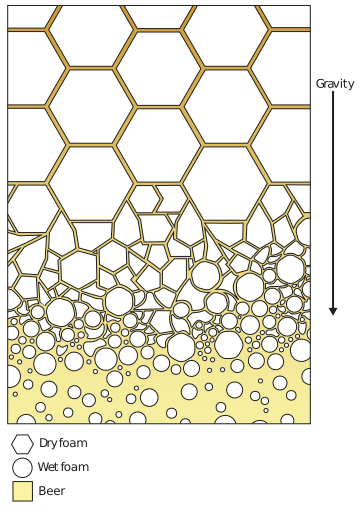
Figure: Foam Drainage
Disproportionation
Disproportionation, or Ostwald ripening, is the process of organic foam collapse. It occurs when smaller bubbles containing higher-pressure gas interact with bigger bubbles of lower internal pressure. Gas diffuses from the small to the big bubbles causing the small bubble to shrink and the large bubble to grow This causes the smaller bubble to collapse.
To put it simply, large bubbles consume smaller bubbles! This is the usual form of bubble evolution in beer poured into a clean glass. The large bubble foam becomes coarse or puffy, unattractive and short-lasting.
To be more technical, the physics of disproportionation is governed by the De Vries equation, which is detailed in Bamforth’s paper, and predicts the disproportionation behaviour of bubbles over a period of time. The main drivers to shrinkage are the gas content and bubble-film wall thickness, with temperature playing a lesser role.
Nitrogen is less soluble than CO2. Because the bubble gas needs to diffuse through the bubble wall for disproportionation to occur, bubbles containing N2 gas disproportionate less readily than CO2 bubbles.
To illustrate this effect:
-
A 0.5 mm bubble of CO2 with a wet foam film thickness of 100 nm at 5 ºC will shrink to 0.03 mm after 300 seconds.
-
A 0.5 mm N2 bubble with remain stable at 0.49 mm after the same time period. If the temperature were at 25 ºC, the CO2 bubble would disappear altogether.
Coalescence
Coalescence is the mechanism of foam collapse in the presence of foam-negative material and happens when two bubbles merge to form a larger bubble. These larger bubbles tend to be less stable because of increased surface tension, and so they become prone to bursting, leading to eventual foam collapse.
This effect does not usually occur in beer unless there is a presence of detergents from poor glass washing or lipid material from fatty snacks or lipstick; these can quickly lead to coalescence and cause the entire loss of the foam head. This is because the detergents, along with fats and grease in the lipids, spread between adjacent bubble walls in the beer foam causing disruption and the foam to coalesce and collapse under increased surface tension.
Although detergents and lipids both destroy beer foam through causing coalescence, they do so by different methods within the bubble-film, namely the ‘spreading particle mechanism’ and the ‘hydrophobic particle mechanism’.
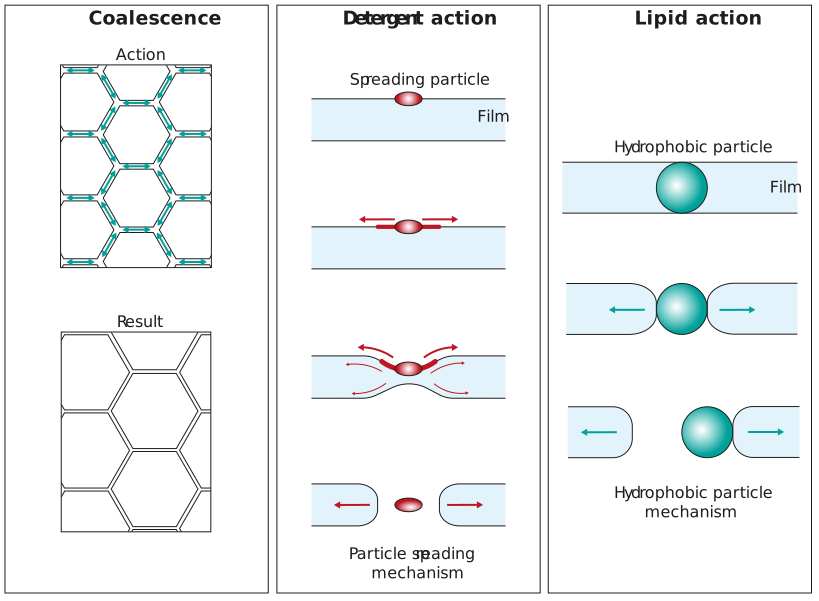
Figure: Coalescence of foam bubbles by detergent and lipid action
While these phenomena have been presented individually, they happen simultaneously and are not independent – affecting each other. While bubble generation and beading replenish lost foam, drainage and disproportionation are promoting foam collapse.
The brewer aims to ensure that their beer has sufficient foam-positive material and CO2 to overcome the foam-negative effects and foam destroying compounds such as lipids and detergents.
Lacing
Lacing (or cling) refers to the residue remaining on the glass after foam collapse or beer consumption. This residue is considered desirable by some consumers and undesirable by others. It consists of hydrophobic polypeptides complexed with hop bitter acids and stabilised with metal-ion bridges. Any grease (lipid) or detergent residue remaining on the beer glass will prevent lacing deposition.
Hydrophobicity means ‘fear of water’.
Hydrophobic substances are ‘non-polar’. This means they do not carry net positive and negative charges (polarity) in the molecule.
Water is a polar molecule carrying:
-
A slight positive charge on the hydrogen atoms
-
A slight negative charge on the oxygen atom
-
Polar substances dissolve in water while non-polar hydrophobic molecules dissolve in non-polar solvents.
Proteins have hydrophobic and hydrophilic amino acids:
-
The hydrophobic amino acids tend to be found on the inside of the protein
-
The hydrophilic amino acids tend to be found on the outside of the molecule, making it more soluble
The more hydrophobic amino acids on the outside, the more hydrophobic the protein becomes, and the more foam-active. These hydrophobic regions interact with other hydrophobic materials, notably the hop iso-α-acids – stabilising the foam bubbles and enabling lacing.
Various methods have been developed to measure foam lacing; an automated solution exists using the Nibem Cling Meter, which uses the cuvette from the Nibem Foam Stability test after foam collapse has been measured (we will cover the Nibem Foam Test later). The instrument quantitatively calculates the glass area covered by foam by driving a scanning head down into the cuvette, which is rotated on a turntable. By calculating the proportion of the area covered by beer foam and the total area scanned, the cling value is calculated and expressed in the percentage of foam coverage.
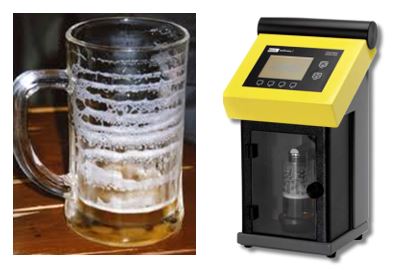
Figure: Lacing and its measurement – Nibem Cling Meter