
Lesson 2 - Warm and Cold Maturation
This lesson explores the processes of warm maturation and cold maturation. Warm maturation can also be described as flavour maturation This process removes negative or unwanted flavours from the beer post-fermentation. Cold maturation occurs at lower temperatures (below 0°C), which in turn causes haze-forming components to form. These components can then be removed by precipitation or clarification via centrifuge or filtration. This lesson highlights the importance of these processes, how they affect the quality of the final product, and how we manage these maturation steps.
Wood Maturation
The maturation of spirits, wines, and beer in oak barrels forms part of a long-practiced tradition.
While wooden barrels have now been replaced with stainless steel kegs for large pack packaging, wooden barrel maturation provides a unique way to differentiate beer styles.
Changes during barrel maturation are shown in the table below.
Table: The wood maturation process
|
Process |
Output |
How |
|
Subtractive maturation |
Removes negative and harsh flavours. |
The inner layer of a barrel is charred during coopering (barrel construction) to create an active carbon layer. This removes undesirable flavours from the beer, such as sulphur compounds. |
|
Interactive maturation |
Develops flavours, often involving oxygen, via reactions such as esterification. |
Oxygen that permeates the wood oxidises flavour compounds in the beer which can then go on to react with other compounds in the beer. Aldehydes can be converted into acetals and alcohols into acids that can go on to form esters. |
|
Additive maturation |
Additive flavours come from the breakdown of components of the wood like lignin and hemicellulose. The breakdown products dissolve in the beer. Examples include oak lactones (coconut or oak flavour) and vanillin (vanilla flavour).
Flavour may be extracted from liquid left in the barrel or soaked in the wood.
Beer may continue to ferment and flavour profile may change, e.g. become spicy or sour (if yeast is stressed, sulphurs may develop).
Microbes in the wood metabolise compounds in the beer producing new flavour compounds.
Increased colour. |
A toasted layer under the charred layer causes flavour to develop in the beer.
Examples include bourbon and sherry.
If unfermented extract is present or sugars come from the barrel.
Wood harbours a mixture of microbes, including wild yeast, which contribute flavour. Brettanomyces is a prime example. Barrels can also be used as a method of spontaneously fermenting beer.
A toasted layer under the charred layer generates colour in the beer. |
In summary, the wood provides additional complexity to the beer’s flavour beer. The product that was in the barrel before the beer significantly affects its colour and flavour.
The following are essential features of a wood maturation system:
-
Capacity – Wood maturation systems must be sized appropriately to meet the demands of the brewery, especially during peak production periods. We may opt to install wooden vats rather than purchase wooden barrels. This avoids the need to handle barrels in a brewery.
-
Cleaning and sanitation – Vessels and process equipment must be designed to allow effective cleaning to remove organic soiling. It is not possible to remove all microbes, but we can use steam or hot water to reduce their level.
-
Temperature control – Ideally, beer must be kept at a constant cool temperature during wood maturation. This helps to develop a consistent wood maturation character, minimises evaporation, and inhibits microbiological activity.
-
Quality analysis – To ensure the maturation process is in control, the barrel or vat should be sampled frequently for quality and sensory analysis.
Before a cask is filled, it should be checked for defects, and smelt, to check it is free of any unpleasant aromas.
During wood maturation, various environmental factors can influence the process. Water and alcohol in the beer can pass very slowly out of the cask by penetrating the wood. As the oak cask is porous, we lose some beer from the barrel by evaporation. The maturation rate depends on the temperature and humidity of where the beer is stored.
To overcome some of these challenges, brewers can accelerate the wood maturation process by using oak chips or wooden staves.
Due to the complexity of multi-stage wood chemistry and its subtle processes, imitating maturation is a challenge. A brewer can, however, use the following methods to accelerate wood maturation in the brewery:
-
Use smaller barrels – The higher the surface area of wood to beer means the wood chemistry will occur at a faster rate, achieving a wood maturation character more quickly.
-
Add wooden staves or wood chips directly to the maturation vessel, suspended in a hygienic nylon bag – This method can restrict the contact surface area with the beer, making extraction less efficient.
-
Add wood chips to a small extraction vessel connected to the maturation vessel – These vessels are typically less than 1 hL in capacity and have a false top and false bottom, to securely contain any ingredients within them. This means that any additions you put in these vessels will not pass into the main maturation vessel. The vessels and lines are flushed with deaerated water or an inert gas before introducing beer, to purge out any oxygen before coming into contact with the beer and avoid oxidation. This process facilitates continuous extraction, as the wood chips are retained in their own separate vessel.
The figure below shows how a system using the continuous extraction of wood chips might look:
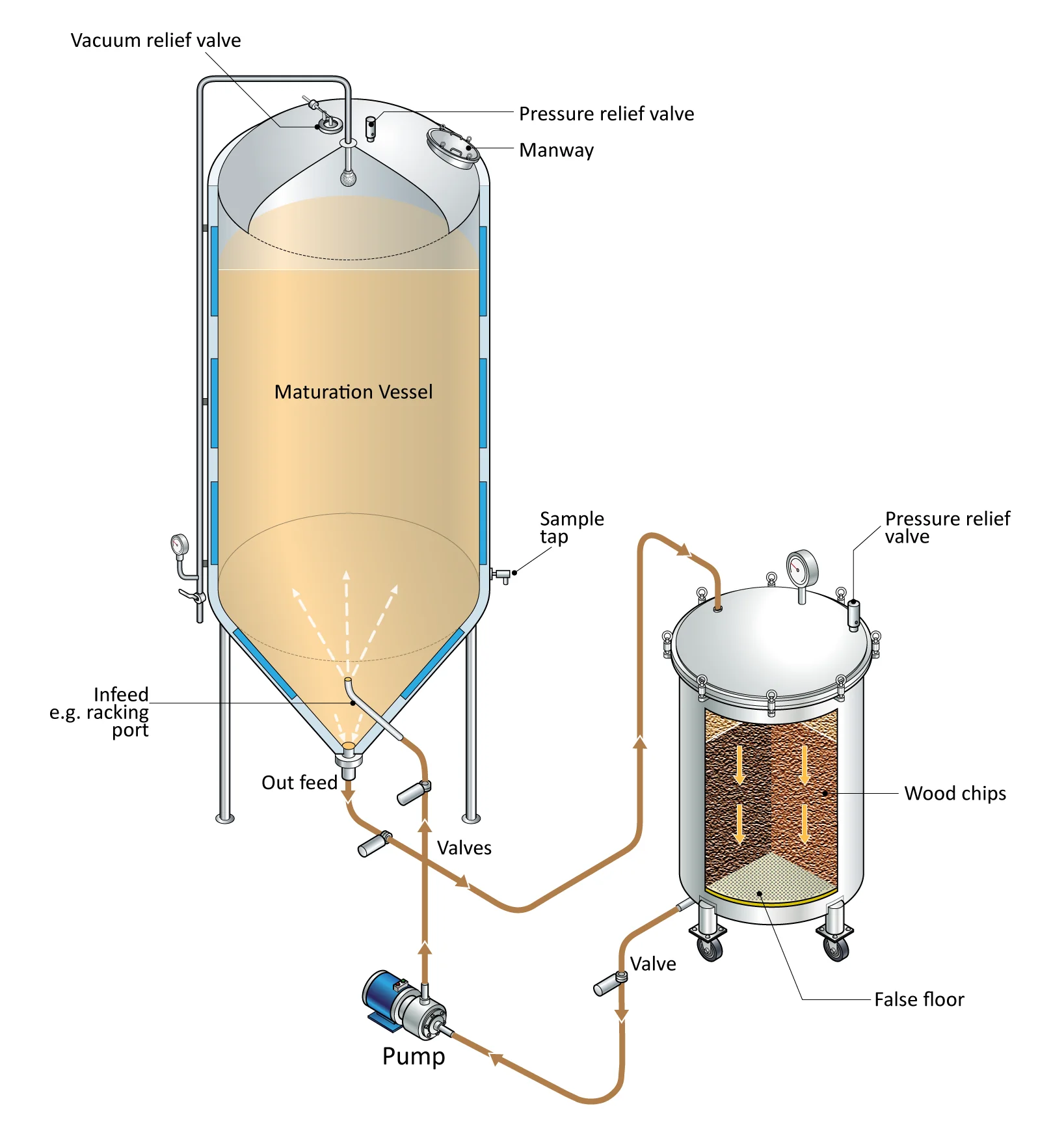
Figure: Continuous extraction of wood chips in a vessel
During the maturation process, beer is pumped from the maturation vessel to the external vessel (which contains the wood chips) and then returned to the maturation vessel. The wood chips have a much greater surface area than the internal surface of a wooden barrel, therefore the subtractive, interactive, and additive maturation reactions are much faster. However, any attempts at acceleration are not likely to deliver an absolute match to any traditionally matured product as less wood chemistry will occur, which is heavily time dependant.
The following factors affect the speed of wood maturation:
-
Size of wood chip – smaller particles have a larger surface area and therefore extractive reactions can occur faster and are more efficiently absorbed into the beer.
-
Agitation – mixing the wood chips within beer causes a more efficient transfer of extracted components into the beer,
-
Contact time – longer contact times allow for greater extractive reactions, so the flavour profile can evolve and become enhanced over an extended period of time.
At the budget end of the market, commercial flavours are added to create imitation wood-aged products. Flavour houses can supply treatments containing some of the critical components developed during the maturation process, such as furfural or vanillin, for example.
Other novel, less-widely used methods exist, which are not so widely used. These include ultra-sonic and pressure treatments. The micro-oxygenation method, inspired by the wine industry, can be very effective. Micro-oxygenators pump medical oxygen into the barrels, in intervals, to oxidise the beer quickly and effectively to the same degree as would naturally occur over many years.
The following two lessons describe centrifugation and the use of process aids. They also explore other additions that can be made to beer during both maturation and post-maturation.