
Lesson 2 - Warm and Cold Maturation
This lesson explores the processes of warm maturation and cold maturation. Warm maturation can also be described as flavour maturation This process removes negative or unwanted flavours from the beer post-fermentation. Cold maturation occurs at lower temperatures (below 0°C), which in turn causes haze-forming components to form. These components can then be removed by precipitation or clarification via centrifuge or filtration. This lesson highlights the importance of these processes, how they affect the quality of the final product, and how we manage these maturation steps.
Maturation Vessel Key Design Features
Our chosen maturation system must include several key design features to ensure effective warm and cold maturation. Let us first briefly describe the materials typically used for constructing maturation vessels.
Material of construction
Maturation vessels are normally cylindrical. They are similar to fermentation vessels such as those described in the Fermentation Unit. Fermentation vessels are typically constructed from stainless steel. However, alternative materials of construction include mild steel or concrete with a glass, enamel, or plastic epoxy lining. Some small breweries may even use plastic vessels.
The most commonly used material is stainless steel. There are multiple grades of stainless steel; types 316 and 304 are generally used for constructing maturation vessels. Some of the reasons for using stainless steel include:
-
High mechanical strength and easily worked into the required shape
-
Inert surface, so off-flavours do not enter the beer
-
Reasonable conductor of heat
-
Easy to clean (good cleanability of surfaces)
-
Resistant to corrosion from cleaning detergents or the relatively low pH of the beer
Vessel shape
Vessels can be vertical cylindrical, horizontal cylindrical, and in few cases, even square. The shape and aspect ratio (height to diameter ratio) of these vessels may affect beer processing time and quality (we will discuss this in the Rate of Sedimentation section, later in this lesson).
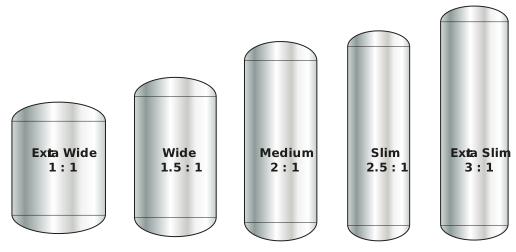
Figure: Illustration of vertical cylindrical maturation vessel aspect ratios
Vessel capacity
Maturation systems must be big enough to meet the brewery’s demands, especially during peak production periods. This not only pertains to actual tank volume, but to the number of vessels – are there enough vessels in which to store the beer during the duration of the maturation process?
Vessel size normally corresponds to the brew length. In large breweries, the capacity should generally equate to half a day’s production. In smaller breweries, the maturation vessel may be the same size as the fermentation vessel. In some breweries, the fermentation vessel can also be used as a maturation vessel – known as a unitank (universal tank) or a dual-purpose vessel (DPV).
The brewer should avoid installing excessively large vessels, as this may affect the final product’s flavour if the fill duration exceeds 24 hours for any one batch.
Vessel cone angle
Another important feature of vessel design is the vessel cone angle (if the vessel design is cylindroconical), which is typically between 60-80°. Correctly designed cone angles ensure the effective removal of maturation vessel sediments (sometimes referred to as ‘vessel or tank bottoms’). This sediment is made up of precipitated solid particles found in beer, such as protein-polyphenol particulates, hop material, and yeast cells.
Vessel headspace
We must also consider vessel headspace, which will vary depending on the vessel’s use. Where a maturation vessel is used purely for cold maturation, there is a requirement for only 5% headspace as there will be no ‘head’ (foam/fob) formation or foaming during the process, unlike with fermentation. For warm maturation, a headspace of 10% is more desirable, as there will likely be some head formation during the process. A unitank needs to have a 25% headspace to accommodate the yeast head during active fermentation. Without adequate headspace, the yeast head will flow into the vessel vent’s main process pipeline and the brewer will incur beer losses and potential micro-infection.
Cleaning and sanitation
Vessels and process equipment must be designed to allow effective cleaning and sterilisation to remove any microbial activity.
Vessel bottoms that form during cold maturation can create heavy organic soiling. Therefore, the detergent and sterilant must reach all internal surfaces directly to guarantee a clean and sanitised vessel. Areas that cannot be reached directly by the CIP spray head are called areas of shadowing; vessels must be designed to avoid this.
Temperature control
All maturation and finishing systems need cooling in order to maintain the desired temperature. Brewery cooling capacity is needed to maintain the target temperature at all stages of the process from fermentation beer transfer to bright beer tank (BBT) or final product tank (FPT) filling. Vessels can be fitted with cooling jackets or breweries can instead install vessels in sealed maturation cellars, using chilled air to cool the vessels.
Temperature control is essential to control flavour (warm maturation) and chilled haze (cold maturation) development.
Other process control requirements
Vessels and process equipment must include appropriate ancillary equipment to facilitate pressure control and an appropriate process gas supply.
Flavour control
To prevent adverse flavour development, controls must be in place to reduce the risk of oxygen pickup and eliminate microbial contamination during filling, emptying, and ingredient and/or process aid additions. These controls would include flushing lines with deaerated water, filling tanks with inert gases prior to filling and ensuring effective CIP and hygiene standards to prevent microbial contamination.
Quality analysis
A sampling point is necessary to take frequent samples for analytical and microbial analysis to ensure the maturation processes is in control.