
Lesson 2 - Warm and Cold Maturation
This lesson explores the processes of warm maturation and cold maturation. Warm maturation can also be described as flavour maturation This process removes negative or unwanted flavours from the beer post-fermentation. Cold maturation occurs at lower temperatures (below 0°C), which in turn causes haze-forming components to form. These components can then be removed by precipitation or clarification via centrifuge or filtration. This lesson highlights the importance of these processes, how they affect the quality of the final product, and how we manage these maturation steps.
Warm Maturation
A brewer wants their beer to taste clean, fresh, and appealing. Flavour maturation, one of the key outcomes of beer maturation, helps to ensure that we get this right. This is especially important in lighter flavoured beers such as lagers, where undesirable flavours can be more easily detected.
As discussed in the Fermentation Unit, the end of fermentation is described as the point at which the wort gravity reaches a low and constant value. At this point, the beer has an array of fermentation flavours, many of which are positive and desired. However, some are less desirable, such as the vicinal diketones (VDK) that were covered extensively in the Fermentation unit.
Fortunately, we can usually remove these less desirable flavours through the process of warm maturation, using the remaining yeast in suspension.
Yeast counts are normally at around 0.5-4 million cells/mL of beer at the beginning of warm maturation. This is sufficient to either reduce undesirable flavours to acceptable levels or into flavourless compounds.
The warm maturation process aims to achieve the following three things:
-
To convert α-acetolactate to diacetyl in the beer
-
Once α-acetolactate has been converted to diacetyl in the beer, it is removed by yeast
-
To convert other undesirable yeast derived compounds, such as aldehydes, to tasteless flavours or to a level below the flavour threshold
This sounds like complex biochemistry, but it is actually a simple process! Let us explore this step by step and take a look under the microscope…
Vicinal diketones (VDK)
The final levels of VDKs in beer, in particular diacetyl, are very important for a number of beer styles. In most cases, the beer must have as low a level of diacetyl as possible, certainly well below the flavour threshold.
As a quick recap, the yeast cell produces α-acetolactate and excretes the α-acetolactate directly into the fermentation medium (as shown in the figure below):
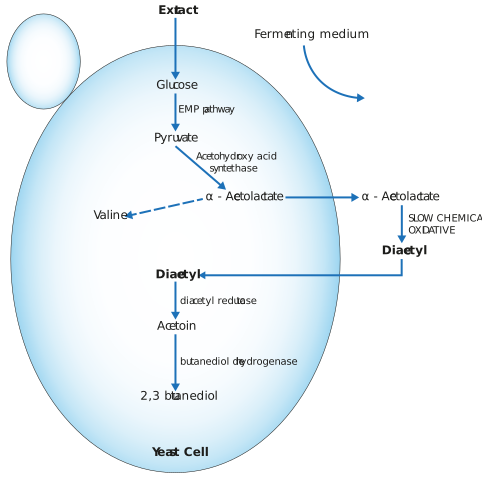
Figure: Schematic presentation showing diacetyl formation, reassimilation, and removal
The conversion of α-acetolactate into diacetyl is a chemical reaction and the rate is directly proportional to temperature – the warmer the reaction conditions, the quicker the conversion takes place.
This is a critical rate-limiting step, as once the diacetyl has been formed, the yeast will usually remove it by taking the diacetyl into the yeast cell and converting it into less flavour-active compounds, acetoin, and 2,3-butanediol.
Brewers make use of this by maintaining a higher temperature after fermentation, normally around 14-16°C for lagers or 18-20°C for ales, until the specified diacetyl levels are achieved.
Desirable diacetyl levels will depend on the style of beer, but the threshold for sensory detection is 0.05-0.1 mg/L.
If brewing a delicately flavoured lager, we may want very low levels of diacetyl (less than 10 μg/L for example). If brewing an ale with high levels of specialty malt, higher levels may be acceptable (around 100 μg/L for example). The warm maturation period should be as short as possible, otherwise the higher temperature may cause other off-flavours, or even yeast autolysis, which negatively affects the final beer’s quality and flavour stability.
Once this is achieved, the temperature can be reduced to aid yeast sedimentation. Brewers often refer to this as chilling the vessel. A guideline chilling rate is 0.25°C per hour until the desired level is attained (typically 4 -8°C).
If the vessel has been warm cropped (yeast has been removed from the fermenting beer at fermentation temperature), the bulk of the yeast will have already been removed. The onset of cooling will thus sediment out any residual yeast. However, if yeast is cold cropped (yeast is removed once the temperature of the beer has been reduced post-fermentation), then the bulk of the yeast will be removed after the diacetyl rest when the vessel is down to cold maturation temperature, normally 0°C or less. This is now the transition from warm to cold maturation.
The transition from warm maturation to cold maturation occurs when the beer temperature is reduced to below 0°C.
In addition to VDK removal, other flavour compounds may form or occur during the maturation process, such as acetaldehyde and volatile fatty acids.
Acetaldehyde
Another aim during warm maturation is to reduce acetaldehyde to below threshold level, typically below 15 mg/L. The yeast will metabolise acetaldehyde to alcohol at the latter stages of fermentation and maturation, to remove the green apple, ‘grassy’ character associated with acetaldehyde.
However, acetaldehyde can increase also. This occurs as a result of ethanol oxidation during the transfer of beer from fermentation to the maturation vessel. To ensure oxygen is eliminated from the transfer system, the brewer can purge the beer transfer system with deaerated water or an inert gas such as CO2. Deaerated water is flushed through the route between the vessels, including all pipework, valve blocks, and pumps, to eliminate any air before beer is introduced into the transfer system. In addition to purging transfer systems with deaerated water, a blanket of CO2 or N2 in the receiving vessel will also reduce the risk of oxygen pick-up. Injecting CO2 into the beer during transfer to the receiving vessel can also reduce any dissolved oxygen in the beer.
Oxygen removal is not only important in relation to acetaldehyde, but it also prevents staling flavour formation caused by the oxidation of other aldehydes. At threshold levels, oxidised beer is characterised as ‘papery’, which is caused by the aldehyde known as trans-2-nonenal (T2N). This compound has an extremely low flavour threshold of 50-250 ng/L.
Volatile fatty acids (VFA)
Volatile fatty acids are metabolised during warm maturation, and generally reduce during this time. However, if maturation extends too far, this trend is reversed. This results in increased free fatty acids and releases caproic acid, which has a ‘goat-like’ / candle wax odour – again, highly undesirable in any style of beer.
The warm maturation process should be managed to allow time to reduce the concentration of VDK. It should not extend beyond this, as this increases the risk of negative flavour development. Good hygienic practices will also reduce the risk of biological activity that might also cause undesirable flavours to develop.
In summary, good practice in the brewery also plays an important role in flavour development during warm maturation. Cutting corners and hurrying beer through the system will only trip you up further down the line and result in a beer that tastes less clean, less fresh, and less appealing to the consumer – which would constitute a disaster!
The warm maturation process aims to achieve the following three things:
-
To convert α-acetolactate to diacetyl in the beer
-
Once α-acetolactate has been converted to diacetyl in the beer, it is removed by yeast
-
To convert other undesirable yeast derived compounds, such as aldehydes, to tasteless flavours or to a level below the flavour threshold
What measures would you take during warm maturation, to ensure a clean tasting final beer that is true to type?
Give yourself 5-10 minutes to think about this, and then click ‘Next’ to continue with this lesson.