
Lesson 2 - Warm and Cold Maturation
This lesson explores the processes of warm maturation and cold maturation. Warm maturation can also be described as flavour maturation This process removes negative or unwanted flavours from the beer post-fermentation. Cold maturation occurs at lower temperatures (below 0°C), which in turn causes haze-forming components to form. These components can then be removed by precipitation or clarification via centrifuge or filtration. This lesson highlights the importance of these processes, how they affect the quality of the final product, and how we manage these maturation steps.
Stokes’ Law
Once the haze has formed during cold maturation, it is important to remove it from the beer. One option is to allow the haze-forming particulates to precipitate or sediment out of the beer.
Let us explore the science behind sedimentation and examine how a brewer can influence the effect and speed of beer clarification. Although some beers styles are deliberately served hazy, it is important to clarify some beer styles during cold maturation to ensure that a bright product is achieved in the final pack.
Stokes’ Law is named after George Gabriel Stokes, a mathematician who studied the behaviour of fluids. He developed an equation that describes the force required to move a sphere through a fluid at a particular velocity. Brewers also use it to understand how to manipulate the variables involved to increase the rate of settling.
At the end of primary fermentation, beer contains suspended yeast and solid particles. These are removed by subsequent processes, using centrifugation, sedimentation, and filtration. A brewer uses clarification process aids, for example silica hydrogel or isinglass, to help remove these components. These process aids are detailed in the Processing Aids and Additions lesson. These process aids either flocculate out the yeast or solid particles, or speed up the rate of sedimentation. This helps to reduce maturation process time and also improves the final beer clarity.
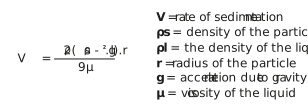
Figure: Stokes’ Law
Let’s look at an example and understand how long it would take for a floc of yeast cells to sediment out of beer, using a process aid in maturation vessel to aid rate of sedimentation. Using the equation above:
Density of yeast = 1,140 kg/m3
Density of beer = 1,017.36 kg/m3
Radius of yeast particle (floc of yeast cells) = 1.08 x 10⁻⁴ m
Acceleration due to gravity = 9.81 m/s2
Viscosity of beer = 1.25 x 10⁻³ kg/m.s (Pa.s)

Velocity of the yeast floc = 2.5 x 10⁻³ m/s
If you had a vessel with a beer depth of 13m and the floc was just below the surface of the beer, how long would it take the yeast floc to sediment out?
Time to sediment = height / velocity
Time to sediment = 13m / 2.5 x 10⁻³ m/s
Time to sediment = 5,200 sec or 1.44 hours
In practice, a brewer aims to sediment out beer as quickly as possible during maturation. They can use Stokes Law to optimise the process.
The fastest rate of sedimentation occurs under the following conditions:
Large particle sizes
Large gravitational force
Low liquid viscosity
Low relative density of liquid (high relative density of particle)
(The two factors that can be directly influenced are particle size and gravitational force.)
A brewer can influence the settling velocity most by increasing the particle’s radius. For example, doubling a particle’s radius would cause a fourfold decrease in the settling time. Increasing particle size is achieved using process aids that adhere to the surface via chemical or electrochemical bonds. This reaction creates a particle-process aid precipitation complex, increasing the radius of the original particle.
The gravitational force can be increased using a centrifuge, where beer is spun at high velocity, in turn increasing particulate acceleration through gravity.
Centrifugation is used to reduce yeast and suspended particles after fermentation and before cold storage and maturation. We cover centrifugation in more detail in the Clarification – Centrifugation lesson later in this unit.
And finally, a brewer can influence the settling velocity by reducing the distance that the particle has to travel before settling out. This is one of the benefits of using a horizontal vessel over a tall vertical vessel. It is also another benefit of using a centrifuge.
In addition to warm and cold maturation, some beer styles may benefit from wood ageing or maturation.